
Step-by-Step Value Chain Guide for Working Professionals
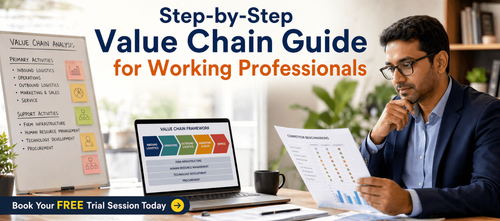

Unlock Strategic Insights with Value Chain Analysis: A Practical Guide for Professionals
Every business thrives on delivering value, but the challenge lies in clearly identifying where that value is created, where it leaks, and where the biggest opportunities exist. Value Chain Analysis (VCA) is one of the most powerful tools for understanding and improving business operations, and yet, it remains underutilised by many professionals. This guide will help you leverage VCA to enhance your strategic thinking and drive better business decisions.
Download these resources and apply them alongside your daily work for improved clarity, productivity, and professional growth. You can also book a free trial to gain expert guidance and enhance your analytical and strategic skills. The materials are designed in a clear, structured format to help professionals learn efficiently and implement insights with confidence.
Who Is This Blog For?
This blog and the accompanying framework are designed for:
- Professionals aiming to improve strategic decision-making and business analysis
- Managers and consultants looking to optimise operations or evaluate competitors
- Career switchers who need to demonstrate strategic thinking during interviews
- Business leaders who want to optimise their firm’s value chain for competitive advantage
Why This Topic Matters Today?
In a fast-evolving business landscape, organizations must differentiate themselves to stay competitive. To do so, they need to fully understand their value chain—the sequence of activities that bring a product or service from concept to customer. With global competition intensifying, understanding your value chain allows you to identify inefficiencies, uncover hidden advantages, and make informed decisions that can lead to significant cost reductions and differentiation.
According to the guidebook, businesses that optimize their value chains outperform competitors by focusing on both primary and support activities. Yet, most professionals have heard of VCA without truly applying it. This blog aims to change that by offering actionable steps and insights into how you can use VCA in your daily work.
Core Concept or Framework Explained
The Value Chain Analysis framework, developed by Michael Porter in 1985, divides business activities into two broad categories: Primary Activities and Support Activities. Understanding the distinction between these two is essential for making strategic decisions.
Primary Activities:
These are the direct value-creating activities:
- Inbound Logistics: Receiving, storing, and distributing raw materials
- Operations: Transforming inputs into products or services
- Outbound Logistics: Delivering finished products to customers
- Marketing & Sales: Creating awareness and driving purchases
- Service: After-sales activities like customer support and returns management
Support Activities:
These enable and enhance the primary activities:
- Firm Infrastructure: Financial, legal, and administrative support
- Human Resource Management: Recruitment, training, and employee performance
- Technology Development: Research, innovation, and process improvement
- Procurement: Sourcing and managing suppliers
By analyzing both primary and support activities, you can uncover cost-saving opportunities, improve operational efficiency, and drive competitive differentiation.
How This Blog and Guidebook Help You?
Together, this blog and guidebook will help you:
- Map your organization’s value chain or that of a competitor
- Assign costs and values to each activity to identify the most strategic areas
- Discover hidden linkages between activities that create compounding value
- Benchmark your value chain against competitors to assess your competitive positioning
- Diagnose strategic implications based on your value chain findings
The end result is a more strategic approach to operational improvements and competitive advantage.
Step-by-Step Breakdown
Step 1: Define the Scope of Your Analysis
Before you begin mapping your value chain, you must first define the scope of your analysis. Decide whether you are analyzing your own organization, a competitor, or an entire industry. Also, determine the specific business unit or product line and the strategic question you want the analysis to answer (e.g., cost reduction, market entry, or differentiation).
Step 2: Map All Value Chain Activities
Start by listing all the significant activities performed in your value chain. Break down each primary activity into its sub-components. For example, under Operations, list tasks such as production, quality control, and packaging. Conduct stakeholder interviews to gather insights from different functions such as operations, sales, and customer service. This will help uncover activities that are not immediately visible in organizational charts but have a significant impact on value creation.
Step 3: Assign Costs and Value to Each Activity
Now, assign costs to each activity, starting with the most accessible data like headcount and departmental budgets. Use estimates where necessary, and flag areas with incomplete data. Additionally, assign customer value to each activity. Activities that drive customer loyalty, premium pricing, or repeat purchases are valuable, while others may just add cost.
Step 4: Identify Linkages Between Activities
Value is often created not just within individual activities, but in the linkages between them. For example, improved quality control in Operations might reduce after-sales service costs. Identifying these linkages can lead to valuable insights on where operational integration or investment could have the most significant impact.
Step 5: Benchmark Against Competitors
Benchmarking your value chain against competitors allows you to identify areas where they have a cost advantage, differentiation advantage, or both. For each activity, rate your firm and its competitors (Strong Advantage, Parity, or Disadvantage) based on available data. This competitive insight helps identify where you need to invest to close gaps and gain a market edge.
Step 6: Diagnose Strategic Implications
The final step involves synthesizing your findings and translating them into strategic actions. Depending on your analysis, you may identify opportunities for Cost Leadership (cutting costs to be the lowest-cost producer), Differentiation (investing in activities that create unique value), or Focus (concentrating on a niche market).
For example, if your logistics costs are higher than your competitors' but customers highly value quick delivery, you may decide to invest in improving logistics efficiency.
Common Mistakes or Pitfalls to Avoid
The guidebook outlines several common mistakes when performing VCA:
- Skipping cost assignments: Even rough cost estimates are better than leaving them blank.
- Treating all activities equally: Focus your efforts on the top 3–5 most strategic activities.
- Ignoring support activities: They often hold the key to competitive advantage.
- Conducting analysis in isolation: Always validate your findings with stakeholders from various functions.
- Stopping at the map: Ensure you translate your analysis into actionable strategic implications.
How Should You Use This Guidebook Effectively?
To get the most out of this guidebook:
- Define your scope clearly before starting the analysis.
- Use the worksheets to map activities, assign costs, and assess value.
- Focus your analysis on the strategic activities that will have the most significant impact.
- Regularly revisit the framework to refine your approach and track your progress.
By following the steps and completing the worksheets, you will gain a deeper understanding of your organization’s value chain and how to improve it.
Key Takeaways
- A value chain analysis reveals where value is created, where it leaks, and where opportunities lie.
- Primary activities drive customer value, but support activities are often where competitive advantages are hidden.
- Linkages between activities create compounding advantages that can be leveraged for strategic gain.
- Benchmarking your value chain against competitors provides insight into how you can gain a competitive edge.
- Strategic implications must be actionable and specific, guiding decisions on cost, differentiation, or focus.
Your Next Step: Accelerate Your Career with PlanetSpark
Creating an impact-driven career is not just about executing tasks—it’s about thinking strategically and leading with clarity. When you understand how value is created across your organization or industry, you can make smarter decisions that drive business success.
At PlanetSpark, we are committed to empowering working professionals with practical, outcome-focused resources that drive real career growth. From value chain analysis and competitive benchmarking to leadership presence and strategic thinking, our programs are designed to help you succeed in today’s fast-evolving job market.
Visit https://www.planetspark.in/resources to explore:
- Strategic analysis and business framework guides
- Leadership and career development resources
- Skill-building tools for working professionals
Want a deeper, hands-on experience?
You can also book a free trial session to learn more about PlanetSpark’s Working Professional Courses, designed to accelerate your career through personalized coaching, real-world practice, and expert guidance.
Your career deserves more than generic advice.
It deserves clarity, confidence, and measurable impact.
Start building that advantage today—with PlanetSpark.
Personalized Communication Roadmaps
Record a video to get a AI generated personalized communication reports