
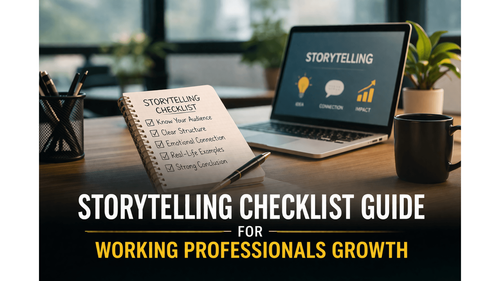
Storytelling Checklist Guide for Working Professionals Growth

Last Updated At: 13 Apr 2026
8 min read
Influential Communication for Professionals to Advance Your Career Path
You may have the right experience,
strong ideas, and solid results—but if you cannot communicate them clearly, they often go unnoticed. In today’s fast-paced professional world, attention is limited, and decision-makers rarely have the time to decode unclear messages.
Many professionals struggle not because they lack capability, but because their communication lacks structure, clarity, and impact. Presentations turn into data dumps, interviews feel scattered, and important ideas fail to land.
This is where professional storytelling becomes a career-defining skill. It is not about being dramatic or creative—it is about making your message clear, relevant, and actionable. This blog transforms a powerful storytelling checklist into a practical, step-by-step guide to help you communicate with precision, credibility, and influence.
Who Is This Blog For?
This blog and the accompanying guidebook are designed for:
- Working professionals aiming to improve communication and influence at work
- Managers and team leaders presenting ideas, updates, or strategies
- Consultants and specialists who need to persuade clients or stakeholders
- Job seekers preparing for interviews and personal branding
- Career changers looking to reposition their story effectively
Why This Topic Matters Today?
Modern workplaces are overloaded with information. Reports, dashboards, and presentations are everywhere—but clarity is rare.
The professionals who stand out are not necessarily the most qualified. They are the ones who are best understood. Whether you are presenting to leadership, speaking in meetings, or writing a LinkedIn post, your ability to structure and deliver a clear story determines how seriously you are taken.
Poor storytelling leads to missed opportunities:
- Strong ideas fail to influence decisions
- Valuable work goes unrecognised
- Career growth slows despite capability
On the other hand, clear, structured storytelling helps you:
- Drive decisions and action
- Build credibility quickly
- Position yourself as a high-impact professional
Core Concept or Framework Explained
At the heart of professional storytelling is one key principle: structure creates clarity.
The guidebook introduces a powerful and widely used storytelling structure known as the Situation-Complication-Resolution framework.
- Situation: Establish context and align the audience
- Complication: Introduce the problem or tension that creates urgency
- Resolution: Present your insight, recommendation, or outcome
This structure works because it mirrors how people naturally process information. It creates logical flow, emotional engagement, and clarity of purpose.
In addition to structure, effective storytelling relies on four critical pillars:
- Audience intelligence: Understanding what your audience cares about
- Emotional resonance: Connecting facts to real human impact
- Language precision: Using clear, specific, and confident language
- Delivery and presence: Ensuring your message lands effectively
Together, these elements transform communication from information-sharing into influence.
How This Blog and Guidebook Help You
This blog and guidebook help you build a complete storytelling system that you can apply across your career.
You will learn how to:
- Structure your communication so it is easy to follow and remember
- Align your message with what your audience actually cares about
- Make your ideas more persuasive by adding clarity and stakes
- Replace vague communication with precise, credible language
- Deliver your message with confidence in both written and spoken formats
The result is not just better communication—but stronger professional impact.
Step-by-Step Breakdown
Step 1: Build Strong Narrative Architecture
Every effective story starts with structure. Without it, even strong content becomes confusing.
Begin by defining your core message in one clear sentence. This becomes the anchor for everything else. Then build your story using the Situation-Complication-Resolution flow.
For example:
- Situation: Set the context your audience recognises
- Complication: Highlight the challenge or gap
- Resolution: Deliver your solution or insight
Keep your story focused. Remove anything that does not support your main message. Strong storytelling is not about saying more—it is about saying what matters.
Step 2: Develop Audience Intelligence
One of the most common mistakes professionals make is focusing on what they want to say instead of what the audience needs to hear.
Before any communication, ask yourself:
- Who is my audience?
- What decision do I need from them?
- What are their priorities or pressures?
- What objections might they have?
For example, a CEO may care about growth and competitive advantage, while a manager may focus on execution and timelines. The same story must be adapted accordingly.
When you align your message with your audience’s priorities, your communication becomes instantly more effective.
Step 3: Create Emotional Resonance
Facts alone do not drive decisions—meaning does.
To make your story memorable and actionable, focus on three elements:
- Specificity: Use concrete details instead of vague statements
- Stakes: Clearly explain what is at risk or what will change
- Human element: Connect the story to real people or experiences
For instance, instead of saying “we improved efficiency,” say “we reduced reporting time from 6 hours to 45 minutes.”
Specific details make your message credible and easier to remember.
Step 4: Use Clear and Precise Language
Clarity in language signals clarity in thinking.
Avoid common traps such as:
- Overuse of jargon
- Passive voice that hides responsibility
- Vague or abstract phrases
- Soft language that reduces confidence
Instead:
- Use active voice
- Replace vague claims with specific numbers or examples
- Speak directly and confidently
For example:
Instead of saying “we leveraged synergies,” say “our teams worked together to reduce onboarding time from 3 weeks to 3 days.”
Precision makes your communication sharper and more persuasive.
Step 5: Focus on Delivery and Presence
Even a well-structured story can fail if delivery is weak.
For spoken communication:
- Rehearse aloud
- Use pauses to emphasise key points
- Maintain steady pacing and eye contact
- Start strong and end with a clear call to action
For written communication:
- Use short paragraphs for readability
- Maintain clear formatting and structure
- Highlight key points early
- Ensure the message is easy to scan
Research shows that delivery factors like tone, pacing, and body language significantly influence how your message is received. Strong delivery ensures your story lands as intended.
Step 6: Apply the Full Storytelling Checklist
Before any important communication, run a quick quality check:
- Is your core message clear?
- Does your story follow a logical structure?
- Is it aligned with your audience’s priorities?
- Are the stakes and impact clearly defined?
- Is your language precise and confident?
- Do you have a clear next step or call to action?
This final check ensures your story is complete, clear, and ready to deliver.
Common Mistakes or Pitfalls to Avoid
Many professionals unknowingly weaken their communication by making avoidable mistakes:
- Starting with process instead of outcome
- Burying the key message in the middle
- Using jargon that the audience does not understand
- Presenting data without explaining its meaning
- Ending without a clear call to action
These mistakes create confusion and reduce impact.
The better approach is simple:
- Lead with the outcome
- State your key message early
- Use clear, audience-friendly language
- Always explain why the information matters
- End with a specific next step
How Should You Use This Guidebook Effectively?
To get the best results, follow a structured approach:
- Start with a quick read to understand the overall framework
- Deep dive into each module and apply it to real scenarios
- Use the checklists before presentations, meetings, or interviews
- Allocate around 40 minutes to refine a high-stakes story
- Revisit the guide regularly to build long-term storytelling habits
Consistency is key. The more you apply these principles, the more natural they become.
Key Takeaways / Summary
- Structure your communication using clear storytelling frameworks
- Always align your message with your audience’s priorities
- Use specific details and real stakes to build credibility
- Replace vague language with precise, confident statements
- Focus on delivery as much as content
- End every communication with a clear call to action
- Practice consistently to build storytelling as a career advantage
Your Next Step: Accelerate Your Career with PlanetSpark
Creating an impact-driven resume is not just about landing your next job—it’s about owning your professional story and presenting it with clarity, confidence, and credibility. When your resume clearly communicates value, results, and impact, opportunities follow naturally.
At PlanetSpark, we are committed to empowering working professionals with practical, outcome-focused resources that drive real career growth. From resume building and workplace communication to leadership presence and professional writing, our programs are designed to help you succeed in today’s fast-evolving job market.
Visit https://www.planetspark.in/resources to explore:
- Career and resume-building guides
- Workplace communication and professional writing resources
- Skill-development tools curated for working professionals
Want a deeper, hands-on experience?
You can also book a free trial session to learn more about PlanetSpark’s Working Professional Courses, designed to accelerate your career through personalised coaching, real-world practice, and expert guidance.
Your career deserves more than generic advice.
It deserves clarity, confidence, and measurable impact.
Personalized Communication Roadmaps
Record a video to get a AI generated personalized communication reports
Whom are the classes for?