
Strategic Decision-Making Under Time Pressure: 2026 Guide


How to Make Strategic Decisions Quickly: A Proven Framework for Confident Decision-Making Under Pressure
In today’s fast-moving professional environment, decisions rarely come with perfect information or unlimited time. Deadlines are tight, stakeholders are waiting, and the pressure to “get it right” can feel overwhelming.
You might find yourself stuck between overthinking and rushing—either delaying decisions in search of certainty or making quick calls that you later question. This cycle leads to decision fatigue, reduced confidence, and missed opportunities.
The truth is, successful professionals are not those who always have more data—they are the ones who have a better decision-making process.
This blog is based on a practical guide designed to help working professionals make strategic decisions quickly, clearly, and confidently—even under time constraints.
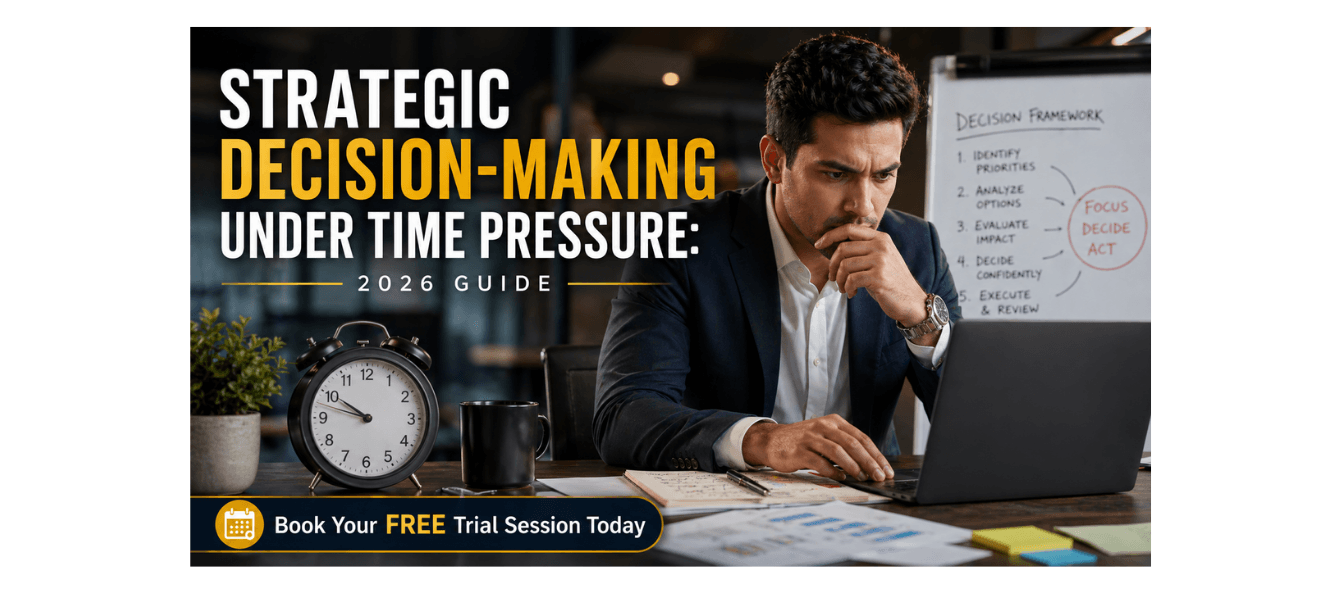
Download these resources and apply them alongside your daily work for improved clarity, productivity, and professional growth. You can also book a free trial to gain expert guidance and enhance your communication, problem-solving, and decision-making skills. The materials are designed in a clear, structured format to help professionals learn efficiently and implement insights with confidence.
Who Is This Blog For?
- Managers handling time-sensitive team and business decisions
- Consultants making recommendations under pressure
- Working professionals dealing with daily prioritisation challenges
- Entrepreneurs navigating fast-changing environments
- Career-focused individuals aiming to improve decision confidence
Why This Topic Matters Today?
Modern workplaces demand speed without compromising quality. However, most professionals were never trained in structured decision-making.
According to the guide, this gap leads to four common decision traps:
- Analysis paralysis from waiting for complete certainty
- Option overload due to lack of filtering
- Stakeholder noise influencing judgment
- Time pressure panic leading to rushed decisions
These challenges result in delayed actions, inconsistent outcomes, and reduced professional credibility.
In a world where decisions directly impact career growth, the ability to decide quickly and effectively is a critical competitive advantage.
Core Concept or Framework Explained
The guide introduces the CLEAR Decision Framework, a structured 5-step system designed for real-world decision-making under time constraints.
CLEAR stands for:
- Clarify: Define the real decision
- List: Identify viable options
- Evaluate: Assess options against key criteria
- Act: Commit to a decision
- Review: Learn and adjust
This framework transforms decision-making from a reactive process into a structured, repeatable system.
As illustrated in the framework overview (page 4), each step represents a clear mental shift—from confusion to clarity, and from hesitation to confident action.
How This Blog and Guidebook Help You?
By applying this framework, you can:
- Reduce overthinking and decision fatigue
- Make faster decisions without sacrificing quality
- Improve clarity and communication
- Build confidence in high-pressure situations
- Create a repeatable system for consistent results
The framework adapts to different time constraints, making it practical for both quick and complex decisions.
Step-by-Step Breakdown
Step 1: Clarify the Decision
The biggest mistake professionals make is solving the wrong problem.
Instead of jumping to solutions, define the decision clearly:
- What exactly are you deciding?
- What does success look like?
- What are the constraints (time, budget, authority)?
- What is the real deadline?
A well-defined decision might look like:
“Should I accept this job offer by Friday given salary and growth trade-offs?”
Clarity eliminates confusion and directs focused thinking.
Step 2: List Only Viable Options
More options do not mean better decisions—they often create confusion.
The guide recommends narrowing options to 2–4 viable choices using three filters:
- Feasible: Can it actually be executed?
- Relevant: Does it address the decision?
- Distinct: Is it meaningfully different?
Eliminate options that:
- Are outside your control
- Depend on unrealistic assumptions
- Exist only to avoid conflict
Fewer, better options lead to faster and clearer decisions.
Step 3: Evaluate Based on What Matters
Instead of analysing everything, focus on 3–5 key decision criteria.
Examples include:
- Career growth
- Financial impact
- Risk level
- Stakeholder alignment
Assign weights to each criterion and score options accordingly.
As shown in the evaluation table on page 7, weighting helps prioritise what truly matters rather than treating all factors equally.
If results feel wrong, revisit your criteria—your intuition may be highlighting missing factors.
Step 4: Act with Confidence
The guide emphasises a critical principle: act at 70% confidence.
Waiting for 100% certainty leads to delays and missed opportunities.
Before acting:
- Confirm you have sufficient information
- Identify any critical missing data
- Commit to your best available option
When communicating your decision:
- State it clearly
- Provide concise reasoning
- Define next steps
Avoid over-explaining, as it signals uncertainty.
Step 5: Review and Learn
Decision-making does not end with action.
The guide introduces a structured review cycle:
- 24 hours: Confirm execution has started
- 1 week: Check early indicators
- 1 month: Reflect on process and outcomes
- 3 months: Evaluate long-term impact
As highlighted in the visual timeline on page 9, this review loop ensures continuous learning without falling into overthinking or regret.
Common Mistakes or Pitfalls to Avoid
Even with a framework, professionals make predictable errors:
- Confusing urgency with importance
- Seeking consensus instead of input
- Reopening decisions unnecessarily
- Anchoring on the first option
Better practices include:
- Using structured evaluation methods
- Separating input gathering from decision-making
- Setting clear review checkpoints
- Generating multiple options before evaluating
How Should You Use This Guidebook Effectively?
To maximise results:
- Start with one real decision you are currently facing
- Apply the CLEAR framework step-by-step
- Use worksheets to document your thinking
- Review outcomes systematically
Time-based approach:
- Under 10 minutes: Use the 10/10/10 rule
- Under 1 hour: Use a 2×2 priority matrix
- 1–3 days: Apply the full CLEAR framework
Matching your method to the decision’s importance ensures efficiency and better outcomes.
Key Takeaways
- Strategic decision-making is a learnable skill
- Clarity is more important than speed at the start
- Limiting options improves decision quality
- Weighted criteria provide structured evaluation
- Acting at 70% confidence prevents delays
- Clear communication strengthens decision impact
- Review loops enable continuous improvement
- Matching decision tools to time constraints improves efficiency
Your Next Step: Accelerate Your Career with PlanetSpark
Creating an impact-driven resume is not just about landing your next job—it’s about owning your professional story and presenting it with clarity, confidence, and credibility. When your resume clearly communicates value, results, and impact, opportunities follow naturally.
At PlanetSpark, we are committed to empowering working professionals with practical, outcome-focused resources that drive real career growth. From resume building and workplace communication to leadership presence and professional writing, our programs are designed to help you succeed in today’s fast-evolving job market.
Visit https://www.planetspark.in/resources to explore:
- Career and resume-building guides
- Workplace communication and professional writing resources
- Skill-development tools curated for working professionals
Want a deeper, hands-on experience?
You can also book a free trial session to learn more about PlanetSpark’s Working Professional Courses, designed to accelerate your career through personalised coaching, real-world practice, and expert guidance.
Your career deserves more than generic advice.
It deserves clarity, confidence, and measurable impact.
Start building that advantage today—with PlanetSpark.
Personalized Communication Roadmaps
Record a video to get a AI generated personalized communication reports