
Strategic Thinking Audit Guide for Career-Focused Professionals
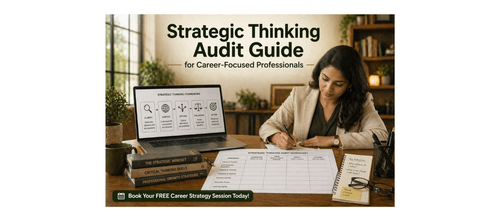

Strategic Thinking Audit Worksheet Guide: How to Assess and Improve Your Strategic Thinking for Career Growth
Most professionals work hard. They meet deadlines, deliver results, and stay busy throughout the day.
Yet, when it comes to promotions, leadership opportunities, or high-impact roles, effort alone is rarely enough.
The difference often comes down to one critical capability: strategic thinking.
You may have experienced this firsthand—being told to “think more strategically” without clear guidance on what that actually means or how to improve it. This creates frustration, self-doubt, and a feeling of being stuck despite strong performance.
As highlighted in the worksheet, strategic thinking is not an innate talent—it is a structured, learnable skill that can be assessed, developed, and improved over time.
The Strategic Thinking Audit Worksheet is designed to give you exactly that structure. It helps you evaluate your current thinking patterns, identify blind spots, and build a focused action plan to become a more effective, confident, and strategic professional.
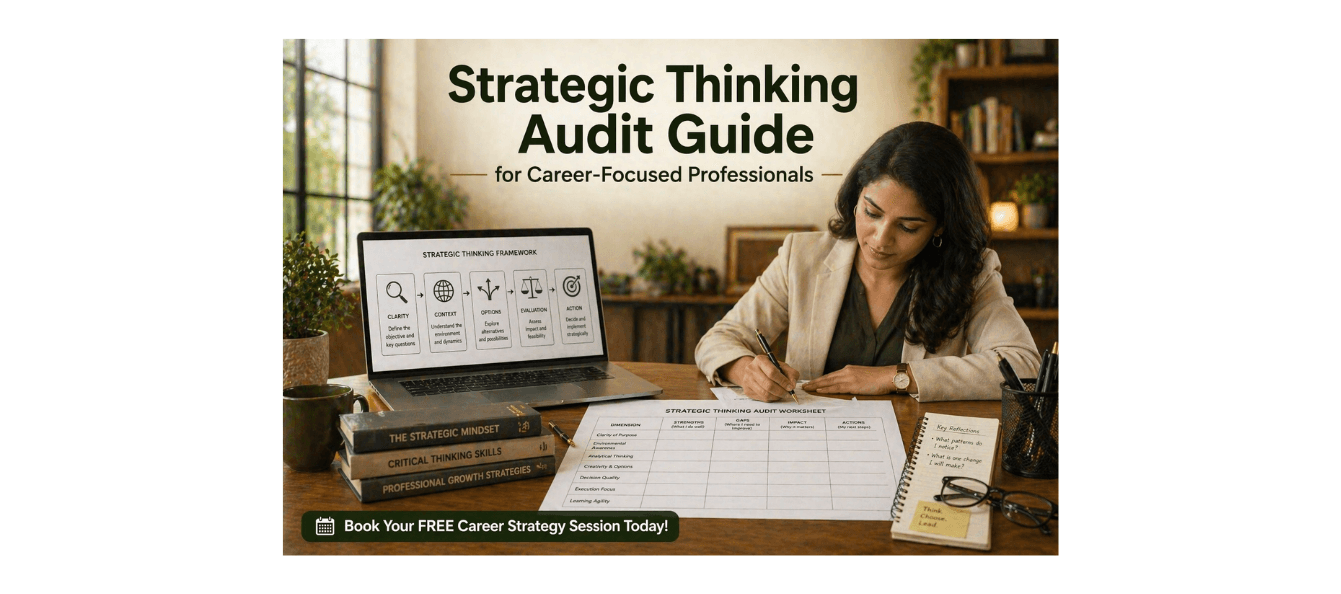
Download these resources and apply them alongside your daily work for improved clarity, productivity, and professional growth. You can also book a free trial to gain expert guidance and enhance your communication, problem-solving, and decision-making skills. The materials are designed in a clear, structured format to help professionals learn efficiently and implement insights with confidence.
Who Is This Blog For?
- Working professionals aiming to move into strategic or leadership roles
- Managers handling complex decisions and team outcomes
- Consultants and analysts solving business problems
- Career switchers building structured thinking capabilities
- Professionals who want to improve clarity, influence, and decision-making
Why This Topic Matters Today?
As explained in the introduction (page 2), the professionals who succeed today are not just those who execute well—but those who can anticipate, connect, and decide effectively.
Common challenges include:
- Reacting to tasks instead of thinking long-term
- Difficulty connecting decisions to broader business impact
- Lack of structured approach to problem-solving
- Feeling overlooked in strategic discussions
- Unclear understanding of personal thinking strengths and gaps
In a fast-changing environment, strategic thinking is no longer optional—it is a career-defining capability.
Core Concept or Framework Explained
The worksheet is built around five core dimensions of strategic thinking (page 3), each representing a critical capability:
- Systems Perspective: Understanding interconnected systems and ripple effects
- Future Orientation: Anticipating trends, risks, and opportunities
- Intent-Driven Focus: Prioritising what truly matters
- Pattern Recognition: Identifying insights across data and experience
- Adaptive Intelligence: Learning, updating, and evolving decisions
Together, these dimensions form a complete model of strategic thinking.
The goal is not perfection across all five—but awareness, focus, and continuous improvement.
How This Blog and Guidebook Help You?
This blog and worksheet help you:
- Diagnose your current strategic thinking level
- Identify specific strengths and gaps
- Build a focused development plan
- Improve decision-making and problem-solving
- Increase visibility and credibility at work
The result is stronger thinking, clearer communication, and faster career growth.
Step-by-Step Breakdown
Step 1: Understand the Five Dimensions of Strategic Thinking
Before assessing yourself, understand what each dimension represents.
As shown in the framework (page 3), strategic thinking is multi-dimensional—not a single skill.
Each dimension contributes to how you think, plan, and act.
Step 2: Conduct a Systems Perspective Audit
This dimension evaluates how well you understand interconnected systems.
As outlined on page 4, assess whether you:
- Understand how your organisation creates value
- Consider second-order effects of decisions
- Stay aware of industry trends
- Think beyond your immediate role
Reflection questions help identify blind spots in your thinking.
Step 3: Evaluate Your Future Orientation
Strategic professionals think ahead.
The checklist on page 5 helps you assess whether you:
- Have a clear 3-year vision
- Track industry trends
- Identify risks proactively
- Build contingency plans
The Horizon Mapping exercise (near-term, mid-term, long-term) strengthens forward thinking.
Step 4: Audit Your Intent-Driven Focus
Focus determines impact.
As shown on page 6, assess:
- Clarity of your top priorities
- Time spent on high-impact work
- Ability to say no to low-value tasks
- Alignment between effort and outcomes
This reveals the gap between activity and strategy.
Step 5: Assess Your Pattern Recognition Ability
Pattern recognition improves decision-making speed and quality.
The audit on page 7 evaluates:
- Exposure to diverse information
- Reflection habits
- Ability to transfer ideas across contexts
- Distinguishing signal from noise
This builds deeper insight.
Step 6: Evaluate Your Adaptive Intelligence
Adaptability is critical in uncertain environments.
As described on page 8, assess whether you:
- Challenge your own assumptions
- Learn from failures
- Seek feedback
- Make decisions with incomplete information
This determines how well you evolve with change.
Step 7: Consolidate Your Audit Results
The summary table (page 9) helps you:
- Compare scores across all dimensions
- Identify your strongest capability
- Identify your biggest gap
Your lowest score becomes your priority focus area.
Step 8: Learn from Real-World Application
The case study (page 10) demonstrates how improving weak areas—such as systems thinking and future orientation—can lead to:
- Better visibility
- Strategic contributions
- Faster promotions
This reinforces practical impact.
Step 9: Build a 90-Day Strategic Thinking Plan
As outlined on page 11, the development plan includes:
- Days 1–10: Diagnose
- Days 11–30: Design habits
- Days 31–60: Practise in real scenarios
- Days 61–90: Embed and demonstrate thinking
This ensures structured improvement.
Step 10: Apply Continuous Improvement
The guide emphasises:
- Quarterly re-assessment
- Consistent practice
- Real-world application
Strategic thinking improves through repetition—not theory.
Common Mistakes or Pitfalls to Avoid
As highlighted in the case study section (page 10), professionals often:
- Try to improve all dimensions at once
- Avoid revisiting their audit
- Confuse activity with progress
- Keep development plans private
- Delay starting improvement
A better approach is focused, consistent development.
How Should You Use This Guidebook Effectively?
To maximise results:
- Complete the full audit honestly
- Identify your lowest-scoring dimension
- Focus on one priority area for 90 days
- Apply learning in real work situations
- Reassess quarterly
Time investment:
- 45–60 minutes for initial audit
- 30 minutes weekly for reflection
- Ongoing application in daily work
Consistency drives transformation.
Key Takeaways
- Strategic thinking is a learnable skill
- Self-awareness is the first step to improvement
- Five dimensions define strategic capability
- Focus on one area at a time for maximum impact
- Real-world application is essential
- Reflection accelerates growth
- Consistency creates long-term advantage
Your Next Step: Accelerate Your Career with PlanetSpark
Creating an impact-driven resume is not just about landing your next job—it’s about owning your professional story and presenting it with clarity, confidence, and credibility. When your resume clearly communicates value, results, and impact, opportunities follow naturally.
At PlanetSpark, we are committed to empowering working professionals with practical, outcome-focused resources that drive real career growth. From resume building and workplace communication to leadership presence and professional writing, our programs are designed to help you succeed in today’s fast-evolving job market.
Visit https://www.planetspark.in/resources to explore:
- Career and resume-building guides
- Workplace communication and professional writing resources
- Skill-development tools curated for working professionals
Want a deeper, hands-on experience?
You can also book a free trial session to learn more about PlanetSpark’s Working Professional Courses, designed to accelerate your career through personalised coaching, real-world practice, and expert guidance.
Your career deserves more than generic advice.
It deserves clarity, confidence, and measurable impact.
Start building that advantage today—with PlanetSpark.
Personalized Communication Roadmaps
Record a video to get a AI generated personalized communication reports