
Strategic Thinking Execution Checklist for Professionals
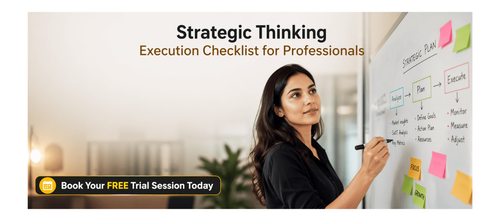

Strategic Thinking Execution Checklist Guide: How to Think Clearly, Decide Confidently, and Deliver Long-Term Impact at Work
Most professionals are excellent at execution.
They complete tasks, meet deadlines, and stay busy throughout the day. But as responsibilities grow—whether through promotions, leadership roles, or complex projects—execution alone is no longer enough.
This is where many careers slow down.
The expectation shifts from “getting things done” to “making the right decisions.” And without a clear system, most professionals fall into predictable traps—reacting to urgency, solving the wrong problems, and confusing activity with progress.
This is not a capability issue.
It is a systems issue.
As highlighted in the guide, strategic thinking is not an innate talent reserved for senior leaders—it is a structured, learnable skill that can be applied consistently with the right framework.
The Strategic Thinking Execution Checklist provides exactly that—a practical, step-by-step system to help you think clearly, prioritise effectively, make confident decisions, and continuously improve your approach.
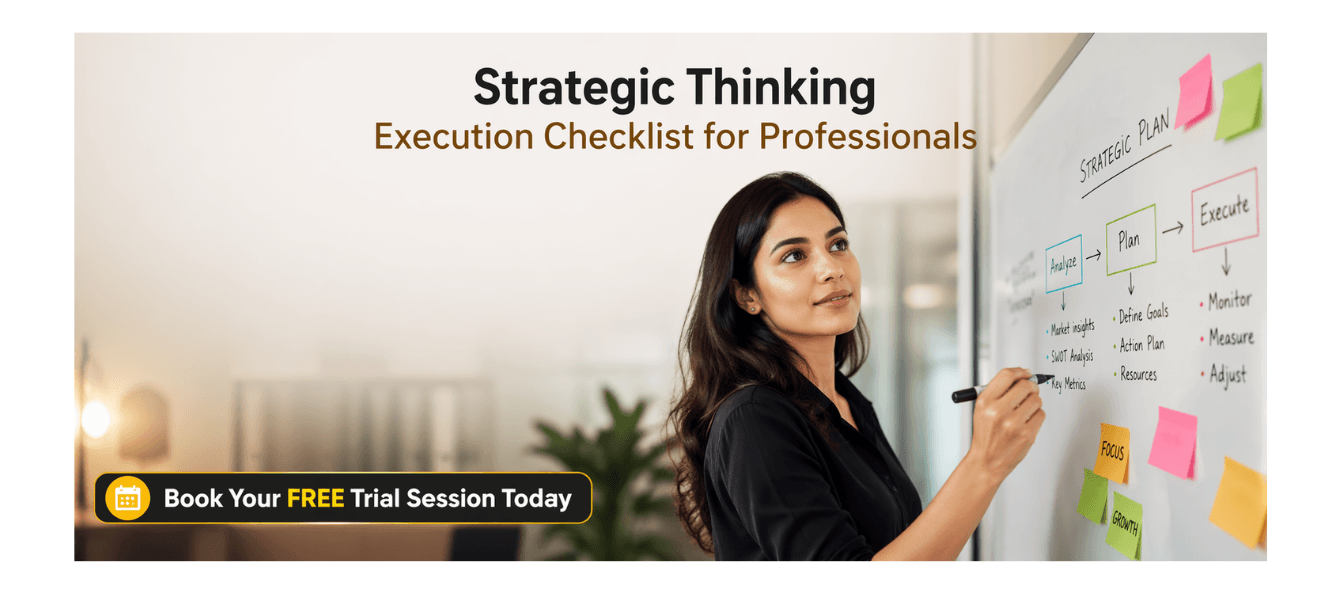
Download these resources and apply them alongside your daily work for improved clarity, productivity, and professional growth. You can also book a free trial to gain expert guidance and enhance your communication, problem-solving, and decision-making skills. The materials are designed in a clear, structured format to help professionals learn efficiently and implement insights with confidence.
Who Is This Blog For?
- Working professionals transitioning from execution to strategic roles
- Managers handling complex decisions and team priorities
- Consultants navigating ambiguous business problems
- Career switchers building structured thinking capability
- Professionals who feel reactive instead of proactive
Why This Topic Matters Today?
As explained in the introduction (page 2), the professionals who advance fastest are not those who work the hardest—but those who think the clearest.
Common challenges include:
- Confusing urgency with importance
- Reacting instead of planning
- Losing long-term focus under short-term pressure
- Making decisions without structure
- Struggling to explain strategic thinking to stakeholders
In today’s dynamic work environment, strategic thinking is not optional—it is a core leadership skill.
Core Concept or Framework Explained
The Strategic Thinking Execution Checklist is built around a three-phase system (pages 3–5):
- Before Action: Clarity and context setting
- During Execution: Decision-making and prioritisation
- After Action: Review, learning, and recalibration
This creates a complete thinking loop—not just a one-time process.
The key principle is simple: strategy is not just about thinking—it is about consistent, structured execution.
How This Blog and Guidebook Help You?
This blog and checklist help you:
- Build clarity before making decisions
- Prioritise high-impact actions effectively
- Apply structured decision-making frameworks
- Improve stakeholder alignment and communication
- Learn continuously through structured reviews
The result is better decisions, stronger outcomes, and faster career growth.
Step-by-Step Breakdown
Step 1: Diagnose the Situation Before Acting
As shown in Phase 1 (page 3), strategic execution begins with clarity.
Use the Situational Diagnosis Checklist:
- Understand what is actually happening
- Identify root causes, not symptoms
- Gather data before forming conclusions
- Assess constraints and stakeholders
This prevents solving the wrong problem.
Step 2: Frame the Problem Clearly
A well-defined problem leads to better solutions.
The Problem Framing Checklist includes:
- Defining the problem in one clear sentence
- Separating facts from assumptions
- Identifying stakeholders and impact
- Defining success criteria
If you cannot explain the problem clearly, you are not ready to act.
Step 3: Set Clear Success Criteria
Strategic thinking requires clarity on outcomes.
Ask:
- What does success look like in 6–12 months?
- What is “good enough” vs ideal?
This aligns expectations before execution.
Step 4: Prioritise Using Impact vs Effort
As shown in Phase 2 (page 4), prioritisation is critical.
Apply the Impact–Effort matrix:
- Focus on high-impact, low-effort actions
- Identify 1–3 key moves that drive results
- Deprioritise low-value tasks
This ensures focused execution.
Step 5: Make Decisions Using a Structured Framework
Effective decisions are not impulsive—they are structured.
The Decision-Making Checklist includes:
- Defining criteria before evaluating options
- Generating multiple alternatives
- Considering risks and second-order effects
- Setting decision deadlines
This improves decision quality and speed.
Step 6: Align Stakeholders Early
Even strong strategies fail without alignment.
Ensure:
- Stakeholders understand priorities
- Expectations are clearly communicated
- Buy-in is secured early
Alignment reduces resistance later.
Step 7: Execute with Clear Milestones
Break strategy into actionable steps:
- 30-day goals
- 60-day progress checkpoints
- 90-day outcomes
Assign ownership and track progress.
Step 8: Conduct After-Action Reviews
As highlighted in Phase 3 (page 5), learning is critical.
The After-Action Review Checklist includes:
- Comparing outcomes with expectations
- Identifying successes and failures
- Separating execution vs strategy issues
- Documenting learnings
This builds long-term capability.
Step 9: Recalibrate Strategy Based on Learning
Strategic thinkers adapt.
Update:
- Assumptions
- Plans
- Priorities
Adaptability improves results.
Step 10: Build a Continuous Strategic Thinking Habit
The guide emphasises:
- Using the checklist regularly
- Applying it in real decisions
- Reviewing outcomes consistently
This turns strategy into a daily practice.
Common Mistakes or Pitfalls to Avoid
As highlighted on page 6, common mistakes include:
- Solving the wrong problem
- Confusing activity with progress
- Skipping stakeholder alignment
- Not reviewing outcomes
- Over-planning without communication
Avoiding these improves effectiveness.
How Should You Use This Guidebook Effectively?
To maximise results:
- Use the checklist before major decisions
- Apply it during project execution
- Conduct after-action reviews consistently
- Revisit it during planning cycles
- Practise regularly in real scenarios
Time investment:
- 15–20 minutes per major decision
- Ongoing application during work
Consistency builds mastery.
Key Takeaways
- Strategic thinking is a structured, learnable skill
- Clarity before action prevents poor decisions
- Prioritisation determines impact
- Structured decision-making improves outcomes
- Stakeholder alignment is critical for success
- Continuous review drives improvement
- Strategic thinking is a daily practice
Your Next Step: Accelerate Your Career with PlanetSpark
Creating an impact-driven resume is not just about landing your next job—it’s about owning your professional story and presenting it with clarity, confidence, and credibility. When your resume clearly communicates value, results, and impact, opportunities follow naturally.
At PlanetSpark, we are committed to empowering working professionals with practical, outcome-focused resources that drive real career growth. From resume building and workplace communication to leadership presence and professional writing, our programs are designed to help you succeed in today’s fast-evolving job market.
Visit https://www.planetspark.in/resources to explore:
- Career and resume-building guides
- Workplace communication and professional writing resources
- Skill-development tools curated for working professionals
Want a deeper, hands-on experience?
You can also book a free trial session to learn more about PlanetSpark’s Working Professional Courses, designed to accelerate your career through personalised coaching, real-world practice, and expert guidance.
Your career deserves more than generic advice.
It deserves clarity, confidence, and measurable impact.
Start building that advantage today—with PlanetSpark.
Personalized Communication Roadmaps
Record a video to get a AI generated personalized communication reports