
Strategic Thinking Framework for Career Growth
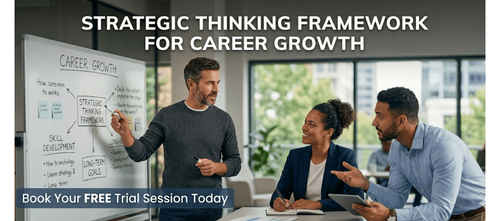

Master Strategic Thinking with This 5-Layer Framework to Elevate Your Career
In today’s fast-paced professional world, the ability to think strategically can be the defining factor in career advancement. Whether you’re looking to shift careers, step into a leadership role, or simply navigate complex decisions, strategic thinking is essential. But many professionals struggle because they focus on tactics and execution without seeing the bigger picture.
The Strategic Thinking Framework provides a clear, structured path to shift from tactical execution to strategic leadership. This resource offers a 5-layer framework that can be applied to any decision, challenge, or opportunity you encounter in your career.
Download these resources and apply them alongside your daily work for improved clarity, productivity, and professional growth. You can also book a free trial to gain expert guidance and enhance your communication, problem-solving, and decision-making skills. The materials are designed in a clear, structured format to help professionals learn efficiently and implement insights with confidence.
Who Is This Blog For?
* Career changers pivoting into new roles
* Mid-career professionals looking to transition from execution to leadership
* Managers and consultants seeking a structured approach to decision-making
* Job seekers aiming to present themselves as strategic thinkers
* Professionals looking to move beyond day-to-day tasks and lead with vision
Why This Topic Matters Today?
In the modern job market, being a hard worker is no longer enough. Professionals who are able to think strategically—that is, see the big picture, anticipate future trends, and make informed decisions that have long-term impact—are in high demand. Strategic thinking not only sets you apart in your current role but also positions you for growth and leadership opportunities.
The value of strategic thinking cannot be overstated. It helps you see connections that others miss, anticipate challenges before they arise, and act decisively to drive meaningful outcomes. Mastering this skill is essential for anyone serious about advancing their career.
Core Concept or Framework Explained
The 5-Layer Strategic Thinking Model is designed to build a holistic approach to decision-making. It provides a repeatable system that you can apply to any professional challenge or decision. The layers are:
1. Situational Awareness
Understanding where you are and what's happening around you before taking action.
Practical Example: A product manager who identifies that competitors have already built features similar to those in development is using situational awareness. This step ensures you understand the full context before moving forward.
2. Systems Thinking
Recognizing how different parts of a system are interconnected and how decisions affect the broader environment.
Practical Example: A manager who understands that changes in one department will ripple across others is applying systems thinking. This helps you identify long-term effects and avoid short-sighted decisions.
3. Strategic Prioritization
Deciding where to focus your energy and resources, especially when everything demands attention.
Practical Example: A team leader who focuses on high-impact activities instead of getting bogged down with low-leverage tasks is prioritizing strategically. This helps you focus on what truly moves the needle.
4. Scenario Planning
Planning for different possible futures and preparing responses for each.
Practical Example: A business owner who anticipates multiple market conditions and has contingency plans in place is practicing scenario planning. This prepares you for uncertainty and allows you to act with confidence.
5. Decisive Action
Making decisions with clarity and commitment, even when full information is unavailable.
Practical Example: A leader who makes bold decisions with about 70% of the required information, based on structured insights, is practicing decisive action. This allows you to move forward without unnecessary delays.
How This Blog and Guidebook Help You?
This blog, paired with the Strategic Thinking Framework guide, helps you:
Develop a strategic mindset that aligns with your long-term career goals
Learn how to approach decisions systematically and make better choices under pressure
Apply proven tools and frameworks like SCAN, SWOT, and scenario planning to real-world challenges
Build a repeatable process for navigating complex decisions with confidence
Improve your communication and influence by framing decisions in terms of strategic impact
Step-by-Step Breakdown
1. Situational Awareness
Before taking any action, understand your environment. Use the SCAN framework to assess stakeholders, context, assumptions, and determine your next move.
Practical Tip: Spend 10 minutes before a key decision writing down what you know, what you assume, and what you need to find out.
2. Systems Thinking
Look at the bigger picture and understand how all elements of the situation are interconnected. Use a systems map to explore direct and second-order effects.
Practical Tip: For every decision, ask "And then what?" to uncover deeper consequences and potential risks.
3. Strategic Prioritization
Focus on high-leverage activities that will drive the greatest impact. Use the 3×3 Priority Matrix to evaluate your options based on strategic impact and feasibility.
Practical Tip: Apply this matrix every week to identify and protect your top 2 strategic priorities.
4. Scenario Planning
Prepare for different possible outcomes by creating multiple scenarios (best case, worst case, etc.). This helps you stay calm and responsive when things don’t go as expected.
Practical Tip: Before any major decision, plan for the best, base, and worst-case scenarios—and decide how you’ll respond to each.
5. Decisive Action
Once you have enough information, commit to a decision and move forward. Don’t wait for perfection—act with 70% information, and course-correct as necessary.
Practical Tip: After making a decision, document it in three lines: What you decided, Why, and What you will monitor to track success.
Common Mistakes or Pitfalls to Avoid
Confusing Urgency with Importance: Don't prioritize tasks just because they’re urgent. Use the Eisenhower Matrix to ensure you focus on high-impact activities.
Mistaking Activity for Progress: Don’t measure success by how busy you are. Always align your actions with strategic goals.
Planning in a Vacuum: Don’t develop strategies in isolation. Consult key stakeholders and gather diverse perspectives before finalizing decisions.
Sunk Cost Anchoring: Don’t continue down a failing path just because you’ve already invested resources. Regularly ask, “If we were starting from scratch, would we choose this path?”
Optimizing the Known: Allocate time to explore new opportunities, not just refining what you already know. Strategic optionality requires forward thinking.
How Should You Use This Guidebook Effectively?
Read-through: Understand the full framework on your first pass.
Reference: Return to specific modules when facing a challenge or decision.
Worksheet Mode: Actively complete the worksheets and reflection prompts to make the framework practical.
Share: Walk your team through the framework in a 30-minute session to ensure alignment.
Action Steps
Block 30 minutes to apply the SCAN framework before your next high-stakes meeting.
Use the Systems Map to analyze a current challenge at work and identify second-order effects.
Prioritize your tasks for the week using the 3×3 Priority Matrix.
Run a scenario planning exercise before your next important decision or negotiation.
Make a decision with 70% of the information and communicate it to relevant stakeholders.
Key Takeaways
Strategic thinking is a skill that can be developed through practice and application.
The 5-layer framework helps you navigate complex decisions with clarity and confidence.
Tools like SCAN, Systems Mapping, and SWOT are essential for making informed, strategic choices.
Being a strategic thinker makes you a more influential, valued leader in any organization.
Your Next Step: Accelerate Your Career with PlanetSpark
Creating an impact-driven resume is not just about landing your next job—it’s about owning your professional story and presenting it with clarity, confidence, and credibility. When your resume clearly communicates value, results, and impact, opportunities follow naturally.
At PlanetSpark, we are committed to empowering working professionals with practical, outcome-focused resources that drive real career growth. From resume building and workplace communication to leadership presence and professional writing, our programs are designed to help you succeed in today’s fast-evolving job market.
Visit [https://www.planetspark.in/resources](https://www.planetspark.in/resources) to explore:
Career and resume-building guides
Workplace communication and professional writing resources
Skill-development tools curated for working professionals
Want a deeper, hands-on experience?
You can also book a free trial session to learn more about PlanetSpark’s Working Professional Courses, designed to accelerate your career through personalised coaching, real-world practice, and expert guidance.
Your career deserves more than generic advice.
It deserves clarity, confidence, and measurable impact.
Personalized Communication Roadmaps
Record a video to get a AI generated personalized communication reports