
Strategic Thinking Performance Checklist for Professionals
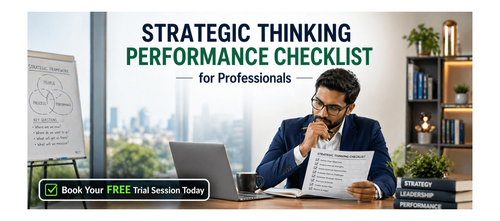

Strategic Thinking Performance Checklist: How to Audit Your Thinking, Close Gaps, and Become a High-Impact Professional
Most professionals believe they are thinking strategically.
They attend meetings, contribute ideas, and stay busy solving problems. But when it comes to promotions, leadership opportunities, or high-visibility roles, something doesn’t add up.
Effort is high. Output is consistent. Yet recognition is limited.
This is where the real gap lies.
Strategic thinking is not about working harder—it is about thinking better, connecting the dots, and focusing on what truly moves the business forward. And as most professionals realise too late, this skill is rarely taught in a structured way.
As highlighted in the Strategic Thinking Performance Checklist, technical skills may get you hired—but strategic thinking is what gets you promoted.
The challenge is that without a clear system, most professionals remain stuck in execution mode—reacting, responding, and staying busy, instead of stepping back and thinking ahead.
This checklist solves that problem by giving you a practical, no-fluff framework to audit your thinking, identify blind spots, and build strategic capability step by step.
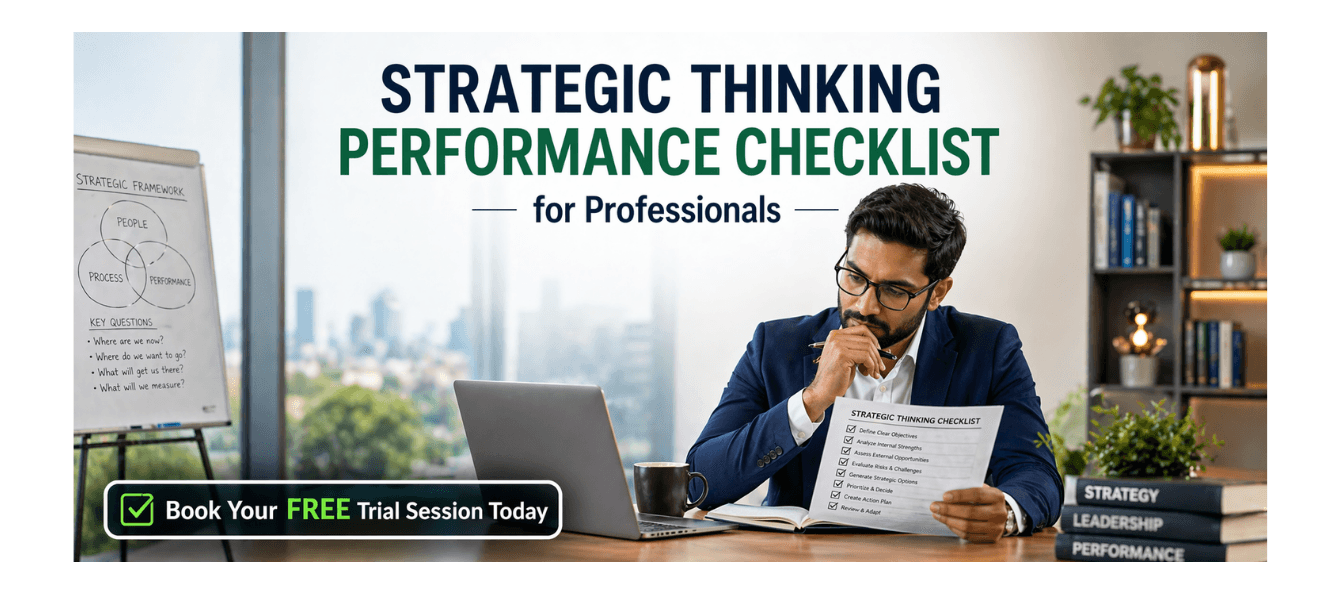
Download these resources and apply them alongside your daily work for improved clarity, productivity, and professional growth. You can also book a free trial to gain expert guidance and enhance your communication, problem-solving, and decision-making skills. The materials are designed in a clear, structured format to help professionals learn efficiently and implement insights with confidence.
Who Is This Blog For?
- Early to mid-career professionals (0–15 years experience) aiming to grow strategically
- Managers responsible for decision-making and team direction
- Consultants solving complex, ambiguous problems
- Career switchers building business and strategic perspective
- Professionals who feel reactive instead of proactive
Why This Topic Matters Today?
As explained on page 2, most professionals fall into a common trap: confusing busyness with strategy.
This leads to:
- Constant firefighting instead of long-term planning
- Responding to urgency rather than focusing on importance
- Limited visibility in leadership discussions
- Difficulty articulating strategic value
- Slower career progression despite strong execution
In today’s fast-paced work environment, strategic thinking is not a luxury—it is a necessity for growth, influence, and impact.
Core Concept or Framework Explained
The checklist is built around a three-level strategic thinking model (pages 2–5):
- Awareness: Understanding context, stakeholders, and the bigger picture
- Application: Translating insights into decisions and actions
- Mastery: Influencing, shaping, and redefining strategy
Each level includes specific behaviours, reflection questions, and measurable checklist items—making strategic thinking practical and actionable.
The structure acts as a performance audit for your thinking—helping you identify where you stand and what to improve next.
How This Blog and Guidebook Help You?
This blog and checklist help you:
- Diagnose your current strategic thinking level
- Identify high-impact gaps in your thinking
- Build structured decision-making habits
- Improve communication and influence
- Demonstrate strategic value consistently
The result is better decisions, stronger visibility, and faster career growth.
Step-by-Step Breakdown
Step 1: Develop Strategic Awareness
As shown in Level 1 (page 3), awareness is the foundation of strategic thinking.
Key behaviours include:
- Understanding your organisation’s top priorities
- Tracking industry and market trends
- Identifying key stakeholders and their motivations
- Recognising assumptions behind decisions
- Distinguishing root causes from symptoms
The checklist on page 3 helps you evaluate whether you truly “see the whole board.”
Step 2: Ask High-Quality Strategic Questions
Reflection questions on page 3 push deeper thinking:
- Did you fully understand the broader context before acting?
- When did you last challenge your own perspective?
- Can you clearly define the biggest strategic risk?
These questions shift your mindset from execution to insight.
Step 3: Translate Insight Into Action
Level 2 (page 4) focuses on application—where strategic thinking becomes visible.
Key behaviours include:
- Framing the right problem before solving
- Prioritising based on impact, not urgency
- Connecting daily work to long-term goals
- Anticipating risks instead of reacting
This is where most professionals have the biggest performance gap.
Step 4: Frame Problems Clearly Before Acting
Strategic thinkers define problems precisely.
As highlighted on page 4:
- Write the core problem in one sentence
- Ask whether it is the real issue or just a symptom
- Avoid jumping directly to solutions
This improves decision quality.
Step 5: Think in Trade-Offs
Every decision involves compromise.
Strategic professionals:
- Explicitly state trade-offs
- Avoid presenting “perfect” solutions
- Demonstrate clarity and honesty in decision-making
This builds credibility.
Step 6: Connect Work to Business Impact
A critical Application-level behaviour:
- Explain how your work contributes to 6–12 month goals
- Focus on outcomes, not just tasks
- Communicate the “so what” clearly
This ensures your work is recognised.
Step 7: Move Toward Strategic Mastery
Level 3 (page 5) focuses on influence and leadership.
Key behaviours include:
- Challenging assumptions in strategic plans
- Thinking across multiple time horizons
- Synthesising complex information
- Influencing stakeholders without authority
- Aligning teams toward shared goals
This is where professionals transition into leadership roles.
Step 8: Shift Your Strategic Mindset
The mindset shifts on page 5 are critical:
- Executor → Architect
- Responder → Anticipator
- Expert → Integrator
These shifts redefine how you approach problems and decisions.
Step 9: Learn from Real-World Application
The case study on page 6 illustrates how a professional:
- Shifted from execution to strategy
- Improved stakeholder communication
- Delivered measurable business impact
- Achieved career advancement
This shows that strategic thinking is practical—not theoretical.
Step 10: Build Consistent Strategic Thinking Habits
The guide emphasises simple but powerful habits:
- 5-minute problem reframe before tasks
- Weekly horizon scan (15 minutes)
- “So what” test before communication
Consistency drives transformation.
Common Mistakes or Pitfalls to Avoid
As highlighted on page 6, common mistakes include:
- Solving the wrong problem
- Thinking in silos
- Mistaking busyness for strategy
Avoiding these creates immediate improvement.
How Should You Use This Guidebook Effectively?
To maximise results:
- Complete all three checklist levels honestly
- Identify your weakest areas
- Focus on one behaviour at a time
- Apply learning in real work scenarios
- Reassess quarterly
Time investment:
- 30–45 minutes for initial audit
- 10–15 minutes weekly for practice
Consistency is more important than intensity.
Key Takeaways
- Strategic thinking is a learnable discipline
- Awareness is the foundation of better decisions
- Application makes thinking visible
- Mastery enables influence and leadership
- Trade-offs are central to strategic thinking
- Communication determines recognition
- Small habits create long-term impact
Your Next Step: Accelerate Your Career with PlanetSpark
Creating an impact-driven resume is not just about landing your next job—it’s about owning your professional story and presenting it with clarity, confidence, and credibility. When your resume clearly communicates value, results, and impact, opportunities follow naturally.
At PlanetSpark, we are committed to empowering working professionals with practical, outcome-focused resources that drive real career growth. From resume building and workplace communication to leadership presence and professional writing, our programs are designed to help you succeed in today’s fast-evolving job market.
Visit https://www.planetspark.in/resources to explore:
- Career and resume-building guides
- Workplace communication and professional writing resources
- Skill-development tools curated for working professionals
Want a deeper, hands-on experience?
You can also book a free trial session to learn more about PlanetSpark’s Working Professional Courses, designed to accelerate your career through personalised coaching, real-world practice, and expert guidance.
Your career deserves more than generic advice.
It deserves clarity, confidence, and measurable impact.
Start building that advantage today—with PlanetSpark.
Personalized Communication Roadmaps
Record a video to get a AI generated personalized communication reports