
Strategic Thinking System Design Guide for Professionals
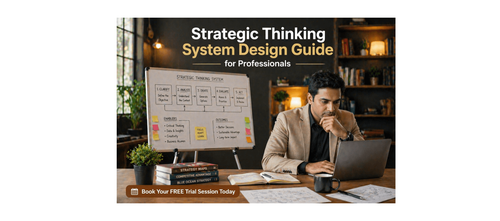

Strategic Thinking System Design Guide: How to Think Clearly, Decide Confidently, and Act Strategically at Work
Most professionals start their careers by focusing on execution—delivering tasks, meeting deadlines, and achieving targets. And for a while, that works.
But somewhere between 3 to 5 years into a career, a gap begins to appear.
Some professionals accelerate into leadership roles, influence decisions, and shape outcomes. Others—equally hardworking and capable—find themselves stuck, despite consistent performance.
The difference is not effort. It is not intelligence.
It is how they think.
Strategic thinking is the invisible skill that separates execution from leadership. Yet, as highlighted in the guide, it is rarely taught in a structured, practical way. Most professionals are told to “think big picture” or “be more proactive”—without any clear system to actually do it.
This is exactly the gap the Strategic Thinking System Design guide solves. It provides a structured, repeatable system that helps professionals think clearly, make better decisions, and create long-term impact—consistently, not occasionally.
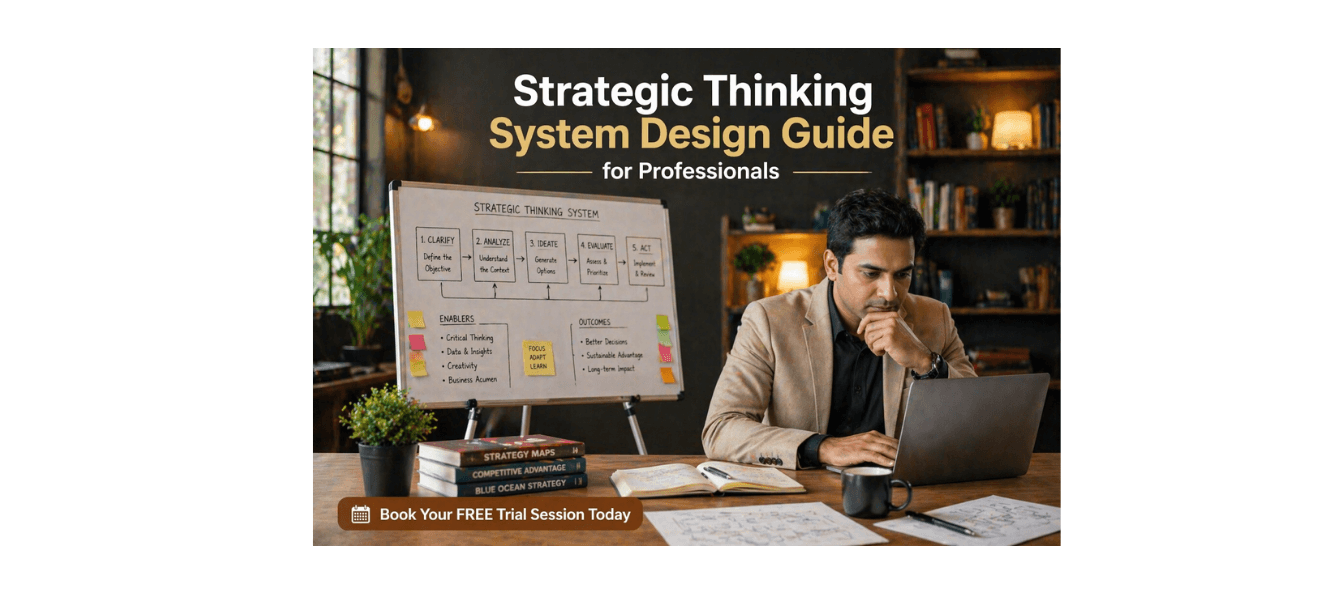
Download these resources and apply them alongside your daily work for improved clarity, productivity, and professional growth. You can also book a free trial to gain expert guidance and enhance your communication, problem-solving, and decision-making skills. The materials are designed in a clear, structured format to help professionals learn efficiently and implement insights with confidence.
Who Is This Blog For?
- Working professionals transitioning from execution to strategic roles
- Managers responsible for decision-making and team outcomes
- Consultants and analysts solving complex business problems
- Career switchers building structured thinking skills
- Professionals who want to improve clarity, confidence, and influence
Why This Topic Matters Today?
As explained in the introduction (page 2), many professionals feel:
- Reactive instead of proactive
- Unable to communicate ideas at a senior level
- Unsure how to structure decisions
- Focused only on immediate tasks
- Mistaking busyness for impact
In modern workplaces, execution is expected—but strategic thinking is what drives career acceleration.
Professionals who can think ahead, connect systems, and communicate clearly are the ones who influence decisions and create long-term value.
Core Concept or Framework Explained
The Strategic Thinking System is not a vague concept—it is a structured combination of three core elements (page 3):
- Mental Models: How you interpret complex situations
- Frameworks: How you structure problems
- Habits and Rituals: How you apply thinking consistently
These elements work together to create a repeatable system that improves decision-making over time.
Additionally, the guide identifies five key dimensions of strategic thinkers (page 4):
- Pattern recognition
- Systems perspective
- Long-range thinking
- Opportunistic thinking
- Hypothesis-driven inquiry
These dimensions define what strategic thinking looks like in practice.
How This Blog and Guidebook Help You?
This blog and guide help you:
- Build a structured system for thinking and decision-making
- Avoid reactive, short-term thinking
- Improve clarity in complex situations
- Communicate ideas effectively to stakeholders
- Develop long-term career advantage
The result is better decisions, stronger influence, and faster professional growth.
Step-by-Step Breakdown
Step 1: Define the Real Problem Before Solving
As explained on page 5, the most common mistake is solving the wrong problem.
Use the Problem Definition Protocol:
- Identify the presenting problem
- Ask “why” at least three times
- Identify affected stakeholders
- Define what success looks like
- Restate the real problem
This ensures you focus on the root cause, not symptoms.
Step 2: Map the System Around the Problem
Strategic thinkers do not see isolated tasks—they see systems.
As shown in the diagram on page 6:
- Identify key actors
- Map connections and dependencies
- Identify feedback loops
- Locate leverage points
This helps you anticipate outcomes and identify high-impact actions.
Step 3: Generate and Stress-Test Multiple Options
Most professionals present one solution. Strategic thinkers generate multiple.
As described on page 7:
- Create at least 3 options
- Stress-test each option
- Evaluate best, worst, and likely scenarios
- Use decision criteria matrices
This improves decision quality and credibility.
Step 4: Prioritise for Impact, Not Activity
As shown in the framework on page 8, strategic professionals focus on:
- High-impact, low-urgency work (Q2 quadrant)
- Long-term value creation
- Avoiding reactive, low-value tasks :contentReference[oaicite:7]{index=7}
The goal is to spend 60–70% of time on strategic work.
Step 5: Communicate Strategy Clearly
Strategic thinking only matters if it leads to action.
The guide introduces the SCR structure (page 9):
- Situation
- Complication
- Resolution
Always:
- Lead with the recommendation
- Support with key points
- Tailor communication to the audience
This ensures your ideas are understood and adopted.
Step 6: Use Core Strategic Frameworks
The guide provides six key frameworks (page 10):
- First Principles Thinking
- MECE Framework
- PESTLE Analysis
- Porter’s Five Forces
- OKR Alignment
- Stakeholder Influence Mapping
These act as tools for structured thinking.
Step 7: Assess Your Strategic Thinking Level
The diagnostic worksheet (page 11) helps evaluate:
- Problem definition
- Systems thinking
- Option generation
- Prioritisation
- Communication
This creates targeted improvement.
Step 8: Build Weekly Strategic Thinking Habits
The weekly checklist (page 12) ensures consistency:
- Problem framing
- System awareness
- Prioritisation
- Communication
Consistency turns thinking into instinct.
Step 9: Apply Structured Decision-Making
The Strategic Decision Template (page 13) helps:
- Define decisions clearly
- Evaluate options
- Identify risks
- Plan next steps
This improves decision quality.
Step 10: Follow a 90-Day Development Plan
The guide provides a structured plan (page 18):
- Days 1–30: Foundation
- Days 31–60: Application
- Days 61–90: Mastery
This ensures continuous improvement.
Common Mistakes or Pitfalls to Avoid
As highlighted on page 15, common mistakes include:
- Solving the first problem instead of the real one
- Thinking in isolation without system awareness
- Presenting only one option
- Burying recommendations in communication
- Confusing activity with impact
Avoiding these significantly improves effectiveness.
How Should You Use This Guidebook Effectively?
To maximise results:
- Read once for full understanding
- Apply one step at a time in real work
- Use worksheets actively
- Practise weekly habits
- Track progress over time
Time investment:
- 10–15 minutes daily
- 20 minutes weekly
- Continuous application in real scenarios
Consistency builds mastery.
Key Takeaways
- Strategic thinking is a system, not a talent
- Problem definition determines solution quality
- Systems thinking reveals leverage points
- Multiple options improve decision-making
- Prioritisation drives impact
- Communication turns ideas into action
- Consistent practice builds long-term capability
Your Next Step: Accelerate Your Career with PlanetSpark
Creating an impact-driven resume is not just about landing your next job—it’s about owning your professional story and presenting it with clarity, confidence, and credibility. When your resume clearly communicates value, results, and impact, opportunities follow naturally.
At PlanetSpark, we are committed to empowering working professionals with practical, outcome-focused resources that drive real career growth. From resume building and workplace communication to leadership presence and professional writing, our programs are designed to help you succeed in today’s fast-evolving job market.
Visit https://www.planetspark.in/resources to explore:
- Career and resume-building guides
- Workplace communication and professional writing resources
- Skill-development tools curated for working professionals
Want a deeper, hands-on experience?
You can also book a free trial session to learn more about PlanetSpark’s Working Professional Courses, designed to accelerate your career through personalised coaching, real-world practice, and expert guidance.
Your career deserves more than generic advice.
It deserves clarity, confidence, and measurable impact.
Start building that advantage today—with PlanetSpark.
Personalized Communication Roadmaps
Record a video to get a AI generated personalized communication reports