
Strengthen Your Career Edge with Smart Strategic Decisions

Creating Career Differentiation Through Strategic Professional Positioning
Many professionals work hard, deliver consistent results, and continuously improve their skills, yet still feel stuck in their careers. Promotions seem delayed, visibility remains limited, and exciting opportunities often go to others who appear more strategically positioned. The problem is rarely a lack of effort. More often, it is the absence of a deliberate career strategy. In today’s fast-changing professional world, career growth is no longer driven by experience alone. Employers increasingly value professionals who combine strong execution with strategic clarity, market relevance, visibility, and decision-making ability. Simply being “good at your job” is no longer enough to create long-term differentiation. This is where building a strong career edge becomes essential. A career edge is the unique combination of strengths, skills, reputation, relationships, and positioning that makes you valuable in the market. Professionals who intentionally build their edge create stronger opportunities, attract better networks, increase visibility, and accelerate career growth more predictably.
This guidebook explains how professionals can strengthen their career edge through strategic skill investments, visibility building, relationship capital, and smarter decision-making frameworks that compound over time into meaningful professional advantages.
Download these resources and apply them alongside your daily work for improved clarity, productivity, and professional growth. You can also book a free trial to gain expert guidance and enhance your communication, problem-solving, and decision-making skills. The materials are designed in a clear, structured format to help professionals learn efficiently and implement insights with confidence.
Who Is This Blog For?
This blog and guidebook are designed for:
- Working professionals seeking faster career growth and better opportunities
- Mid-career professionals preparing for leadership roles
- Professionals feeling stuck despite strong performance reviews
- Career changers looking to reposition themselves strategically
- Managers and specialists aiming to strengthen market visibility
- Professionals who want to improve networking and relationship-building skills
- Individuals seeking clarity before making major career decisions
- High performers who want to build long-term career resilience
Why This Topic Matters Today?
Career growth today is increasingly influenced by strategy rather than effort alone. The guidebook highlights an important truth: exceptional work that remains invisible produces limited career returns. Professionals who consistently advance are often those who intentionally communicate value, build strategic relationships, and position themselves effectively in the market.
Modern workplaces have changed significantly:
- Hiring markets evolve rapidly
- Skill requirements shift constantly
- Internal competition has intensified
- Professional visibility matters more than ever
- Relationships influence opportunities at every level
Many professionals fall into reactive career patterns. They accept roles based on salary alone, pursue certifications without direction, or wait passively to be noticed. Over time, these decisions dilute professional differentiation and slow career momentum.
The guidebook explains that career growth compounds through strategic choices. Small, consistent actions related to skills, positioning, visibility, and networking create powerful long-term advantages.
Professionals who actively manage these areas are more likely to:
- Attract better opportunities
- Build stronger reputations
- Gain access to influential networks
- Increase compensation potential
- Develop long-term career resilience
Core Concept or Framework Explained
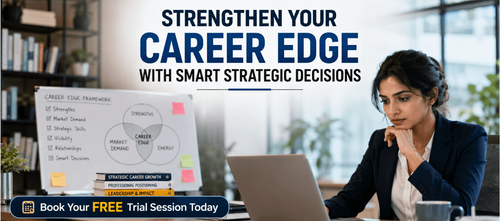
The foundation of the guidebook is the Career Edge Framework.
According to the framework:
Strength + Market Demand + Energy = Your Career Edge
This means your strongest career advantage exists at the intersection of:
- What you are naturally strong at
- What the market actively values
- What energizes and motivates you consistently
The guidebook emphasizes that professionals often focus on only one or two of these dimensions instead of combining all three strategically.
The framework also includes several supporting systems:
The Skill Investment Matrix
Not all skills deserve equal investment. Professionals should focus heavily on “Double Down” skills that create the highest long-term career return.
The Visibility Stack
Visibility compounds over time through five channels:
- Content creation
- Speaking and teaching
- Portfolio evidence
- Digital presence
- Mentoring
The Relationship Capital Model
The guidebook explains that networking is not transactional job-seeking. It is the deliberate creation of value-driven professional relationships across different relationship tiers.
The Strategic Decision Framework
Professionals should evaluate career decisions systematically instead of reacting emotionally or socially. The framework includes:
- Align
- Assess
- Analyze risks
- Act with conviction
Together, these frameworks create a complete system for long-term professional positioning and career growth.
How This Blog and Guidebook Help You?
This blog and guidebook help professionals move from reactive career management to strategic career building.
You will learn how to:
- Identify and define your unique career edge
- Invest in the right skills strategically
- Build visibility without feeling self-promotional
- Develop stronger professional relationships
- Create long-term professional positioning
- Make career decisions with greater clarity
- Build measurable proof of expertise
- Increase market relevance and credibility
The guidebook also helps professionals avoid common traps such as random upskilling, invisible performance, and transactional networking.
Most importantly, it teaches professionals how to create compounding career advantages rather than chasing short-term wins.
Step-by-Step Breakdown
Step 1: Conduct an Honest Career Self-Audit
The guidebook explains that clarity must come before action. Professionals cannot strengthen their career edge without understanding their current position honestly.
The Career Self-Audit evaluates several dimensions:
- Skills
- Reputation
- Market value
- Satisfaction
- Visibility
- Relationship strength
- Decision quality
Professionals are encouraged to ask:
- What am I currently known for?
- What strengths create the most value?
- Where am I invisible despite strong work?
- Which skills genuinely differentiate me?
- What drains energy versus creates momentum?
This audit creates awareness of both strengths and growth gaps.
The guidebook also includes a self-evaluation framework where professionals rate themselves across key dimensions such as strategic clarity, visibility, relationship capital, and decision quality. Lowest scores indicate the highest-priority improvement areas.
Step 2: Define Your Career Edge Statement
Once the audit is complete, professionals create a Career Edge Statement.
This statement defines:
- The value you create
- The audience you help
- The unique combination of strengths you bring
The guidebook emphasizes that strong positioning is specific, not generic.
For example, instead of saying:
“Experienced Product Manager”
A stronger edge statement would explain:
“I help B2B SaaS companies improve retention by combining behavioral psychology insights with product strategy.”
Strong Career Edge Statements:
- Clarify differentiation
- Guide career decisions
- Improve professional positioning
- Strengthen LinkedIn and resume messaging
- Create better networking conversations
This clarity becomes a strategic filter for future opportunities.
Step 3: Apply the Skill Investment Matrix
One of the most practical frameworks in the guidebook is the Skill Investment Matrix.
The guidebook explains that professionals waste significant time learning low-impact skills without strategic alignment.
Instead, professionals should prioritize:
- Double Down skills
- Selective Build skills
- Tactical Acquire skills
- Deprioritized skills
The highest investment should go toward skills that:
- Strengthen your career edge
- Align with market demand
- Create measurable career ROI
The guidebook recommends several practical actions:
- Identify top three “Double Down” skills
- Find one mentor, course, or project for each
- Schedule deliberate practice weekly
- Document measurable growth evidence
The guidebook also highlights three critical principles:
Learn in public
Teaching and sharing accelerate mastery.
Project over course
Applied learning beats passive consumption.
Seek stretch assignments
Real growth happens outside comfort zones.
Step 4: Build Strategic Visibility
One of the most important insights from the guidebook is that visibility is not vanity. It is strategic communication of value.
Many professionals remain invisible because they assume excellent work will automatically speak for itself.
The guidebook introduces the Visibility Stack, which includes five compounding channels:
Content Creation
Share insights, lessons, and project learnings consistently.
Speaking and Teaching
Present internally or externally to reinforce expertise.
Portfolio Evidence
Maintain measurable proof of projects and outcomes.
Digital Presence
Optimize LinkedIn and professional profiles strategically.
Mentoring
Teaching others strengthens authority and visibility.
The guidebook recommends focusing deeply on two or three visibility channels instead of trying to be everywhere at once. Consistency creates stronger results than intensity.
The 90-Day Visibility Sprint Plan includes actions such as:
- Publishing weekly LinkedIn insights
- Presenting project learnings internally
- Attending industry events monthly
- Updating portfolios bi-weekly
- Mentoring junior professionals consistently
Step 5: Build Relationship Capital Intentionally
The guidebook strongly challenges transactional networking behavior.
According to the framework, relationships are long-term career assets that create:
- Intelligence
- Sponsorship
- Opportunities
- Referrals
- Growth support
The Golden Rule of Networking is simple:
Give generously before asking for anything.
The guidebook introduces three relationship tiers:
Core Circle
Trusted relationships that actively support career growth.
Active Network
Professionals with regular professional interaction.
Broad Network
Larger visibility and industry awareness connections.
Professionals are encouraged to:
- Identify top 10 core relationships
- Schedule monthly touchpoints
- Find mentors strategically
- Join professional communities
- Provide specific value consistently
The guidebook emphasizes that relationship quality matters more than network size.
Step 6: Use the Strategic Decision Framework
Career decisions compound over time. Yet many professionals make major decisions emotionally, socially, or reactively.
The Strategic Decision Framework introduces four stages:
Align
Does the opportunity strengthen your Career Edge Statement?
Assess
What skills, reputation, or network access does it provide?
Analyze Risks
What are the realistic downsides and trade-offs?
Act with Conviction
Commit fully or decline clearly.
The guidebook also includes a Decision Worksheet covering:
- Skill gains
- Reputation impact
- Network expansion
- Financial considerations
- Recovery risk
- Gut-check evaluation
This structured approach improves long-term career quality significantly.
Step 7: Learn from Real-World Application
The guidebook shares Priya’s case study as a practical example of the system in action.
Priya was a Product Manager who consistently delivered results but lacked strategic visibility. Despite strong reviews, she felt stuck while less experienced peers advanced faster.
After completing the framework:
- She identified a visibility gap
- Defined her Career Edge Statement clearly
- Started writing LinkedIn articles
- Presented internally
- Built stronger strategic positioning
Within five months:
- She earned a promotion to Senior Product Manager
- Received industry speaking opportunities
- Attracted inbound recruiter interest from target companies
The guidebook emphasizes that Priya’s success was not accidental. It resulted from focused, strategic career investments.
Common Mistakes or Pitfalls to Avoid
The guidebook identifies several predictable mistakes that slow career growth.
Waiting to be noticed
Strong work alone does not guarantee visibility.
Skill hoarding
Collecting certifications without strategic direction creates diluted positioning.
Transactional networking
Only reaching out when help is needed weakens relationships.
Optimizing for safety
Consistently choosing low-risk paths often limits long-term growth. The guidebook explains that professionals who recognize these patterns early gain a significant long-term advantage.
How Should You Use This Guidebook Effectively?
The guidebook is designed as a practical implementation system rather than passive reading material.
Recommended workflow:
- Complete the Career Self-Audit honestly
- Draft your Career Edge Statement
- Apply the Skill Investment Matrix
- Build a visibility plan
- Strengthen your Core Circle relationships
- Use the Decision Framework before major career choices
- Review progress every 90 days
The guidebook also includes a structured 90-Day Career Edge Sprint:
Days 1–30
- Build foundational clarity
Days 31–60
- Strengthen visibility and skill investments
Days 61–90
- Activate strategic opportunities and relationships
This phased structure helps professionals create momentum without overwhelm.
Key Takeaways
- Career growth compounds through strategic choices
- Your Career Edge exists where strengths, market demand, and energy intersect
- Visibility is a professional responsibility, not vanity
- Strategic skill investment creates higher long-term ROI than random learning
- Relationship capital influences opportunities significantly
- Career decisions should follow structured evaluation frameworks
- Consistency outperforms intensity in visibility building
- Strong positioning requires specificity and clarity
- Networking works best when value is given before asking
- Regular self-audits help professionals adapt to changing markets
- Small weekly career habits create significant long-term advantages
- Starting imperfectly is better than waiting indefinitely
Your Next Step: Accelerate Your Career with PlanetSpark
Creating an impact-driven resume is not just about landing your next job—it’s about owning your professional story and presenting it with clarity, confidence, and credibility. When your resume clearly communicates value, results, and impact, opportunities follow naturally.
At PlanetSpark, we are committed to empowering working professionals with practical, outcome-focused resources that drive real career growth. From resume building and workplace communication to leadership presence and professional writing, our programs are designed to help you succeed in today’s fast-evolving job market.
Visit https://www.planetspark.in/resources to explore:
- Career and resume-building guides
- Workplace communication and professional writing resources
- Skill-development tools curated for working professionals
Want a deeper, hands-on experience?
You can also book a free trial session to learn more about PlanetSpark’s Working Professional Courses, designed to accelerate your career through personalised coaching, real-world practice, and expert guidance.
Your career deserves more than generic advice.
It deserves clarity, confidence, and measurable impact.
Start building that advantage today—with PlanetSpark.
Personalized Communication Roadmaps
Record a video to get a AI generated personalized communication reports