
System Feedback Loops: Continuously Improve Performance
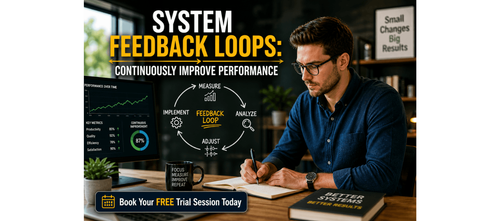

How to Create a Feedback Loop That Continuously Improves Your Professional Systems
Most working professionals are exceptionally good at execution.
They manage projects, attend meetings, deliver reports, solve urgent problems, and keep operations moving forward under constant pressure. But very few professionals build deliberate systems for learning from what they have already done.
As a result, the same mistakes repeat repeatedly.
Projects become reactive. Communication gaps continue cycle after cycle. Processes remain inefficient for years. Teams work harder without becoming meaningfully smarter. Professionals stay busy but fail to improve the underlying systems driving their work.
This is the core problem addressed in the guidebook “Creating A Feedback Loop To Continuously Improve Systems.” The resource explains that sustainable professional growth does not come from execution alone. It comes from building systems that learn, adapt, and improve over time.
The guidebook introduces a practical five-phase feedback loop model designed for managers, consultants, career switchers, and professionals who want to create systems that become more intelligent through structured reflection and iteration.
Instead of relying on vague lessons or occasional reviews, the framework provides a repeatable operating system for collecting signals, analysing patterns, designing targeted improvements, and continuously refining professional processes.
For professionals trying to build scalable performance rather than constant firefighting, this approach is transformative.
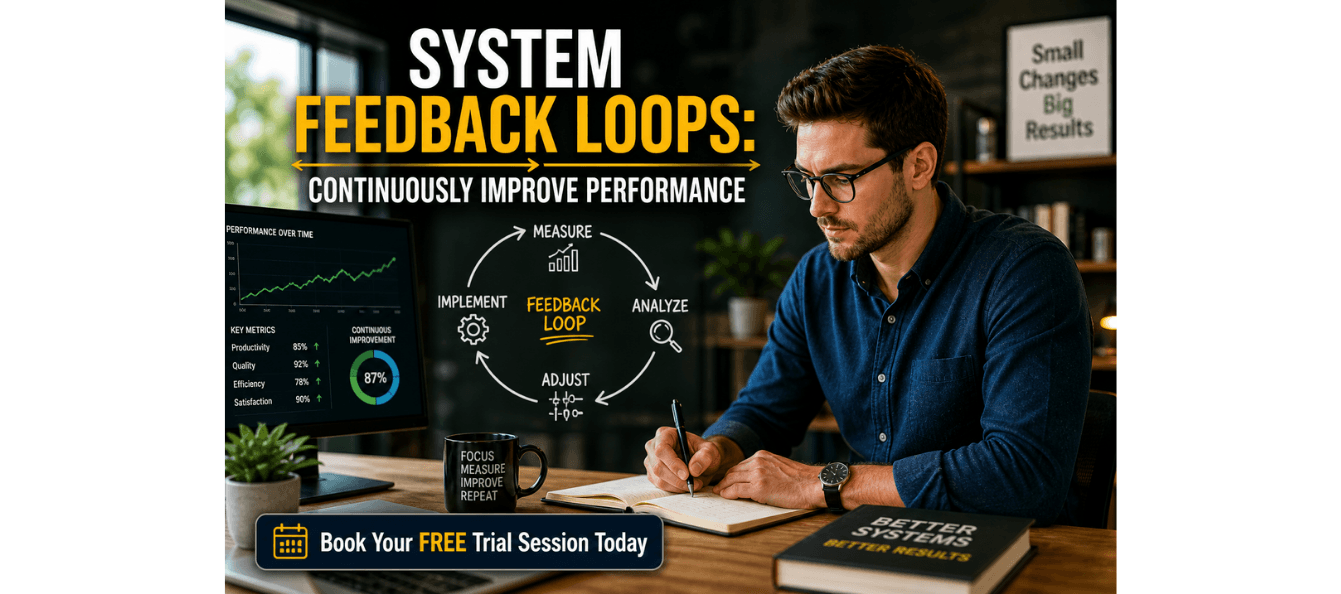
Download these resources and apply them alongside your daily work for improved clarity, productivity, and professional growth. You can also book a free trial to gain expert guidance and enhance your communication, problem-solving, and decision-making skills. The materials are designed in a clear, structured format to help professionals learn efficiently and implement insights with confidence.
Who Is This Blog For?
- Working professionals managing recurring processes and workflows
- Managers leading teams and operational systems
- Consultants improving delivery quality and client experience
- Career switchers building structured professional habits
- Professionals frustrated by repeated mistakes and inefficiencies
- Team leaders seeking sustainable performance improvement
- Professionals building productivity and review systems
- Individuals wanting structured reflection and continuous learning systems
Why This Topic Matters Today?
Modern workplaces reward speed aggressively.
Professionals are expected to:
- Deliver faster
- Respond immediately
- Execute continuously
- Handle constant operational pressure
In this environment, reflection often disappears.
The guidebook highlights a critical problem:
Most professionals focus heavily on doing but rarely build systems for learning from what they have already done.
As a result:
- Teams repeat the same operational mistakes
- Processes stagnate
- Systems become reactive rather than adaptive
- Professionals collect feedback but fail to act on it
- Valuable lessons disappear between projects
The guidebook strongly emphasises that the highest-performing systems across industries share one important characteristic:
They are wired to listen.
Whether in consulting, software development, manufacturing, or leadership, resilient systems continuously:
- Gather signals
- Analyse patterns
- Identify friction
- Implement targeted improvements
- Review outcomes
- Restart the learning cycle
Professionals who master feedback loops gain significant advantages:
- Faster learning cycles
- Better decision-making
- Reduced repeated mistakes
- More intelligent systems
- Higher operational clarity
- Better stakeholder alignment
- Stronger long-term professional growth
Feedback loops are no longer optional management tools.
They are becoming core professional operating systems.
Core Concept or Framework Explained
The guidebook introduces a complete Five-Phase Feedback Loop Model designed to continuously improve systems over time.
The Five-Phase Feedback Loop Model
The framework consists of:
1. Define
2. Collect
3. Analyse
4. Act
5. Review
The guidebook explains that each phase feeds directly into the next, creating a continuous improvement cycle rather than isolated review sessions.
The Define Phase
This phase establishes:
- What the system is trying to achieve
- What success looks like
- What failure signals look like
- How often the loop will run
Without clear definitions, feedback becomes noise rather than useful intelligence.
The Collect Phase
This phase gathers signals from multiple sources including:
- Stakeholder feedback
- System data
- Self-observation
- External benchmarks
The guidebook strongly emphasises that waiting passively for feedback creates distorted understanding.
The Analyse Phase
This stage transforms raw input into actionable insight.
The guidebook introduces the “3-Lens Analysis Method”:
Frequency
What themes appear repeatedly?
Severity
Which problems create the greatest impact?
Source Credibility
Which feedback comes from direct system experience?
This prevents emotional or reactive interpretation.
The Act Phase
Insights become precise, testable improvements.
The guidebook strongly discourages vague intentions.
Instead, professionals design measurable experiments with:
- Clear ownership
- Deadlines
- Success metrics
The Review Phase
The final phase evaluates whether changes produced meaningful improvement.
The review then feeds back into the next Define phase, restarting the cycle with greater system intelligence.
How This Blog and Guidebook Help You?
This blog and the original guidebook help professionals transform stagnant systems into adaptive learning systems.
Most professionals already receive feedback.
The problem is that feedback often:
- Remains unstructured
- Goes unanalyzed
- Produces vague action
- Never closes the learning loop
The guidebook helps you:
- Build structured feedback systems
- Define meaningful success criteria
- Collect higher-quality signals
- Analyse patterns objectively
- Design measurable improvement experiments
- Review outcomes rigorously
- Build systems that improve continuously over time
Most importantly, it shifts professionals from reactive problem-solving toward proactive system refinement.
Step-by-Step Breakdown
Step 1: Define What Success Actually Looks Like
The guidebook strongly emphasises that feedback loops fail without clear definitions.
Most professionals track too many vague metrics without identifying what genuinely matters.
The Define phase requires professionals to specify:
System Purpose
What is this system designed to accomplish?
Success Indicators
What observable signals indicate strong performance?
Failure Signals
What early warning signs indicate problems?
Review Cadence
How frequently will the full loop run?
The guidebook includes a “System Definition Snapshot” worksheet helping professionals define:
- System name
- Primary purpose
- Stakeholders
- Success indicators
- Early failure signals
- Review schedule
The guidebook strongly advises limiting success indicators to two or three meaningful measures.
Too many metrics dilute focus.
Step 2: Build Multi-Source Feedback Channels
One of the strongest concepts in the guidebook is intentional feedback collection.
The resource explains that passive feedback systems mostly hear from the loudest voices rather than the most useful sources.
Professionals are encouraged to build four feedback categories.
Stakeholder Feedback
Examples include:
- Structured conversations
- Client debriefs
- Retrospectives
- Anonymous surveys
System Data
Examples include:
- Error rates
- Process completion rates
- Cycle times
- Output quality scores
Self-Observation
Examples include:
- Reflection journals
- Decision logs
- Friction tracking
- Assumption notes
External Benchmarks
Examples include:
- Industry comparisons
- Peer reviews
- Cross-functional insights
The guidebook strongly emphasises triangulation.
No single source should define reality alone.
Step 3: Analyse Feedback Systematically
Collecting feedback is relatively easy.
Interpreting it correctly is far harder.
The guidebook introduces the “3-Lens Analysis Method.”
Lens 1: Frequency
Repeated themes matter more than isolated comments.
Lens 2: Severity
Which issues create the greatest risk if ignored?
Lens 3: Source Credibility
How directly connected is the source to the system?
Professionals are encouraged to complete a “Pattern Mapping Table” identifying:
- Themes
- Sources
- Frequency
- Severity
The guidebook also warns strongly against confirmation bias.
Professionals naturally prefer feedback confirming existing beliefs.
The most valuable insights are often uncomfortable.
Reflection questions include:
- What assumption is being challenged?
- Which insight feels most uncomfortable?
- What patterns are emerging repeatedly?
This creates more objective analysis.
Step 4: Convert Insights Into Testable Improvements
One of the strongest sections of the guidebook focuses on turning insights into measurable action.
The guidebook strongly criticises vague improvement language such as:
- “Improve communication”
- “Be more efficient”
- “Increase collaboration”
Instead, professionals design precise experiments.
Example:
“Add a weekly 10-minute async video update and measure whether decision response times improve.”
The guidebook introduces the principle of:
Minimal Effective Dose
Rather than changing everything simultaneously, professionals implement the smallest meaningful change possible.
This improves learning clarity.
Each improvement should include:
- Specific change
- Owner
- Deadline
- Success metric
The guidebook also introduces the SMART-I framework:
Specific
Measurable
Achievable
Relevant
Time-bound
Impact-connected
This ensures improvements remain meaningful rather than performative.
Step 5: Conduct a Structured Review
Many professionals skip review once changes appear successful.
The guidebook strongly warns against this.
The Review phase asks:
- Did the change work?
- Why did it work?
- What did we learn about the system?
- What should change next?
The guidebook explains that this phase creates institutional learning and long-term intelligence.
Professionals are encouraged to document:
- Expected outcomes
- Actual outcomes
- Unexpected consequences
- New assumptions
- Future improvements
The review then resets the Define phase for the next cycle.
This creates continuous improvement rather than isolated optimisation.
Step 6: Learn from a Real-World Feedback Loop
The guidebook includes a consulting case study featuring Priya, a consulting manager.
Her weekly client reports had existed for years without major complaints.
However, when she applied the feedback loop framework, she discovered:
- Only 34% of clients opened the reports
- Reports were too dense
- Calls-to-action were unclear
- Mobile readability was poor
Rather than redesigning everything simultaneously, she implemented one precise experiment:
- Replaced a four-page PDF with a concise executive summary
- Highlighted one clear action item
- Improved mobile formatting
Results after one cycle:
- Open rates rose to 71%
- Response rates improved dramatically
- Client satisfaction increased significantly
The case study demonstrates the power of precise, measurable iteration.
Common Mistakes or Pitfalls to Avoid
The guidebook identifies several major feedback loop mistakes.
Collecting Feedback Without Analysis
Many professionals gather information but never interpret it systematically.
Better approach:
- Schedule fixed analysis sessions
Acting on Single Opinions
Strong personalities can distort decision-making.
Better approach:
- Triangulate across multiple sources
Changing Too Many Variables Simultaneously
This prevents understanding which change caused improvement.
Better approach:
- Implement one precise experiment per cycle
Skipping the Review Phase
Positive results still require explanation.
Better approach:
- Analyse successful outcomes rigorously
Taking Feedback Personally
Professionals often confuse process feedback with personal criticism.
Better approach:
- Separate identity from system evaluation
How Should You Use This Guidebook Effectively?
The guidebook works best as an implementation-focused operating system.
Recommended workflow:
- Choose one professional system to improve
- Complete the System Definition Snapshot
- Identify two feedback sources immediately
- Conduct structured collection sessions
- Analyse patterns using the 3-Lens Method
- Design one testable improvement experiment
- Schedule the Review session immediately
Suggested time investment:
- Around 30 minutes for system definition
- 15–20 minutes weekly for feedback collection
- 30–60 minutes monthly for full review cycles
The guidebook strongly recommends anchoring review loops to existing calendar rituals such as:
- Monthly planning
- Quarterly reviews
- Weekly retrospectives
Consistency matters more than intensity.
Key Takeaways
- Feedback loops transform systems from static to adaptive
- Clear success definitions are essential before collecting feedback
- Multi-source feedback prevents blind spots and distortion
- Analysis requires structure, not intuition alone
- One precise experiment is more valuable than broad vague intentions
- Minimal effective dose creates faster learning and cleaner insights
- The Review phase creates compound professional learning
- Feedback should be treated as system data, not personal criticism
- Small consistent loops outperform occasional ambitious reviews
- Continuous improvement is built through disciplined iteration over time
Your Next Step: Accelerate Your Career with PlanetSpark
Creating an impact-driven resume is not just about landing your next job—it’s about owning your professional story and presenting it with clarity, confidence, and credibility. When your resume clearly communicates value, results, and impact, opportunities follow naturally.
At PlanetSpark, we are committed to empowering working professionals with practical, outcome-focused resources that drive real career growth. From resume building and workplace communication to leadership presence and professional writing, our programs are designed to help you succeed in today’s fast-evolving job market.
Visit https://www.planetspark.in/resources to explore:
- Career and resume-building guides
- Workplace communication and professional writing resources
- Skill-development tools curated for working professionals
Want a deeper, hands-on experience?
You can also book a free trial session to learn more about PlanetSpark’s Working Professional Courses, designed to accelerate your career through personalised coaching, real-world practice, and expert guidance.
Your career deserves more than generic advice.
It deserves clarity, confidence, and measurable impact.
Start building that advantage today—with PlanetSpark.
Personalized Communication Roadmaps
Record a video to get a AI generated personalized communication reports