
Team-Building Leadership Resume Guide for Professionals
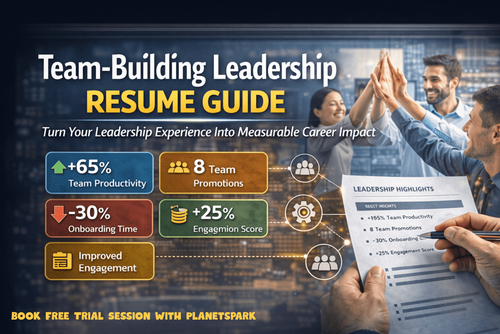

Team-Building Leadership Resume Guide: Turn Your Leadership Experience Into Measurable Career Impact
You may have hired top talent, mentored team members into promotions, resolved conflicts, and built high-performing teams—but if your resume simply says “managed a team,” you are underselling your leadership.
Book your free trial session today with Planetspark.
Download for more details or PDF file.
This is one of the most common challenges professionals face. Leadership is often experienced deeply but communicated poorly. As highlighted in this guide, many strong leaders get overlooked because their resumes read like job descriptions instead of stories of measurable human impact.
In today’s competitive job market, hiring managers are not just looking for people who have managed teams. They are looking for leaders who have built, developed, and transformed teams—and can prove it with clarity and results.
This blog will help you understand how to position your team-building leadership experience in a way that stands out and gets you shortlisted.
Who Is This Blog For?
- Managers and team leads with people management responsibilities
- Professionals transitioning from individual contributor to leadership roles
- Startup leaders who built teams from scratch
- HR and People Operations professionals
- Technical professionals moving into people management roles
- Senior leaders shaping organisational culture and leadership systems
Why This Topic Matters Today?
Leadership has evolved. It is no longer just about managing tasks—it is about building people, culture, and performance systems.
Organisations today prioritise:
- Talent development and retention
- Cross-functional collaboration
- Culture-building and employee engagement
- Leadership pipelines and succession planning
However, as the guide explains, most professionals fail to communicate these effectively on their resumes.
Common issues include:
- Listing responsibilities instead of measurable leadership outcomes
- Using vague phrases like led a team or collaborated with stakeholders
- Hiding leadership contributions deep within job descriptions
- Ignoring ATS keywords like People Management or Team Development
The result is a disconnect between actual leadership capability and perceived value.
Core Concept or Framework Explained
The core idea of this guide is simple: your resume must show what changed because of your leadership.
Leadership is not defined by titles—it is defined by outcomes such as:
- Team performance improvements
- Faster onboarding and ramp-up
- Promotions and talent development
- Retention and engagement improvements
- Successful cross-functional execution
To help professionals communicate this effectively, the guide provides 10 scenario-based resume templates tailored to real-world leadership contexts.
These include:
- First-time team lead transitioning from an individual contributor role
- Cross-functional team builder managing multiple departments
- Startup people lead building teams from scratch
- Remote team leadership specialist managing distributed teams
- Mentorship and coaching-focused manager
- HR or People Operations team builder
- Industry switcher leveraging transferable leadership skills
- Technical lead transitioning into people management
- Return-to-work leader showcasing leadership during career gaps
- Senior leader or culture architect shaping organisational systems
Each template is designed to align your experience with how recruiters evaluate leadership potential.
How This Blog and Guidebook Help You?
This blog and the template pack help you transform your leadership experience into a compelling, structured narrative.
Key benefits include:
- Clear positioning of your leadership impact
- Scenario-based templates tailored to your career stage
- Guidance on highlighting measurable team outcomes
- ATS-friendly structure and formatting
- Faster resume creation with ready-to-use frameworks
Instead of writing generic resumes, you create targeted, high-impact documents.
Step-by-Step Breakdown
1. Identify Your Leadership Story
Start by identifying your strongest leadership contribution.
This could include:
- Building a team from scratch
- Leading a cross-functional initiative
- Improving team performance or productivity
- Mentoring and developing talent
Your resume should centre around this story.
2. Choose the Right Template
The guide provides templates based on real-world scenarios.
For example:
- First leadership role aligns with the First-Time Team Lead template
- Managing across departments aligns with the Cross-Functional Team Builder template
- Startup experience aligns with the Startup People Lead template
- Remote leadership aligns with the Distributed Team template
Choosing the right template ensures relevance and clarity.
3. Lead With Leadership Impact
Instead of writing:
- Managed a team of 5
Write:
- Built and scaled a 5-person team that delivered X outcomes within Y timeframe
Focus on what changed because of your leadership.
4. Highlight Measurable Outcomes
Quantify your leadership wherever possible.
Examples include:
- Reduced onboarding time by X percent
- Improved team productivity by X percent
- Increased retention or engagement scores
- Delivered projects faster or under budget
Metrics make your leadership credible.
5. Structure Your Resume Strategically
Each template follows a consistent structure:
- Professional summary highlighting leadership identity
- Leadership highlights or impact section
- Experience with measurable outcomes
- Skills and competencies focused on people management
- Tools and platforms where relevant
This ensures clarity and readability.
6. Show Team Development and Culture Impact
Leadership is not just about execution—it is about people.
Your resume should highlight:
- Mentorship and coaching initiatives
- Performance management systems
- Culture-building efforts
- Conflict resolution and collaboration
This differentiates you from task-focused candidates.
7. Demonstrate Scale and Scope
Recruiters evaluate leadership based on scale.
Include:
- Team size
- Number of departments or stakeholders
- Geographic or remote scope
- Complexity of projects
This adds depth to your profile.
8. Ensure ATS Compatibility
The templates are designed to pass ATS filters.
Best practices include:
- Using clear section headings
- Including keywords like Team Development and Leadership
- Avoiding complex formatting
- Keeping content structured and concise
This improves visibility in automated systems.
Common Mistakes or Pitfalls to Avoid
The guide highlights several mistakes that weaken leadership resumes:
- Writing responsibilities instead of outcomes
- Using vague, non-specific leadership language
- Hiding leadership contributions within job descriptions
- Not including measurable impact
- Choosing the wrong template for your scenario
Avoiding these mistakes significantly improves your resume quality.
How Should You Use This Guidebook Effectively?
To get the best results from this resource, follow a structured workflow:
- Select the template that matches your leadership scenario
- Replace all placeholders with real examples and metrics
- Focus on measurable outcomes and team impact
- Tailor your summary for each job application
- Ensure ATS compatibility before submission
Suggested workflow:
- Spend 1–2 hours identifying leadership achievements
- Spend 2–3 hours customising the template
- Spend 30–45 minutes refining metrics and language
- Perform a final quality check
As highlighted in the guide, every bullet point should answer one critical question: what changed because of your leadership?
Key Takeaways
- Leadership resumes must highlight impact, not just responsibilities
- Always show what changed because of your leadership
- Use scenario-based templates to match your career stage
- Quantify team performance, development, and outcomes
- Highlight mentorship, culture, and people development
- Optimise for ATS with clear structure and keywords
- Tailor your resume for every application
Your Next Step: Accelerate Your Career with PlanetSpark
Creating an impact-driven resume is not just about landing your next job—it’s about owning your professional story and presenting it with clarity, confidence, and credibility. When your resume clearly communicates value, results, and impact, opportunities follow naturally.
At PlanetSpark, we are committed to empowering working professionals with practical, outcome-focused resources that drive real career growth. From resume building and workplace communication to leadership presence and professional writing, our programs are designed to help you succeed in today’s fast-evolving job market.
Visit https://www.planetspark.in/resources to explore:
- Career and resume-building guides
- Workplace communication and professional writing resources
- Skill-development tools curated for working professionals
Want a deeper, hands-on experience?
You can also book a free trial session to learn more about PlanetSpark’s Working Professional Courses, designed to accelerate your career through personalised coaching, real-world practice, and expert guidance.
Your career deserves more than generic advice.
It deserves clarity, confidence, and measurable impact.
Personalized Communication Roadmaps
Record a video to get a AI generated personalized communication reports