
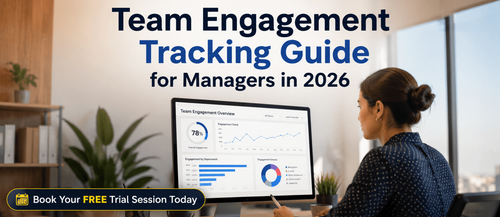
Team Engagement Tracking Guide for Managers in 2026

How to Track Team Engagement and Morale as a New Manager
Most new managers step into leadership focused on deliverables, deadlines, productivity, and performance reviews. While these areas matter, many overlook one of the most powerful drivers of long-term team success: engagement and morale.
A disengaged team rarely announces its struggles openly. Instead, warning signs appear gradually through quieter meetings, lower enthusiasm, reduced initiative, increased conflict, declining work quality, or emotional withdrawal. By the time most organisations notice the problem through annual surveys or retention issues, the damage has already been done.
The challenge is that many professionals are never taught how to systematically track engagement and morale. They rely on intuition, occasional conversations, or assumptions rather than structured observation and action.
This guidebook provides a practical engagement tracking system designed specifically for new managers. It introduces measurable frameworks, weekly tracking systems, reflection tools, conversation prompts, and intervention strategies that help leaders identify morale shifts early and respond effectively.
Whether you manage a team of three or thirty, work remotely or in-office, or are stepping into leadership for the first time, this guidebook offers a clear roadmap for building high-trust, high-energy teams through intentional leadership habits.
Download these resources and apply them alongside your daily work for improved clarity, productivity, and professional growth. You can also book a free trial to gain expert guidance and enhance your communication, problem-solving, and decision-making skills. The materials are designed in a clear, structured format to help professionals learn efficiently and implement insights with confidence.
Who Is This Blog For?
- First-time managers building leadership confidence
- Team leaders managing employee morale and engagement
- Startup founders leading growing teams
- HR professionals supporting people management
- Professionals transitioning into leadership roles
- Managers handling hybrid or remote teams
- Mid-career professionals improving leadership effectiveness
- Leaders seeking better employee retention and productivity
- Working professionals interested in people-first leadership
Why This Topic Matters Today?
Employee engagement directly affects productivity, retention, collaboration, innovation, and workplace culture. Yet many organisations still treat morale as a “soft” issue instead of a measurable business driver.
The guidebook highlights that research consistently shows managers account for at least 70% of the variance in employee engagement. This means leadership behaviour significantly shapes:
- Team motivation
- Trust levels
- Workplace energy
- Collaboration quality
- Employee retention
- Performance consistency
The guidebook also references Gallup research showing that highly engaged teams experience:
- 21% greater profitability
- 41% lower absenteeism
- 59% lower turnover
When managers fail to monitor engagement consistently:
- Burnout goes unnoticed
- High performers disengage quietly
- Team conflict escalates
- Productivity declines
- Employees emotionally disconnect from work
In fast-moving workplace environments, engagement tracking is no longer optional. It is a critical leadership skill.
Core Concept or Framework Explained
The guidebook introduces the PULSE Framework, a practical model for measuring engagement through five observable dimensions.
The PULSE Framework
P — Participation
Participation measures whether employees are actively contributing to team activities.
Managers should observe:
- Meeting participation
- Initiative-taking
- Collaboration levels
- Volunteer behaviour
- Contribution consistency
A noticeable drop in participation is often one of the earliest signs of disengagement.
U — Uplift
Uplift refers to the emotional energy within the team.
Managers should monitor:
- Enthusiasm
- Humour
- Positivity
- Team energy during discussions
- Emotional engagement
Energy is contagious. Both positive and negative emotional patterns spread quickly across teams.
L — Loyalty
Loyalty reflects whether employees:
- Support team goals
- Defend the team positively
- Collaborate under pressure
- Remain emotionally invested in shared success
The guidebook explains that loyalty often erodes quietly before visible performance problems emerge.
S — Safety
Psychological safety is the foundation of engagement.
Managers should assess whether employees feel comfortable:
- Speaking honestly
- Sharing concerns
- Asking questions
- Admitting mistakes
- Challenging ideas respectfully
Without safety, employees only communicate what feels politically safe rather than what is actually true.
E — Effort
Effort measures discretionary contribution beyond minimum requirements.
Signs of strong effort include:
- Proactive problem-solving
- Initiative
- Ownership
- Creative thinking
- Voluntary contribution
The guidebook identifies discretionary effort as one of the clearest indicators of genuine engagement.
How This Blog and Guidebook Help You?
This guidebook helps managers move beyond guesswork by introducing a repeatable engagement tracking system.
Key benefits include:
- Detecting morale issues early
- Improving team communication
- Strengthening leadership awareness
- Building stronger employee trust
- Reducing disengagement risks
- Improving retention of high performers
- Creating structured leadership habits
- Supporting healthier workplace culture
The guidebook also provides practical resources managers can apply immediately, including:
- Weekly engagement trackers
- Reflection worksheets
- Pulse survey templates
- Red-flag recognition systems
- One-on-one conversation prompts
- Engagement scoring systems
Instead of reacting only when problems escalate, leaders learn how to identify and address engagement shifts proactively.
Step-by-Step Breakdown
Step 1: Establish Your Baseline
The guidebook strongly recommends that new managers begin by observing before intervening.
During the first one to two weeks:
- Listen more than you speak
- Observe meeting dynamics
- Notice energy patterns
- Watch communication behaviours
- Identify existing tensions or strengths
The guidebook emphasises:
Your first job is not to fix everything immediately. Your first job is to understand the team accurately.
Managers are encouraged to maintain a private leadership journal with daily observations.
Step 2: Conduct Baseline One-on-One Conversations
The guidebook provides a question bank for initial conversations.
Sample questions include:
- What aspect of your work gives you the most energy?
- What has been frustrating recently?
- Do you feel your contributions are valued?
- What would improve your day-to-day work experience?
- Are there team dynamics I should understand?
The goal is to gather insight rather than perform formal evaluations.
Strong managers listen carefully without rushing into solutions.
Step 3: Score Team Engagement Using PULSE
Managers are encouraged to rate each team member weekly across all five dimensions.
The scoring system includes:
5 — Thriving
- High energy
- Strong initiative
- Open participation
4 — Engaged
- Positive
- Reliable
- Consistent contributor
3 — Neutral
- Stable but not highly energised
2 — Drifting
- Lower energy
- Reduced initiative
- Increased withdrawal
1 — Disengaged
- Reactive only
- Emotionally disconnected
- Clear signs of struggle
The guidebook explains that trends matter more than isolated scores.
A gradual decline across several weeks requires attention.
Step 4: Create a Weekly Engagement Tracking Ritual
One of the most practical sections of the guidebook introduces a 15-minute weekly management ritual.
The suggested process includes:
Open Last Week’s Tracker
Review previous scores and notes for context.
Score Team Members
Rate participation, uplift, loyalty, safety, and effort.
Identify One Action
Choose one specific engagement action for the coming week.
Document Observations
Write short notes about energy shifts, tensions, strengths, or behavioural changes.
The guidebook repeatedly stresses consistency over perfection.
Small weekly tracking habits create powerful long-term leadership awareness.
Step 5: Learn to Recognise Red Flags Early
The guidebook identifies several critical engagement warning signs.
Sudden Withdrawal
Examples include:
- Going quiet in meetings
- Reduced interaction
- Short responses
- Emotional distance
Recommended response:
Schedule a supportive private conversation within 48 hours.
Unexplained Productivity Decline
Examples include:
- Missed deadlines
- Lower quality work
- Reduced initiative
The guidebook advises managers to approach these situations with empathy rather than immediate performance criticism.
Increased Conflict or Irritability
Examples include:
- Passive-aggressive behaviour
- Short tempers
- Increased interpersonal tension
Managers are encouraged to address these dynamics quickly before they escalate.
Absenteeism Patterns
Repeated absences, late arrivals, or sudden schedule inconsistency often signal deeper engagement concerns.
The guidebook advises managers to look for patterns rather than isolated incidents.
Step 6: Run Monthly Pulse Checks
In addition to weekly observation, the guidebook recommends monthly anonymous pulse surveys.
Suggested survey questions include:
- How energised do you feel about work this month?
- Do you feel appreciated by your manager?
- What is making work harder than necessary?
- How supported do you feel by your team?
- What would improve your experience at work?
The guidebook strongly warns managers against collecting feedback without acting on it.
Trust grows only when leaders close the loop visibly.
Step 7: Share and Act on Feedback
After collecting pulse survey responses:
- Summarise themes
- Share insights with the team
- Acknowledge concerns openly
- Commit to specific improvements
- Follow up consistently
Example:
“Last month you mentioned communication delays. Here’s what we changed this month.”
This behaviour strengthens leadership credibility dramatically.
Real-World Leadership Example
The guidebook shares the story of Priya, a new marketing operations team leader.
The Situation
Within her first two weeks, Priya noticed:
- Quiet meetings
- Low camera participation
- Reduced initiative from a senior employee named Arjun
Instead of reacting immediately, she used the PULSE framework to establish a baseline.
What Priya Did
- Observed carefully before intervening
- Scheduled an informal check-in conversation
- Learned Arjun felt sidelined after organisational changes
- Assigned him meaningful campaign ownership
- Connected responsibilities to his strengths
- Continued tracking engagement consistently
The Results
Within six weeks:
- Arjun’s engagement scores improved significantly
- He became more proactive
- Team morale visibly increased
- Team collaboration strengthened
The guidebook highlights that consistent observation and thoughtful intervention created the shift — not dramatic leadership actions.
Common Mistakes or Pitfalls to Avoid
Relying Only on Gut Feeling
Assumptions often miss hidden disengagement.
Better approach:
Use structured observation systems consistently.
Waiting Too Long to Act
Small morale issues grow quickly when ignored.
Better approach:
Address noticeable shifts within days, not months.
Treating Engagement Like a Performance Problem
Disengagement is often rooted in:
- Burnout
- Lack of recognition
- Misalignment
- Poor communication
- Low psychological safety
Managers should begin with curiosity rather than criticism.
Ignoring Quiet Employees
Not all disengagement appears loudly.
The guidebook warns managers to pay close attention to subtle behavioural changes.
Collecting Feedback Without Follow-Up
Nothing damages trust faster than surveys that produce no visible action.
Always close the feedback loop.
Overreacting to Single Incidents
The guidebook reminds managers to focus on patterns rather than isolated behaviours.
How Should You Use This Guidebook Effectively?
This guidebook is designed as a practical weekly leadership tool rather than a one-time reading resource.
Weekly Usage
- Complete the engagement tracker every Friday
- Reflect on behavioural changes
- Identify one meaningful leadership action weekly
Monthly Usage
- Run pulse surveys
- Share findings transparently
- Implement small improvements consistently
Leadership Reflection
The included reflection worksheet encourages managers to evaluate:
- Team energy levels
- Missed signals
- Leadership blind spots
- Specific engagement actions
Recommended Workflow
- Spend 15 minutes weekly on tracking
- Spend 5–10 minutes documenting observations
- Conduct regular one-on-ones consistently
- Follow up quickly on engagement signals
The guidebook repeatedly reinforces one principle:
Consistent attention matters more than perfect leadership.
Key Takeaways
- Employee engagement is a measurable leadership responsibility
- Managers significantly influence team morale and productivity
- The PULSE Framework provides a structured engagement tracking system
- Early observation prevents larger performance and retention problems
- Weekly tracking habits improve leadership awareness dramatically
- Psychological safety is essential for honest communication
- Small behavioural shifts often signal deeper morale issues
- Monthly pulse surveys provide valuable qualitative insight
- Leaders must close the feedback loop consistently
- Strong engagement cultures are built through consistency, not occasional interventions
Your Next Step: Accelerate Your Career with PlanetSpark
Creating an impact-driven resume is not just about landing your next job—it’s about owning your professional story and presenting it with clarity, confidence, and credibility. When your resume clearly communicates value, results, and impact, opportunities follow naturally.
At PlanetSpark, we are committed to empowering working professionals with practical, outcome-focused resources that drive real career growth. From resume building and workplace communication to leadership presence and professional writing, our programs are designed to help you succeed in today’s fast-evolving job market.
Visit https://www.planetspark.in/resources to explore:
- Career and resume-building guides
- Workplace communication and professional writing resources
- Skill-development tools curated for working professionals
Want a deeper, hands-on experience?
You can also book a free trial session to learn more about PlanetSpark’s Working Professional Courses, designed to accelerate your career through personalised coaching, real-world practice, and expert guidance.
Your career deserves more than generic advice.
It deserves clarity, confidence, and measurable impact.
Personalized Communication Roadmaps
Record a video to get a AI generated personalized communication reports