
The Best Way to Create Personal Systems That Survive Disruptions

How to Build Personal Systems That Survive Disruptions and Keep Your Career on Track
In today’s fast-paced professional world, disruptions are no longer outliers—they are the baseline. Whether it's a sudden layoff, team restructuring, health challenges, or unexpected global events, these disruptions are a regular part of the modern professional’s life. But here’s the problem: most professionals are caught off-guard every time. Not because they lack the capability or intelligence, but because their systems for managing work, recovery, and productivity aren’t built to withstand shocks.
If you’ve ever found yourself struggling to regain momentum after a disruption—whether it took a few days or several weeks—you’re not alone. Most professionals report that it takes 3–6 weeks to get back to full productivity after a major setback. This isn’t a personal failure; it’s a systems failure. The systems that hold your productivity together weren’t designed to absorb disruptions.
This guide introduces the Disruption-Proof System (DPS)—a modular, flexible framework that will help you build resilience, recovery plans, and stable work systems, no matter what life throws at you. It’s not about doing more; it’s about designing systems that can bend without breaking. And the best part? You don’t need to be a productivity expert. You just need to invest 90 minutes, be open to auditing your current systems, and build something more durable for your future.
Download these resources and apply them alongside your daily work for improved clarity, productivity, and professional growth. You can also book a free trial to gain expert guidance and enhance your communication, problem-solving, and decision-making skills. The materials are designed in a clear, structured format to help professionals learn efficiently and implement insights with confidence.
Who Is This Blog For?
This blog is for professionals who face constant challenges in staying productive and resilient, including:
Career changers navigating professional uncertainty
Managers and team leaders adjusting to shifting team dynamics
Consultants managing fluctuating workloads
Early- to mid-career professionals grappling with disruptions
Freelancers and independent workers facing irregular client demands.
Why This Topic Matters Today?
The world is full of unpredictable disruptions, and today’s professional landscape demands that we be prepared for the unexpected. With the constant shift in job markets, technology, and global events, you cannot afford to have a fragile system. This blog highlights a key finding: professionals who proactively follow a structured approach to handle disruptions—through personal systems and recovery frameworks—succeed in maintaining momentum.
Effective disruption management ensures that you:
Stay visible and relevant even during career transitions
Maintain strong relationships through clear and consistent communication
Build long-term resilience that prepares you for inevitable setbacks
By understanding and applying the Disruption-Proof System (DPS), you can make your professional life more stable and adaptable in any situation.
Core Concept or Framework Explained
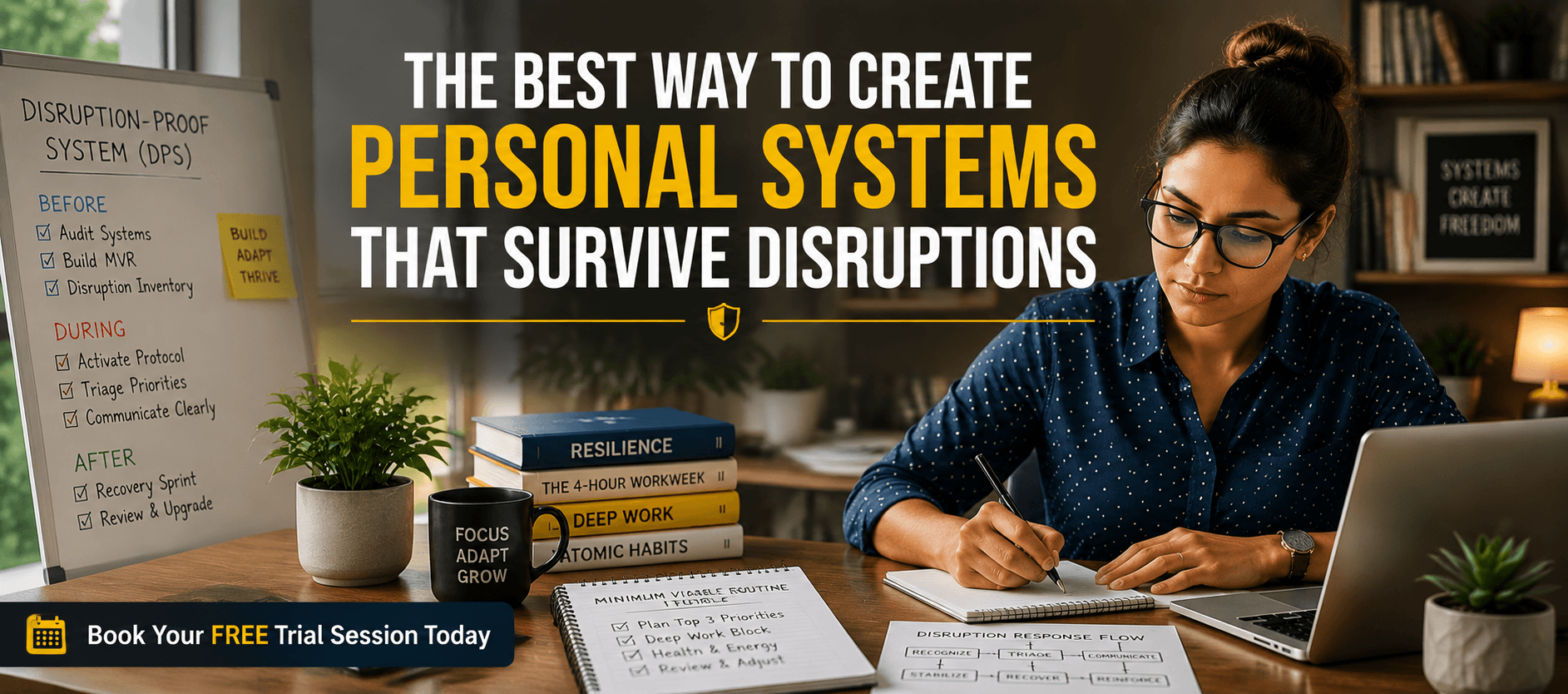
The Disruption-Proof System (DPS) is a framework designed to help professionals create robust systems that remain intact during periods of uncertainty. The system is broken into three phases:
Before (Prevention and Preparation)
Audit Your Current Systems: Identify what is working in your professional systems and where weaknesses lie. This self-assessment allows you to spot any single points of failure before they cause disruptions.
Build Your Minimum Viable Routine (MVR): Create a routine that works under stress—something simple, but effective, that keeps you productive during tough times.
The Disruption Inventory: Map out potential vulnerabilities, such as career shifts, health issues, and environmental changes. Understanding your weaknesses helps you prepare for when things go wrong.
During (Triage and Stabilization)
Activate Your Disruption Protocol: This is your preset response to any disruption. You don’t want to be making decisions in the heat of the moment. Instead, you activate a pre-designed protocol to help you manage the disruption effectively.
Triage Your Priorities: Use the 3-Stack Method to sort your tasks by importance: Critical Hold, Intelligent Pause, and Honest Drop. This helps you focus on what truly matters when everything feels urgent.
Communicate Through Disruption: A clear and concise communication strategy with stakeholders is critical. Use the 3-part formula to communicate your capacity changes, what you’ll still deliver, and when to expect updates.
After (Recovery and Reinforcement)
Run a Recovery Sprint: After a disruption, gradually reintroduce tasks and systems to prevent burnout. This phased approach allows you to rebuild stronger and more sustainably.
The Post-Disruption Review: After the disruption ends, review your systems. What worked? What failed? This process allows you to learn from the disruption and make upgrades for future resilience.
How This Blog and Guidebook Help You?
By following the DPS framework and reading this blog, you’ll:
Gain a clear understanding of your current work systems and their vulnerabilities
Develop a Minimum Viable Routine (MVR) that ensures you remain productive even during stressful times
Learn how to manage disruptions in a structured, intentional way
Build communication strategies that maintain your professional reputation during disruptions
Reinforce your systems after every disruption, making you more resilient with each challenge.
Step-by-Step Breakdown:
Step 1: Post-Interview Thank You
Sending a follow-up within 24 hours reinforces your interest in the role and reminds the hiring manager of your skills. Use the template to personalize your message and reference specific discussions from the interview.
Step 2: Networking Event Follow-Up
After meeting someone at an event, send a concise follow-up email, mentioning the event and a specific topic discussed. Offer value before asking for anything, keeping the message focused on building a lasting connection.
Step 3: Cold Outreach to Recruiters
Reach out to recruiters proactively by introducing yourself, your skills, and your areas of interest. Keep it concise and professional, avoiding lengthy introductions.
Step 4: Application Status Follow-Up
If you haven’t heard back after applying, follow up 7–10 days later. Reinforce your interest and add any relevant updates about the company or position to show you’re staying engaged.
Step 5: Referral Introduction Response
Thank the person who referred you, introduce yourself clearly, and suggest the next steps. A quick response within 24 hours demonstrates your professionalism.
Step 6: LinkedIn Connection Request
Send a personalized message when requesting to connect on LinkedIn, referencing a shared interest or context. This significantly increases the acceptance rate of your requests.
Step 7: Reconnecting with a Former Colleague
Rebuild connections with past colleagues by offering a casual update on your career. A warm, friendly approach is more likely to rekindle meaningful communication.
Step 8: Informational Interview Request
Request informational interviews to learn about new industries or roles. Focus on learning, not asking for a job, and ask specific, thoughtful questions.
Step 9: Proposal or Project Follow-Up
For freelancers and consultants, send a polite follow-up about your proposal or project to keep the conversation moving forward. Be clear about your deliverables and maintain professionalism.
Step 10: Career Switch Outreach
When switching careers, emphasize your transferable skills and research the industry thoroughly before reaching out. Be clear about your motivations and interests.
Common Mistakes or Pitfalls to Avoid
Avoid these common mistakes in your follow-up communication:
Generic Messaging: Always personalize your emails by referencing specific interactions.
Vague Subject Lines: Avoid ambiguous subject lines like “Checking In”. Instead, use specific subject lines like “Following Up on Interview – [Company Name]”.
Apologizing Unnecessarily: Focus on confidence, not apology. Your message should reflect your commitment and professionalism.
Asking for Too Much: Keep your message concise and focus on one clear ask.
Excessive Follow-Ups: Be patient. If you haven’t received a response, wait before following up again.
How Should You Use This Guidebook Effectively?
To maximize the impact of this guidebook:
Audit your current systems and identify areas for improvement.
Build your Minimum Viable Routine (MVR) to ensure you stay productive during disruptions.
Implement the Disruption Protocol for immediate action when a disruption strikes.
Continuously review and reinforce your systems after each disruption.
The time investment is minimal—just 5–10 minutes per email using the templates—but the long-term benefits to your professional life are immense.
Key Takeaways:
Disruptions are inevitable—plan for them, don’t just react.
Personalization in communication increases response rates.
Use the 3-Stack Method to prioritize tasks during disruptions.
A clear, confident communication strategy is key to protecting your professional reputation.
Recovery is not about returning to full capacity immediately—gradual re-entry is crucial.
Review and upgrade your systems after each disruption to build resilience.
Your Next Step: Accelerate Your Career with PlanetSpark
Creating an impact-driven resume is not just about landing your next job—it’s about owning your professional story and presenting it with clarity, confidence, and credibility. When your resume clearly communicates value, results, and impact, opportunities follow naturally.
At PlanetSpark, we are committed to empowering working professionals with practical, outcome-focused resources that drive real career growth. From resume building and workplace communication to leadership presence and professional writing, our programs are designed to help you succeed in today’s fast-evolving job market.
Visit https://www.planetspark.in/resources
to explore:
Career and resume-building guides
Workplace communication and professional writing resources
Skill-development tools curated for working professionals.
Want a deeper, hands-on experience?
You can also book a free trial session to learn more about PlanetSpark’s Working Professional Courses, designed to accelerate your career through personalized coaching, real-world practice, and expert guidance.
Your career deserves more than generic advice.
It deserves clarity, confidence, and measurable impact.
Start building that advantage today—with PlanetSpark.
Personalized Communication Roadmaps
Record a video to get a AI generated personalized communication reports