
The Ultimate Canvas for Planning Professional Resume Content
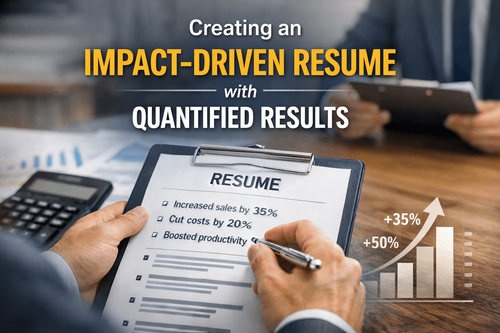

Creating an Impact-Driven Resume with Quantified Results: A Practical Guide for Career Acceleration
Most professionals assume their resumes fail because they lack the right experience or technical skills. In reality, the problem is usually much simpler: the resume does not clearly communicate impact.
Recruiters typically spend only six to eight seconds scanning a resume before deciding whether to continue reading. In that brief moment, they are not analysing every detail. They are scanning for signals of relevance, credibility, and results. If those signals are missing, the resume is set aside before the candidate ever receives a real evaluation.
The challenge is that many resumes read like job descriptions rather than professional success stories. They list responsibilities, describe daily tasks, and mention collaboration with teams. While these details may be accurate, they rarely demonstrate value.
This is where an impact-driven resume changes everything. Instead of describing duties, it shows outcomes. It communicates what improved, what was solved, and what measurable results were achieved.
The PlanetSpark Professional Resume Content Planning Canvas was created to address this exact challenge. It helps professionals extract, organise, and prioritise the most important evidence from their careers before writing a single line of the final resume.
This blog translates the canvas and its structured planning process into a practical guide that professionals can apply immediately to build stronger, more effective resumes. Book your free trial session today with Planetspark.
Download for more details or PDF file.
Who Is This Blog For?
This blog and the accompanying guidebook
are designed for:
- Working professionals with 0–15 years of experience seeking faster career growth
- Career changers repositioning their experience for new industries or roles
- Mid-career professionals targeting promotions or leadership positions
- Consultants and specialists building a stronger professional narrative
- Job seekers receiving few interview callbacks despite strong experience
- Time-constrained professionals who want a structured resume-building process.
Why This Topic Matters Today?
Hiring processes have evolved dramatically in the last decade. Recruiters now evaluate large volumes of resumes quickly using both human scanning and automated screening systems.
In this environment, resumes that simply list responsibilities rarely stand out. They provide activity but not evidence of value.
The Professional Resume Content Planning Canvas explains that the biggest problem with most resumes is not formatting, font choice, or document length. The real issue is content planning. Many professionals begin writing their resumes without first identifying the most important achievements, results, and career narratives that should be highlighted. :contentReference[oaicite:1]{index=1}
As a result, their resumes become generic summaries of work history rather than persuasive professional stories.
Employers, however, are not just evaluating what candidates have done. They are asking a more important question: what impact will this person create if we hire them?
A resume that answers that question clearly and quickly immediately earns attention.
Core Concept or Framework Explained:
The foundation of an impact-driven resume is a mindset shift from responsibilities to results.
Traditional resumes focus on what a professional was hired to do. Impact-driven resumes focus on what changed because of their work.
The guidebook introduces a structured approach to building powerful resume content using achievement frameworks such as CAR and STAR-style storytelling. These frameworks help transform routine work into clear, persuasive evidence of performance.
The CAR framework, for example, structures achievements into three components:
- Challenge: the problem, situation, or goal that existed
- Action: the specific steps taken to address that challenge
- Result: the measurable outcome achieved
Using this structure ensures that every resume bullet demonstrates real value.
For example:
Weak bullet
Responsible for managing social media accounts and publishing content.
Stronger CAR-based bullet
Rebuilt dormant social media presence by launching a structured content calendar and publishing three weekly posts, increasing LinkedIn followers by 180 percent within one quarter.
The difference is not the work itself. The difference is how the work is presented.
How This Blog and Guidebook Help You?
By applying the frameworks and exercises from the guidebook, professionals can transform their resumes into clear, results-driven career narratives.
The guidebook helps you:
- Identify hidden achievements across your career history
- Extract measurable outcomes from everyday work
- Build a library of strong achievement statements
- Align your resume content with specific job targets
- Structure your resume for faster recruiter scanning
- Present your experience as evidence of value
The outcome is a resume that communicates impact in seconds and positions you as a credible, results-oriented professional.
Step-by-Step Breakdown:
Step 1: Define Your Target Role Before Writing
The first step in building a strong resume is not writing at all. It is defining exactly where you want your career to go.
The planning canvas emphasises that effective resumes are written backwards. Instead of starting with your past experience, you begin by defining the role you want next. :contentReference[oaicite:2]{index=2}
This step involves analysing two or three job descriptions for positions you genuinely want and identifying common signals within them.
Key elements to capture include:
- Target role title
- Industry or sector
- Company size or type
- Skills repeatedly mentioned in job descriptions
- Outcomes employers expect candidates to deliver
- Keywords used in those job listings
This exercise shifts your resume from a retrospective document that lists past work to a prospective document that shows exactly what you bring to a specific role.
Step 2: Mine Your Career History for Achievements
Many professionals underestimate their own accomplishments because they focus only on job titles and responsibilities.
The second step of the planning canvas encourages professionals to perform a career excavation exercise. Instead of editing immediately, you gather as much raw material as possible from your experience.
Important areas to explore include:
- Projects you led or contributed to
- Problems you solved or inefficiencies you fixed
- Revenue generated or costs saved
- Teams managed or stakeholders influenced
- Systems, tools, or processes implemented
- Recognition, feedback, or awards received
At this stage, volume is more important than perfection. The goal is to create a detailed inventory of achievements that can later be shaped into resume content.
Step 3: Build Strong Achievement Statements
Once the raw material is collected, the next step is transforming achievements into powerful bullet points.
The CAR framework helps structure these statements clearly:
Challenge
Briefly describe the situation or problem.
Action
Explain the steps you took.
Result
Highlight the measurable outcome.
For example:
Weak statement
Managed vendor relationships.
Strong statement
Identified delays in vendor invoicing by analysing internal workflows, redesigned approval processes, and reduced processing time from 21 days to 6 days, saving ₹18 lakh annually.
This approach transforms generic descriptions into concrete evidence of performance.
The guidebook recommends building a bullet bank of 20 to 30 strong achievement statements across your career. These statements can then be reused and customised across resumes, cover letters, and LinkedIn profiles.
Step 4: Structure Your Resume Strategically
Once achievements are written, the next step is organising them effectively.
Resume structure determines how quickly recruiters understand your value.
The guidebook outlines three primary resume structures:
- Chronological structure presenting experience in reverse order
- Hybrid structure combining skills and experience
- Functional structure grouping achievements by skill area
For most professionals, particularly career changers, the hybrid format is the most effective because it highlights relevant skills before the job timeline.
A strong resume architecture typically includes:
- Professional summary highlighting your value proposition
- Core competencies aligned with the target role
- Professional experience supported by achievement bullets
- Education and certifications
This structure ensures recruiters immediately see your most relevant strengths.
Step 5: Write a High-Impact Professional Summary
The professional summary is the most valuable section of the resume because it appears at the top and shapes the reader's first impression.
The planning canvas recommends writing a focused four-line summary that clearly answers why the recruiter should keep reading.
A strong summary includes:
- Who you are and your experience level
- What you are known for professionally
- Your key skills or areas of expertise
- Your forward career direction and value to the next role
For example:
Marketing manager with seven years of B2B SaaS experience known for building scalable content programmes that drive measurable pipeline growth. Skilled in data-driven campaign strategy, cross-functional collaboration, and stakeholder communication. Seeking a senior product marketing role where strategic storytelling and analytical insight deliver business impact.
This concise pitch sets context and positions the candidate strategically.
Common Mistakes or Pitfalls to Avoid:
Even experienced professionals often make predictable resume mistakes.
The guidebook highlights several of the most common issues:
- Using the same generic resume for every application
- Listing responsibilities instead of achievements
- Writing vague statements without measurable results
- Using cliché phrases such as results-driven professional
- Hiding transferable skills beneath unrelated job titles
- Mixing inconsistent verb tenses
- Writing overly long resumes without clear prioritisation
Each of these mistakes weakens credibility and reduces the likelihood of getting interviews.
Avoiding them significantly improves the clarity and effectiveness of your resume.
How Should You Use This Guidebook Effectively?
The guidebook is designed as a practical worksheet rather than just a reference document.
It can be used in three different ways:
- Read-through approach to understand the full framework
- Reference approach for specific modules such as achievement building
- Worksheet approach where you complete every canvas section before drafting your resume
The most effective workflow typically includes:
- Completing the target role profile first
- Scheduling a focused session to perform career excavation
- Writing multiple CAR achievement bullets
- Drafting your professional summary
- Auditing your resume against the common mistakes checklist
Most professionals can implement the full framework within two to three focused hours.
Key Takeaways:
- The biggest problem with most resumes is lack of content planning
- Impact-driven resumes focus on results rather than responsibilities
- The CAR framework helps convert work experience into measurable achievements
- Defining your target role improves resume relevance and clarity
- Building an achievement bullet bank prevents starting from scratch each time
- The hybrid resume structure works well for most professionals
- A clear four-line professional summary improves first impressions
- Avoid generic language and prioritise quantifiable results.
Your Next Step: Accelerate Your Career with PlanetSpark
Creating an impact-driven resume is not just about landing your next job—it’s about owning your professional story and presenting it with clarity, confidence, and credibility. When your resume clearly communicates value, results, and impact, opportunities follow naturally.
At PlanetSpark, we are committed to empowering working professionals with practical, outcome-focused resources that drive real career growth. From resume building and workplace communication to leadership presence and professional writing, our programs are designed to help you succeed in today’s fast-evolving job market.
Visit https://www.planetspark.in/resources to explore:
- Career and resume-building guides
- Workplace communication and professional writing resources
- Skill-development tools curated for working professionals.
Want a deeper, hands-on experience?
You can also book a free trial session to learn more about PlanetSpark’s Working Professional Courses, designed to accelerate your career through personalised coaching, real-world practice, and expert guidance.
Your career deserves more than generic advice.
It deserves clarity, confidence, and measurable impact.
Start building that advantage today—with PlanetSpark.
Personalized Communication Roadmaps
Record a video to get a AI generated personalized communication reports