
The Ultimate Guide to Long-Term Time Management Strategies
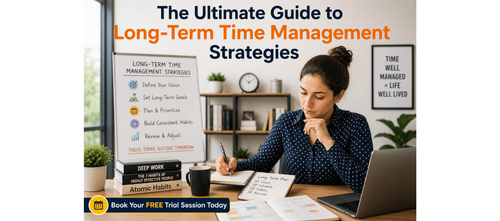

Sustainable Term Time Management Strategy: A Practical Guide to Align Your Time with Career Goals and Achieve Sustainable Productivity
You respond to emails quickly. You attend every meeting. Your calendar is full, and your task list never ends. Yet, at the end of the week, there is a lingering frustration—your most important goals remain untouched.
This is the reality for many working professionals today. Being busy has become the norm, but meaningful progress has become rare. Career transitions get delayed, strategic projects stay incomplete, and long-term growth feels like something you will “get to later.”
The problem is not a lack of effort. It is a lack of direction.
This is exactly where a long-term time management strategy becomes critical. Instead of optimizing how you work day-to-day, it helps you align your time with where you want to be months or even years from now. The Long-Term Time Management Strategy Guide provides a structured, practical system to move from reactive busyness to intentional progress.
Download these resources and apply them alongside your daily work for improved clarity, productivity, and professional growth. You can also book a free trial to gain expert guidance and enhance your communication, problem-solving, and decision-making skills. The materials are designed in a clear, structured format to help professionals learn efficiently and implement insights with confidence.
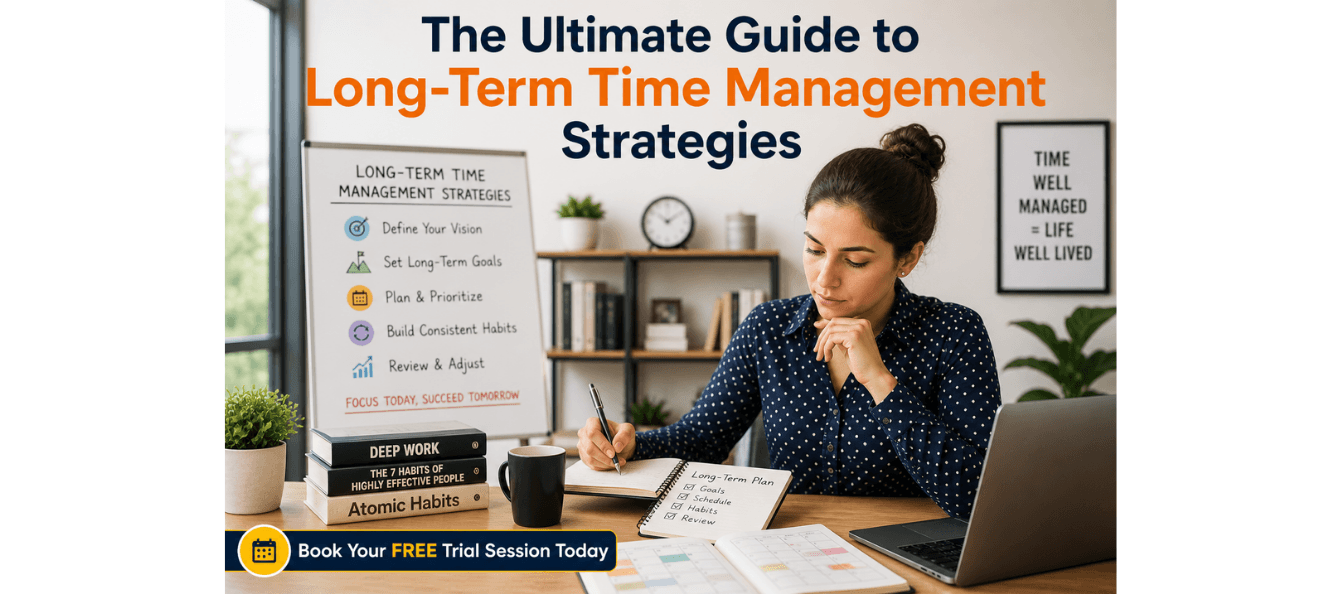
Who Is This Blog For?
- Working professionals managing demanding roles and struggling to prioritise long-term goals
- Career switchers trying to build new skills alongside full-time work
- Managers and consultants dealing with constant meetings and reactive tasks
- Early to mid-career professionals aiming for structured career growth
- Individuals who feel productive daily but lack meaningful long-term progress
Why This Topic Matters Today?
Modern work environments reward responsiveness over reflection. Professionals are expected to reply instantly, attend frequent meetings, and handle constant interruptions. As a result, reactive work dominates the day.
The guide highlights a critical gap: most professionals underestimate time spent on emails, meetings, and interruptions, while overestimating time spent on deep, high-impact work. In reality, deep work often amounts to less than two focused hours per day.
This imbalance creates a dangerous pattern. Short-term tasks get completed efficiently, but long-term goals—like career transitions, skill development, or strategic initiatives—are consistently postponed.
Without a structured long-term strategy, professionals become more efficient at doing the wrong things.
Core Concept
At the heart of the guide is a simple but powerful idea: time management is not about doing more, but about doing the right things consistently.
The framework is built on five core pillars:
- Awareness through Time Audit
- Direction through Three Horizons Vision
- Structure through Ideal Week Design
- Focus through Priority Clarity System
- Sustainability through Energy and Review Systems
One of the most important frameworks introduced is the Three Horizons model:
- Horizon 1 (90 days): Immediate execution and short-term outcomes
- Horizon 2 (12 months): Skill-building and career progression
- Horizon 3 (3 to 5 years): Long-term direction and professional identity
This model ensures that your daily work connects to a larger purpose, preventing drift and maintaining alignment across timeframes.
How This Blog and Guidebook Help You?
By applying the concepts from this guide, you can:
- Gain clarity on how your time is actually spent
- Align daily work with long-term career goals
- Reduce overwhelm caused by reactive tasks
- Improve focus and deep work capability
- Make better decisions about priorities and commitments
- Build consistent progress on meaningful goals
- Avoid burnout through sustainable productivity systems
The result is not just better time management—it is a more intentional and controlled professional life.
Step-by-Step Breakdown
Step 1: Understand Your Time Reality
Before making any changes, the guide emphasises conducting a Time Audit. This involves tracking your activities in 30-minute blocks over a week.
Tasks are categorised into four types:
- Deep Work: High-value, focused tasks requiring full attention
- Shallow Work: Routine tasks like emails and admin
- Reactive Time: Interruptions and urgent requests
- Wasted Time: Low-value activities and distractions
This process reveals the gap between perceived and actual time usage. It becomes the foundation for all future improvements.
Step 2: Define Your Long-Term Time Vision
Once you understand your current reality, the next step is defining where you want to go.
Using the Three Horizons framework, you identify:
- A 90-day priority goal
- Key outcomes for the next 12 months
- Your ideal professional identity in 3 to 5 years
This step transforms vague ambitions into actionable direction. It also introduces the concept of a North Star Statement—a single sentence that guides all major time decisions.
Step 3: Design Your Ideal Week Architecture
The guide then moves into structuring your week intentionally.
An Ideal Week is not a rigid schedule but a framework that ensures priority work gets protected time.
It is built using three principles:
- Time Theming: Group similar tasks together
- Energy Matching: Align tasks with peak focus hours
- Buffer Architecture: Build flexibility into your schedule
For example, deep work is scheduled during peak energy hours, while meetings are batched into specific days.
Step 4: Apply the Priority Clarity System
Having time blocks is not enough—you must fill them with the right tasks.
The Priority Clarity System uses three filters:
- Impact: Does this task create meaningful value?
- Alignment: Does it support your current goals?
- Timing: When should this task actually be done?
This system ensures that your best hours are spent on high-impact work rather than urgent but low-value tasks.
A practical daily habit introduced here is the Top 3 method—identifying three key tasks each day that drive meaningful progress.
Step 5: Build Sustainable Focus Systems
The guide emphasises that focus is not accidental—it must be designed.
It introduces three environments for focus:
- Physical Environment: Dedicated workspace and minimal distractions
- Digital Environment: Controlled notifications and app usage
- Psychological Environment: Focus rituals and mental readiness
Structured work cycles are also recommended, such as 60 to 90 minutes of focused work followed by recovery breaks.
Step 6: Implement the Quarterly Review System
Long-term progress requires regular reflection.
Every 90 days, a structured review helps you:
- Evaluate what worked and what did not
- Identify patterns and inefficiencies
- Adjust systems and priorities
- Set the next 90-day goal
This ensures that your strategy evolves with new insights and changing circumstances.
Step 7: Manage Energy, Not Just Time
The guide highlights a critical shift—productivity depends more on energy than time.
It identifies four types of energy:
- Physical energy from sleep and health
- Emotional energy from relationships and boundaries
- Mental energy from focus and cognitive load
- Purposive energy from meaningful work
Managing these ensures sustained performance rather than short bursts of productivity.
Step 8: Protect Your Time from Common Disruptions
The guide identifies five major time thieves:
- Meeting overload
- Constant communication expectations
- Overcommitting to tasks
- Digital distractions
- Perfectionism
Each comes with a practical defence strategy, such as setting response windows or auditing meetings regularly.
Common Mistakes
The guide highlights several common mistakes professionals make:
- Designing a perfect schedule but failing to defend it
- Setting goals but forgetting them during busy periods
- Skipping weekly or quarterly reviews
- Trying to implement too many changes at once
- Confusing busyness with productivity
The key solution is simple: focus on consistency rather than perfection. Even 60 to 70 percent execution of the system produces strong results.
How Should You Use This Guidebook Effectively?
To get the best results, follow a phased approach:
- Week 1: Conduct a complete time audit
- Week 2: Define your Three Horizons vision
- Week 3: Design your Ideal Week structure
- Week 4 onward: Apply priority filters and weekly reviews
Time investment:
- Daily: 5 minutes for Top 3 tasks
- Weekly: 20 to 30 minutes for planning
- Quarterly: 2 to 3 hours for review
The key is to build one habit at a time rather than attempting everything simultaneously.
Key Takeaways
- Data comes before strategy—always start with a time audit
- Align your time across 90 days, 12 months, and 3 to 5 years
- Design your week before demands take over your schedule
- Prioritise impact over urgency
- Protect your energy as much as your time
- Identify and eliminate key time drains
- Review and refine your system regularly
- Consistency matters more than perfection
Your Next Step: Accelerate Your Career with PlanetSpark
Creating an impact-driven resume is not just about landing your next job—it’s about owning your professional story and presenting it with clarity, confidence, and credibility. When your resume clearly communicates value, results, and impact, opportunities follow naturally.
At PlanetSpark, we are committed to empowering working professionals with practical, outcome-focused resources that drive real career growth. From resume building and workplace communication to leadership presence and professional writing, our programs are designed to help you succeed in today’s fast-evolving job market.
Visit https://www.planetspark.in/resources to explore:
- Career and resume-building guides
- Workplace communication and professional writing resources
- Skill-development tools curated for working professionals
Want a deeper, hands-on experience?
You can also book a free trial session to learn more about PlanetSpark’s Working Professional Courses, designed to accelerate your career through personalised coaching, real-world practice, and expert guidance.
Your career deserves more than generic advice.
It deserves clarity, confidence, and measurable impact.
Personalized Communication Roadmaps
Record a video to get a AI generated personalized communication reports