
The Ultimate Strategic Thinking Checklist for 2026 Success
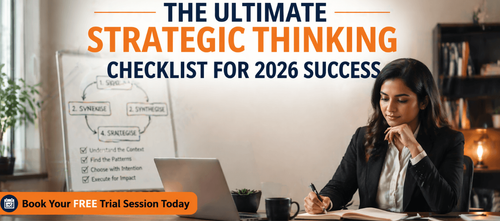

Strategic Thinking for Career Growth and Success
In today’s fast-paced work environment, most professionals focus on completing tasks and meeting deadlines. While execution is essential, it’s strategic thinking that differentiates those who rise through the ranks from those who plateau. Strategic thinkers can see beyond immediate issues, connect the dots others miss, and make decisions that compound over time.
If you’re looking to accelerate your career, mastering strategic thinking is a must. This blog draws from our Strategic Thinking Checklist to provide you with actionable steps to develop this invaluable skill.
Download these resources and apply them alongside your daily work for improved clarity, productivity, and professional growth. You can also book a free trial to gain expert guidance and enhance your communication, problem-solving, and decision-making skills. The materials are designed in a clear, structured format to help professionals learn efficiently and implement insights with confidence.
Who Is This Blog For?
This blog and the accompanying checklist are designed for:
- Professionals aiming for career advancement into leadership or strategic roles
- Consultants and managers looking to develop a strategic mindset for client work or internal decisions
- Job seekers and career changers who want to stand out by demonstrating their strategic acumen
- Individuals facing complex challenges and seeking a methodical approach to decision-making
Why This Topic Matters Today?
The ability to think strategically is becoming increasingly important across all industries. As the workplace becomes more complex, the skills needed to make long-term, impactful decisions have evolved. Strategic thinking is what allows professionals to navigate ambiguity and make choices that lead to sustained success.
Strategic thinking enables you to:
- Identify key challenges and opportunities
- Make more deliberate, informed decisions
- Prioritize effectively in high-stakes situations
Without a strategic mindset, you risk reacting impulsively to the demands of the day rather than addressing the most critical challenges that will drive long-term growth.
Core Concept or Framework Explained
At the heart of the Strategic Thinking Checklist is the 4-Phase Strategic Thinking System. This system provides a repeatable framework for tackling any strategic challenge.
- Phase 1: Sense
Before making decisions, it’s crucial to gather accurate inputs. This means scanning your environment to understand market trends, stakeholder interests, and the assumptions you might be operating under.
- Phase 2: Synthesise
Raw information is not insight. Synthesis involves connecting the dots, finding patterns, and asking the right questions like "What does this mean?" to uncover actionable insights.
- Phase 3: Strategise
Once you have a clear understanding, you generate strategic options. It’s not just about picking the easiest or safest option but making conscious trade-offs that align with your broader goals.
- Phase 4: Sequence
Great strategy requires effective execution. This phase ensures that your strategic decisions translate into actions that are prioritized and sequenced for maximum impact.
By following this 4-phase system, you can ensure that your decision-making process is strategic, methodical, and aligned with long-term objectives.
How This Blog and Guidebook Help You?
This blog and checklist will help you:
- Cultivate a strategic mindset that informs every decision you make
- Break down complex challenges into manageable steps with clear focus
- Align short-term actions with long-term career goals
- Develop the ability to execute strategy effectively and consistently
- Boost your influence by demonstrating strategic thinking in meetings, interviews, and team discussions
Step-by-Step Breakdown
Step 1: Sense — Understand Before You Conclude
In this phase, it’s essential to map the context before jumping to solutions. This involves identifying stakeholders, understanding the external forces at play, and questioning your assumptions.
For example, Priya, a project manager, was struggling to make a career transition. By mapping out her stakeholders (managers, peers, and hiring managers) and recognizing her assumptions, she gained clarity about what was holding her back.
Step 2: Synthesise — Find the Pattern, Not Just the Data
This step involves identifying the root causes of the challenge. It’s important to use frameworks such as MECE thinking or first principles to organize your analysis.
For Priya, the pattern revealed that her career constraint was not a lack of technical skills but confidence. This insight allowed her to move forward with clarity.
Step 3: Strategise — Choose With Intention
With a clear understanding of the situation, generate at least three distinct options and evaluate them. Deliberately choose a course of action, understanding what you are prioritizing and what you are deprioritizing.
In Priya’s case, she generated multiple options and chose to apply externally for roles while upgrading her skills through a targeted course — a conscious decision aligned with her career goals.
Step 4: Sequence — Translate Strategy Into Action
The key to turning strategy into results is execution. Identify the critical path — actions that must happen first — and assign owners and deadlines for accountability.
Priya’s execution plan involved updating her LinkedIn, reaching out to contacts, and applying for roles in the next couple of weeks. This structured approach led her to a Senior PM role within 11 weeks.
Common Mistakes or Pitfalls to Avoid
The guidebook highlights several common mistakes in strategic thinking:
- Jumping to Solutions: Always begin with a clear sense of the problem before forming solutions.
- Confusing Busyness with Strategy: A full calendar is not a strategy. Always be clear on your top priorities.
- Analysis Paralysis: Overthinking without committing to action can delay progress.
- Strategy Without Sequence: Great strategies fail when execution is not carefully sequenced.
- Working in Isolation: Build feedback loops throughout the strategic process, not just at the end.
How Should You Use This Guidebook Effectively?
To use this checklist effectively:
1. Read through the entire checklist for foundational understanding.
2. Complete the phases sequentially for a specific challenge you’re facing.
3. Allocate focused time (e.g., 2-3 hours) to implement this checklist and make decisions based on it.
4. Revisit the guide regularly to refine your strategic thinking and enhance your decision-making processes.
Key Takeaways
- Strategy is a discipline, not a trait. Anyone can learn to think strategically with practice.
- Break down challenges into manageable phases: Sense, Synthesise, Strategise, and Sequence.
- Focus on clarity and prioritization to align your short-term actions with long-term career growth.
- Avoid common strategic mistakes by maintaining clarity on your goals and staying committed to your strategy.
Your Next Step: Accelerate Your Career with PlanetSpark
Strategic thinking is essential not only for making better decisions but also for driving long-term career growth. By mastering this skill, you can elevate your influence, make smarter choices, and achieve greater success in your professional journey.
At PlanetSpark, we are committed to empowering working professionals with practical, outcome-focused resources that drive real career growth. From strategic thinking and leadership development to professional writing and communication, our programs are designed to help you succeed in today’s fast-evolving job market.
Visit https://www.planetspark.in/resources to explore:
- Career development guides
- Leadership and communication resources
- Skill-enhancement tools for professionals
Want a deeper, hands-on experience?
You can also book a free trial session to learn more about PlanetSpark’s Working Professional Courses, designed to accelerate your career through personalised coaching, real-world practice, and expert guidance.
Your career deserves more than generic advice.
It deserves clarity, confidence, and measurable impact.
Start building that advantage today—with PlanetSpark.
Personalized Communication Roadmaps
Record a video to get a AI generated personalized communication reports