
The Ultimate Strategic Thinking Roadmap for Professionals

Maximizing Career Potential Through Strategic Thinking: A Practical Guide
In today's fast-paced world, technical expertise alone is no longer enough to move ahead in your career. Strategic thinking—the ability to look beyond immediate tasks and foresee the bigger picture—has become the key differentiator between strong individual contributors and trusted leaders. This blog post dives into actionable strategies from the "Strategic Thinking Improvement Roadmap," designed to help you shift from being reactive to becoming a proactive, strategic thinker who drives long-term value.
Download these resources and apply them alongside your daily work for improved clarity, productivity, and professional growth. You can also book a free trial to gain expert guidance and enhance your communication, problem-solving, and decision-making skills. The materials are designed in a clear, structured format to help professionals learn efficiently and implement insights with confidence.
Who Is This Blog For?
- Working professionals eager to level up their leadership and strategic thinking skills
- Managers and team leaders who wish to move from reactive to proactive decision-making
- Mid-career professionals looking to break through the career ceiling by adopting strategic thinking
- Job seekers and career changers who want to showcase strategic thinking in interviews
- Consultants and advisors aiming to enhance their influence and provide more value to clients
Why This Topic Matters Today?
Strategic thinking is no longer just an optional skill for high-level leaders—it's essential at every level of the organization. As professionals move up in their careers, being excellent at the technical aspects of their jobs is no longer sufficient. To stand out, you need to demonstrate your ability to think bigger, make smarter decisions, and lead with clarity. This ability to think strategically is the key to navigating complex challenges, driving meaningful results, and influencing decision-makers across departments.
In the guide, it’s emphasized that professionals who understand strategic thinking become invaluable assets to their organizations. They are the ones who can see the long-term impact of their decisions, which positions them as indispensable players in any team.
Core Concept or Framework Explained
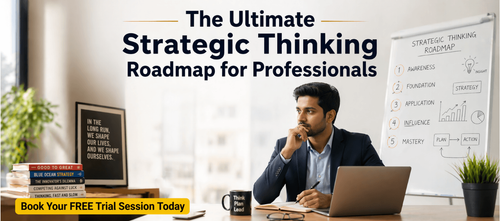
Strategic thinking is the ability to go beyond immediate tasks, anticipate future challenges, and align actions with long-term goals. The "Strategic Thinking Improvement Roadmap" provides a structured, five-phase approach to building this crucial skill.
Here are the five phases of this roadmap:
1. Awareness – Understand how you currently think and where your decision-making stands.
2. Foundation – Learn the core frameworks every strategic thinker needs.
3. Application – Start applying strategic thinking in real, everyday situations.
4. Influence – Learn how to lead and persuade others strategically.
5. Mastery – Embed strategic habits into your daily work rhythm.
This roadmap emphasises that strategic thinking is a learned skill—not an innate trait. Anyone can develop it by practising the right frameworks and habits consistently.
How This Blog and Guidebook Help You?
This blog, combined with the "Strategic Thinking Improvement Roadmap," helps you:
- Develop self-awareness around your current thinking patterns and move from a reactive to a proactive mindset
- Build a toolkit of strategic frameworks to help you think more critically and plan long-term
- Apply strategic thinking in your day-to-day decisions, meetings, and leadership moments
- Influence others by communicating your strategic ideas effectively and persuasively
- Integrate strategic thinking into your daily habits and routines, ensuring continuous improvement
By following this guide, you’ll start making better decisions, influencing key stakeholders, and leading with clarity.
Step-by-Step Breakdown
Phase 1 — Awareness: Understanding How You Currently Think
The first step in strategic thinking is becoming aware of your current thought patterns. Reflect on questions such as:
- How often do you make decisions based on urgency vs. importance?
- Are you spending enough time on long-term goals (H2, H3 thinking) rather than just addressing immediate problems (H1 thinking)?
- Do you actively consider second-order consequences when making decisions?
Use the provided Phase 1 Reflection Worksheet to audit your thinking patterns and establish a clear starting point for growth.
Phase 2 — Foundation: The Core Frameworks Every Strategic Thinker Needs
This phase introduces key frameworks to aid in strategic decision-making:
1. The So What? Ladder: This framework helps you move from observation to implication and then to strategic consequence. It ensures that every decision is linked to an actionable outcome.
2. The 3 Horizons Model: This model forces you to think in three time horizons—optimizing for today (H1), planning for growth (H2), and exploring transformative opportunities (H3).
3. Inversion Thinking: By asking "what could cause failure?" you identify risks and blind spots that forward-thinking approaches often miss.
4. MECE Structuring: This principle ensures clarity by making sure problems are broken into distinct, non-overlapping parts.
Phase 3 — Application: Putting Strategic Thinking to Work
Strategic thinking isn’t just a theory—it’s something you need to practice daily. The 5-Minute Strategic Pause is a simple but powerful habit that involves pausing before meetings or decisions to ask:
- What is the actual goal here, beyond the stated agenda?
- Who are the stakeholders and what do they care about?
- What could be the second-order consequences of the most likely outcomes?
Use this habit to make strategic thinking your default approach to work.
Phase 4 — Influence: Using Strategic Thinking to Lead and Persuade
Strategic thinking is not valuable unless it’s visible and persuasive to others. This phase focuses on making your thinking influential:
- Strategic Storytelling: Structure your communication using the SCR Framework (Situation → Complication → Resolution), focusing on outcomes, not processes.
- Anticipating Objections Strategically: Before presenting recommendations, anticipate and address objections, ensuring you’re seen as a credible decision-maker.
- Building Strategic Alliances: Strategic decisions are often made before meetings. Align with key influencers in advance to ensure your recommendations are supported.
Phase 5 — Mastery: Embedding Strategic Habits into Your Daily Rhythm
Mastery comes from consistent practice. The Weekly Strategic Review (a 30-minute ritual) encourages you to reflect on your work week and adjust your strategic focus. This habit builds over time, compounding your ability to think and act strategically.
Common Mistakes or Pitfalls to Avoid
- Jumping to solutions before defining the real problem: Use the So What? Ladder to clarify the root cause before proposing solutions.
- Thinking only in H1 (immediate-term focus): Block time to think in H2 and H3, expanding your perspective.
- Treating strategic thinking as a one-time effort: Make the Weekly Strategic Review a consistent habit to maintain long-term growth.
How Should You Use This Guidebook Effectively?
- Read through once for context.
- Apply frameworks and habits immediately to your real work situations.
- Set aside focused time for each phase and revisit earlier phases when needed to reinforce learning.
Key Takeaways
- Strategic thinking is a learnable skill that requires practice and application.
- Use frameworks like the So What? Ladder and 5-Minute Strategic Pause to improve decision-making.
- Make strategic thinking a daily habit through reflection, storytelling, and stakeholder alignment.
Your Next Step: Accelerate Your Career with PlanetSpark
Creating an impact-driven resume is not just about landing your next job—it’s about owning your professional story and presenting it with clarity, confidence, and credibility. When your resume clearly communicates value, results, and impact, opportunities follow naturally.
At PlanetSpark, we are committed to empowering working professionals with practical, outcome-focused resources that drive real career growth. From resume building and workplace communication to leadership presence and professional writing, our programs are designed to help you succeed in today’s fast-evolving job market.
Visit https://www.planetspark.in/resources to explore:
- Career and resume-building guides
- Workplace communication and professional writing resources
- Skill-development tools curated for working professionals
Want a deeper, hands-on experience?
You can also book a free trial session to learn more about PlanetSpark’s Working Professional Courses, designed to accelerate your career through personalised coaching, real-world practice, and expert guidance.
Your career deserves more than generic advice.
It deserves clarity, confidence, and measurable impact.
Start building that advantage today—with PlanetSpark.
Personalized Communication Roadmaps
Record a video to get a AI generated personalized communication reports