
Time Management Strategies for Job Seekers to Stay Productive
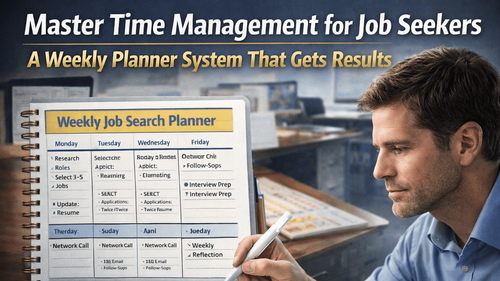

Master Time Management for Job Seekers: A Weekly Planner System That Gets Results
If you’ve ever tried to balance a full-time job while searching for a new opportunity, you already know the reality — it’s not a lack of ambition that holds you back, it’s a lack of time.
Or more accurately, a lack of structured time.
Most professionals don’t fail their job search because they aren’t capable. They fail because their efforts are scattered — 20 minutes here, an hour there, incomplete applications, missed follow-ups, and last-minute interview prep.
The result? A job search that stretches for months, drains energy, and delivers inconsistent results.
The Time Management Planner for Job Seekers changes that completely. It transforms your job search from a reactive activity into a structured, repeatable system designed for busy professionals with real constraints and real ambitions.
Who Is This Blog For?
- Working professionals managing a full-time job alongside a job search
- Career switchers navigating a structured transition
- Early to mid-career professionals seeking faster growth
- Managers and consultants with limited daily availability
- Anyone struggling with consistency, focus, or job-search burnout
Why This Topic Matters Today?
A modern job search is not quick, and it is rarely linear.
According to insights highlighted in the planner, mid-career professionals typically spend 3 to 6 months in an active job search — even when they are searching intentionally.
The real challenge is not opportunity. It is fragmentation.
When you’re working full-time, your available time comes in small, inconsistent pockets. Without a system:
- Applications remain half-finished
- Follow-ups are delayed or forgotten
- Interview preparation becomes rushed
- Momentum disappears
This is what the planner calls the “job search time trap” — and escaping it requires structure, not more effort.
Core Concept or Framework Explained
At its core, this planner treats your job search as a project — not a side activity.
And like any high-performing project, it relies on three key principles:
- Structured weekly planning
- Daily execution blocks
- Continuous tracking and reflection
The framework is built around a 5-day weekly system that assigns specific activities to specific days, ensuring clarity and consistency.
The planner also emphasizes a powerful insight: consistency beats intensity.
As shown in the framework on page 4, even 45 focused minutes daily can outperform several hours of unstructured weekend effort.
This shift — from random effort to structured execution — is what drives results.
How This Blog and Guidebook Help You?
This blog and planner help you:
- Convert fragmented time into focused, productive work sessions
- Eliminate decision fatigue by defining daily tasks
- Build momentum through visible weekly progress
- Reduce stress by planning ahead instead of reacting
- Maintain performance in your current role while job searching
Instead of constantly asking “What should I do next?”, you operate with clarity every single day.
Step-by-Step Breakdown
Step 1: Build Your Foundation First
Before you start applying, you need a strong setup.
The planner recommends a 2–3 hour “Setup Sprint” to establish your job search foundation.
This includes:
- Auditing your real weekly schedule and identifying available time slots
- Defining clear job search parameters (roles, industries, salary expectations)
- Preparing core assets like your resume and LinkedIn profile
- Creating a tracking system to manage applications
Skipping this step is one of the biggest reasons job searches stall early.
Step 2: Follow the 5-Day Weekly Framework
The planner introduces a clear weekly rhythm:
- Monday: Research and identify 3–5 roles
- Tuesday–Wednesday: Apply and customise applications
- Thursday: Network and follow up
- Friday: Prepare for interviews and reflect
This structure ensures that every critical activity — from applications to networking — gets dedicated attention.
It also aligns with your natural energy levels, placing high-focus tasks earlier in the week.
Step 3: Execute Daily in 30–60 Minute Blocks
Time-poor professionals need precision.
The planner breaks daily work into manageable sessions:
30-minute sprint:
- Review tracker
- Complete one focused task
- Follow up
- Update tracker
60-minute session:
- Deep work (applications or prep)
- Research
- Outreach
- Reflection and planning
The key rule is simple: complete one meaningful action every day.
Consistency compounds faster than intensity.
Step 4: Use the Weekly Planner Worksheet
The worksheet on page 6 provides a simple but powerful planning system.
Each week, you define:
- Daily tasks
- Target outcomes
- Completion status
- Weekly intention
- Weekly reflection
This turns your job search into a measurable, trackable system rather than a vague effort.
Step 5: Apply the Weekly Checklist
The planner includes a comprehensive checklist covering:
- Applications and research
- Networking and follow-ups
- Interview preparation
- Mindset and maintenance
As noted in the checklist section, consistently completing 80% of these actions puts you in the top tier of job seekers.
This is not about doing more — it’s about doing the right things consistently.
Step 6: Learn from Real-World Execution
The case example of Aditya on page 8 demonstrates how structure drives results.
With just 45 minutes daily:
- He submitted 8 tailored applications
- Achieved a 3 out of 8 response rate
- Secured networking calls and referrals
- Reached final interview rounds within weeks
The key takeaway is clear: better structure, not more time, leads to better outcomes.
Step 7: Reflect and Improve Weekly
The planner emphasizes weekly reflection as a performance tool.
Every Friday, you evaluate:
- What worked
- What got blocked
- What to change next week
This transforms your job search into a learning system that improves over time.
Common Mistakes or Pitfalls to Avoid
- Applying to too many roles without customisation
- Spending excessive time browsing instead of applying
- Delaying applications in pursuit of “perfect” resumes
- Ignoring networking opportunities
- Skipping reflection and repeating the same mistakes
- Running at full intensity without rest, leading to burnout
Each of these traps reduces efficiency and extends your job search unnecessarily.
How Should You Use This Guidebook Effectively?
To get the most value from this planner:
- Start with the Setup Sprint (2–3 hours on a weekend)
- Block daily job-search time in your calendar
- Follow the weekly structure consistently
- Use the worksheet every Sunday for planning
- Complete the checklist every Friday
- Reflect weekly and adjust your strategy
- Reuse the system until your goal is achieved
This is not a one-time read — it is a reusable system designed for continuous use.
Key Takeaways
- A job search without structure leads to stress and delays
- Treat your job search like a project with clear systems
- Daily consistency outperforms occasional intensity
- Tailored applications drive higher response rates
- Networking is a critical, high-ROI activity
- Tracking and reflection turn effort into strategy
- Small, consistent actions create long-term momentum
Your Next Step: Accelerate Your Career with PlanetSpark
Creating an impact-driven resume is not just about landing your next job—it’s about owning your professional story and presenting it with clarity, confidence, and credibility. When your resume clearly communicates value, results, and impact, opportunities follow naturally.
At PlanetSpark, we are committed to empowering working professionals with practical, outcome-focused resources that drive real career growth. From resume building and workplace communication to leadership presence and professional writing, our programs are designed to help you succeed in today’s fast-evolving job market.
Visit https://www.planetspark.in/resources to explore:
- Career and resume-building guides
- Workplace communication and professional writing resources
- Skill-development tools curated for working professionals
Want a deeper, hands-on experience?
You can also book a free trial session to learn more about PlanetSpark’s Working Professional Courses, designed to accelerate your career through personalised coaching, real-world practice, and expert guidance.
Your career deserves more than generic advice.
It deserves clarity, confidence, and measurable impact.
Personalized Communication Roadmaps
Record a video to get a AI generated personalized communication reports