
Top Call-to-Action Tips to Close Your Cover Letter Strong
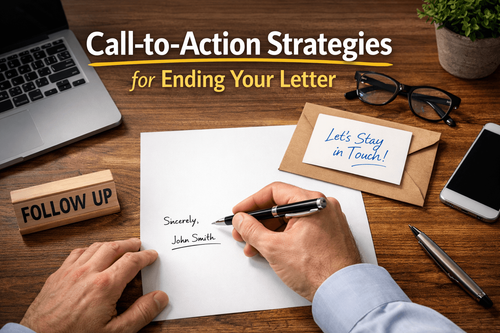

Guide for Call-to-Action Strategies for Ending Your Cover Letter
You’ve written a strong opening.
You’ve highlighted measurable achievements.
You’ve aligned your experience with the role.
And then your cover letter ends with:
“Thank you for your time and consideration.”
Polite? Yes.
Memorable? Not really.
The closing paragraph of your cover letter is not a formality—it is a conversion point. It is your final opportunity to reinforce value, express confidence, and guide the recruiter toward the next step.
A weak closing fades out.
A strategic call-to-action (CTA) creates momentum.
This guide explains how to craft powerful closing statements that increase response rates and position you as a confident, proactive professional.
Who Is This Blog For?
This blog and guidebook are designed
for:
- Working professionals applying for competitive roles
- Mid-career candidates seeking leadership opportunities
- Applicants who rarely receive interview callbacks
- Professionals who want stronger, more persuasive applications
- Anyone looking to improve cover letter effectiveness
If your cover letters feel complete but not compelling, your ending may be the missing piece.
Why This Topic Matters Today?
Recruiters review dozens—sometimes hundreds—of applications daily. Attention spans are short, and impressions are formed quickly.
The final paragraph is psychologically powerful because it is the last thing the reader sees. A strong CTA:
- Reinforces confidence
- Signals enthusiasm
- Demonstrates professionalism
- Encourages action
- Differentiates you from passive applicants
A generic closing blends into the crowd. A strategic one positions you as proactive and prepared.
Core Concept or Framework Explained
The C.L.O.S.E. Model for Strong Cover Letter Endings:
- Confidence
- Link to value
- Openness to discussion
- Specific next step
- Expression of appreciation
This five-part structure ensures your closing is assertive without being aggressive.
How This Blog and Guidebook Help You?
Together, this blog and guidebook help you:
- Avoid weak or generic closing lines
- Craft confident yet professional CTAs
- Align your closing with your value proposition
- Strengthen recruiter engagement
- Improve overall cover letter impact
A well-crafted CTA transforms your letter from informative to persuasive.
Step-by-Step Breakdown
Step 1: Reinforce Confidence
Avoid hesitant phrases such as:
- I hope to hear from you
- I would be grateful for an opportunity
- I believe I could contribute
These reduce authority.
Instead, use confident language:
- I am confident my experience aligns with your needs
- I look forward to contributing to your team
- I am excited to bring my expertise to this role
Confidence signals readiness.
Step 2: Link Back to Your Value
Before closing, briefly reconnect to your strongest strength.
Example:
“With a proven track record of improving operational efficiency by 30%, I am eager to apply similar strategies to support your growth objectives.”
This reminds the recruiter why you are relevant.
Step 3: Invite Further Conversation
Encourage engagement without sounding demanding.
Effective phrases:
- I welcome the opportunity to discuss how I can contribute
- I look forward to discussing this role further
- I would appreciate the chance to elaborate on my experience
The goal is to open the door, not push it.
Step 4: Suggest a Clear Next Step
Subtle clarity improves professionalism.
Example:
“I look forward to the opportunity to speak with you about how my skills can support your team’s objectives.”
Avoid:
“I expect to hear from you soon.”
Assertive does not mean entitled.
Step 5: Close with Professional Appreciation
A brief, professional thank-you reinforces courtesy.
Example:
“Thank you for your time and consideration.”
Keep it concise and genuine.
Types of Effective Call-to-Action Endings
1. The Confident Contribution CTA
Focuses on value and readiness.
2. The Results-Oriented CTA
Highlights measurable impact and future contribution.
3. The Leadership-Oriented CTA
Emphasises strategic alignment for senior roles.
4. The Growth-Oriented CTA
Shows long-term commitment and development mindset.
5. The Direct but Professional CTA
Encourages discussion clearly without sounding aggressive.
Matching the CTA style to your career level strengthens authenticity.
Common Mistakes or Pitfalls to Avoid
The guidebook identifies frequent closing errors:
- Ending abruptly without a CTA
- Repeating earlier statements
- Sounding desperate
- Using overly casual language
- Writing long, unfocused final paragraphs
- Forgetting to include appreciation
- Sounding entitled or demanding
The ideal closing paragraph is 2–4 sentences long.
Tone matters as much as wording.
How Should You Use This Guidebook Effectively?
To implement strategically:
1. Draft your full cover letter
2. Review your final paragraph separately
3. Apply the C.L.O.S.E. framework
4. Remove weak qualifiers
5. Ensure alignment with earlier achievements
6. Keep the ending concise and focused
Time required:
- Draft refinement: 15–20 minutes
- Final tone review: 5–10 minutes
Small refinements can increase recruiter engagement significantly.
Key Takeaways
- The closing paragraph influences final impression
- Avoid hesitant or passive phrasing
- Reinforce your value before closing
- Invite conversation professionally
- Maintain confident but respectful tone
- Keep it concise and structured
- Tailor CTA to role and seniority level
- A strong ending converts interest into action
Your cover letter should not fade out—it should finish strong.
Your Next Step: Accelerate Your Career with PlanetSpark
Professional communication is not only about what you say—it’s about how you close the conversation. A strategic call-to-action demonstrates confidence, clarity, and readiness for the next step.
At PlanetSpark, we empower working professionals with practical frameworks that strengthen resumes, cover letters, interview responses, and leadership communication. Our programs focus on measurable skill improvement aligned with real-world hiring expectations.
Visit https://www.planetspark.in/resources to explore:
- Resume and cover letter mastery guides
- Interview communication frameworks
- Workplace writing toolkits
- Career advancement resources
You can also book a free trial session to learn more about PlanetSpark’s Working Professional Courses, designed to help you communicate persuasively and progress confidently.
Finish strong.
Speak with confidence.
Turn interest into opportunity.
Start building your advantage today—with PlanetSpark.