
Top Competitive Analysis Skills for Working Professionals
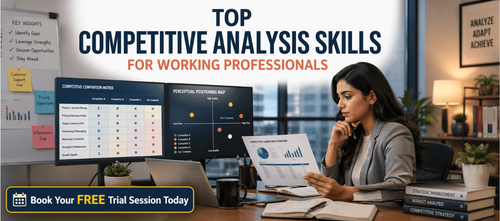

Competitive Analysis to Outmaneuver Your Rivals and Accelerate Career Growth
In a fast-paced, ever-evolving job market, staying ahead of your competitors is essential. Whether you're strategizing for a new product launch, preparing for a career transition, or enhancing your market position, understanding your competitors is a key to making smarter, more informed decisions. Most professionals know they should conduct competitive analysis, but few have a structured, repeatable process to do it effectively.
This blog is based on our Competitive Analysis Template, a step-by-step guide to help you understand your market, outmaneuver competition, and make strategic decisions that will lead to growth and success.
Download these resources and apply them alongside your daily work for improved clarity, productivity, and professional growth. You can also book a free trial to gain expert guidance and enhance your communication, problem-solving, and decision-making skills. The materials are designed in a clear, structured format to help professionals learn efficiently and implement insights with confidence.
Who Is This Blog For?
This blog and the accompanying template are designed for:
- Consultants and managers who need to position products or services against competitors
- Product managers and marketers refining strategy or scoping new features
- Career changers evaluating industries and market conditions before making a pivot
- Professionals preparing for competitive interviews by understanding key players in the industry
- Anyone needing a clear framework for making data-driven strategic decisions
Why This Topic Matters Today?
In today’s highly competitive business environment, failing to analyze your competition means making decisions based on assumptions, not facts. Without structured competitive intelligence, strategies can become incomplete, and opportunities may slip through your fingers.
When you approach your work with a competitive analysis mindset, you can:
- Spot opportunities that competitors are missing
- Articulate exactly why your company, product, or service is the right choice
- Make smarter decisions that lead to faster career growth and stronger business positioning
Moreover, the use of a structured approach makes all the difference between reacting impulsively and acting strategically.
Core Concept or Framework Explained
The Competitive Analysis Template is built around four core modules designed to structure your analysis process:
1. Defining Your Competitive Landscape
It’s crucial to understand the full scope of your competition. The template helps you categorize competitors into three tiers:
- Tier 1: Direct Competitors — Same product, service, audience, and geography.
- Tier 2: Indirect Competitors — Different product, same problem being solved.
- Tier 3: Emerging Disruptors — Early-stage players or market shifts that signal future changes.
2. Research Framework
The template guides you to focus on seven key dimensions when conducting research:
- Product/Service Offering
- Pricing & Business Model
- Target Customer & Ideal Customer Profile (ICP)
- Positioning & Messaging
- Marketing & Channels
- Strengths & Weaknesses
- Growth Signals
3. The Competitive Comparison Matrix
This matrix allows you to compare competitors across these dimensions. It’s a structured way to identify gaps and strengths. After filling it in, highlight where your brand is weak but your competitors are strong (gaps) and where you have a competitive advantage (defensible strengths).
4. Positioning Analysis
Understand how competitors position themselves in the market. The Perceptual Map and Competitive Differentiators Framework help visualize this by plotting key players against crucial factors like price, quality, or service level. This allows you to spot underserved areas (white spaces) in the market.
How This Blog and Guidebook Help You?
This blog, together with the Competitive Analysis Template, will help you:
- Sharpen your competitive instincts and market understanding
- Make data-driven decisions to outmaneuver competition
- Position your product, service, or career in the most compelling way
- Identify and act on gaps and opportunities others might miss
- Stay ahead of market trends with continuous competitive intelligence
Step-by-Step Breakdown
Step 1: Define Your Competitive Landscape
Start by mapping your competitors. Categorize them into Tier 1, Tier 2, and Tier 3 based on their direct or indirect rivalry. Understand who your competitors are and where the real threats lie.
For instance, in a software market, a Tier 1 competitor could be another project management tool like Asana, while Tier 2 might include task management apps like Trello. Tier 3 could be a fast-growing startup offering a novel approach that could disrupt the market in the future.
Step 2: Research Framework: What to Look For
Use the seven research dimensions to guide your competitive intelligence gathering. Start by exploring competitor websites, pricing models, product offerings, customer reviews, and social media presence.
For example, analyze customer feedback on platforms like G2 or Trustpilot. Look for consistent pain points across competitors — this will help you spot opportunities to differentiate.
Step 3: Complete the Competitive Comparison Matrix
This matrix is the centerpiece of your analysis. Evaluate each competitor across the seven dimensions (product, pricing, customer support, etc.) and rate them on a scale of Strong (S), Moderate (M), or Weak (W). Once the matrix is filled, highlight any areas where your competitors are strong, but you are weak — these are your gaps. Conversely, areas where you are strong but competitors are weak should be your defensible advantages.
For instance, if your competitors offer similar features but lack strong customer support, this could be an opportunity for you to focus your messaging around customer service excellence.
Step 4: Positioning Analysis
The next step is to visualize your position and your competitors’ positions in the market. Using the Perceptual Positioning Map, you can chart competitors against two important axes — such as Price (Low → High) and Quality (Basic → Premium). This visualization helps identify where there’s a gap that you can exploit.
Additionally, fill in the Competitive Differentiators Framework to understand your unique strengths. This could be anything from your product’s specific capabilities to your customer support model.
Common Mistakes or Pitfalls to Avoid
The guidebook highlights several common mistakes when conducting competitive analysis:
- Mistake 1: Focusing Only on Direct Competitors
Don’t ignore Tier 2 and Tier 3 competitors. Some of the biggest strategic insights come from indirect or emerging competitors.
- Mistake 2: Collecting Data Without a Clear Framework
Gathering random data without a structured approach leads to confusion. Use the Competitive Comparison Matrix to structure your findings.
- Mistake 3: Competing on the Same Claims
Avoid copying your competitors’ claims. Use the Perceptual Map to identify where your competitors are clustered, and position your offering in an unclaimed space.
- Mistake 4: One-Time Analysis
Competitive analysis should be ongoing. Use the checklist provided in the guide to build a habit of quarterly reviews, keeping your strategy agile.
How Should You Use This Guidebook Effectively?
To get the most out of this template:
1. Review the entire framework once to understand the strategic approach.
2. Apply the research and analysis modules to your competitive landscape.
3. Use the Competitive Comparison Matrix to identify strategic priorities.
4. Perform periodic reviews to keep your competitive intelligence current.
By following this process, you’ll develop a robust understanding of the competitive landscape and be better equipped to make informed, strategic decisions.
Key Takeaways
- Map your competition across three tiers (direct, indirect, and emerging disruptors) to gain a complete view.
- Use the Competitive Comparison Matrix to identify gaps and defensible advantages.
- The Perceptual Positioning Map helps visualize your market position and uncover unexploited white space.
- Keep your analysis ongoing to stay agile and ahead of market trends.
Your Next Step: Accelerate Your Career with PlanetSpark
Competitive intelligence is not just for business owners or product managers. It’s a critical skill for professionals aiming to make smarter, data-driven decisions and accelerate their career growth. Whether you’re positioning yourself in the job market, evaluating a business strategy, or refining your product’s place in the market, this skill will set you apart.
At PlanetSpark, we are committed to empowering working professionals with practical, outcome-focused resources that drive real career growth. From strategic thinking and leadership development to career acceleration, our programs are designed to help you succeed in today’s fast-evolving job market.
Visit https://www.planetspark.in/resources to explore:
- Career development and strategic thinking guides
- Professional growth and leadership resources
- Skill-enhancement tools for working professionals
Want a deeper, hands-on experience?
You can also book a free trial session to learn more about PlanetSpark’s Working Professional Courses, designed to accelerate your career through personalised coaching, real-world practice, and expert guidance.
Your career deserves more than generic advice.
It deserves clarity, confidence, and measurable impact.
Start building that advantage today—with PlanetSpark.
Personalized Communication Roadmaps
Record a video to get a AI generated personalized communication reports