
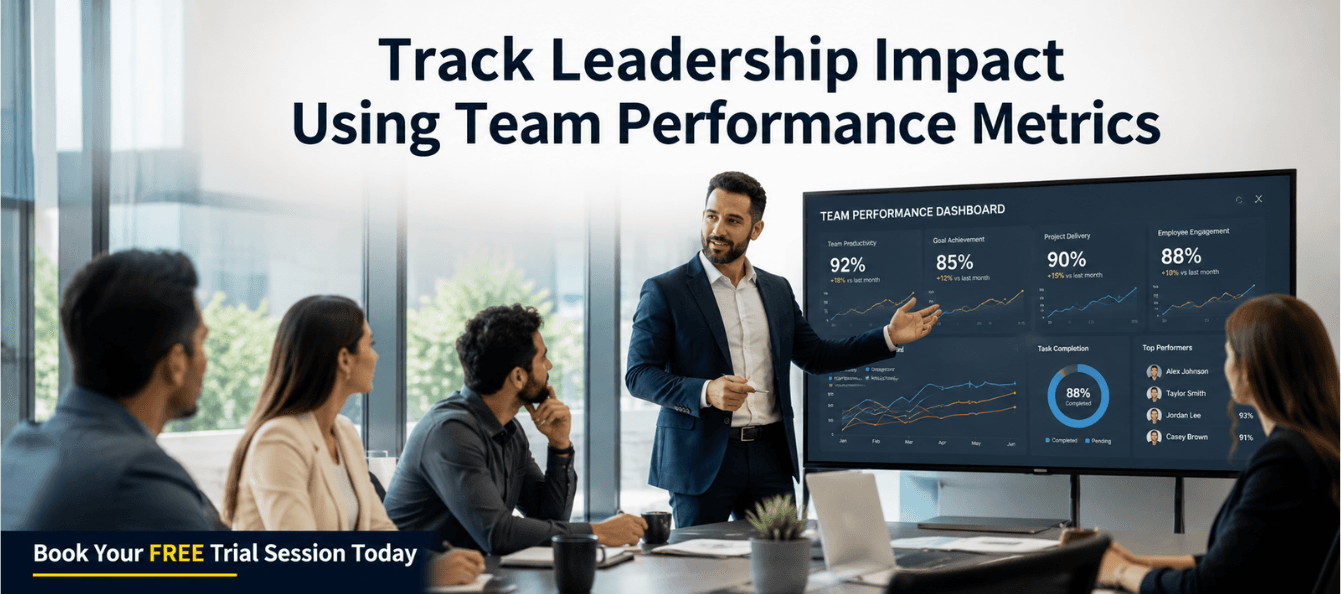
Track Leadership Impact Using Team Performance Metrics


How to Track Leadership Impact Through Team Performance Metrics to Build Stronger Results, Visibility, and Career Growth
Many professionals work extremely hard as leaders but struggle to answer one critical question when promotion reviews, stakeholder discussions, or performance evaluations happen:
“What measurable impact has your leadership actually created?”
This is where many capable managers fall short. They can describe activities such as leading meetings, resolving blockers, mentoring employees, or coordinating projects. But they cannot clearly connect their leadership behavior to measurable outcomes like delivery improvement, engagement growth, retention increases, reduced rework, or business impact.
In today’s workplace, leadership credibility increasingly depends on evidence, not effort alone.
The “Tracking Leadership Impact Across Team Performance Metrics” playbook helps professionals solve this problem through a practical leadership measurement system. Instead of tracking random productivity numbers, the guide introduces a structured framework that connects leadership actions to team enablers, performance indicators, and business outcomes. Through weekly check-ins, metric portfolios, baseline systems, monthly reviews, and leadership impact statements, the playbook helps professionals measure what actually matters and build a stronger career narrative backed by evidence.
Download these resources and apply them alongside your daily work for improved clarity, productivity, and professional growth. You can also book a free trial to gain expert guidance and enhance your communication, problem-solving, and decision-making skills. The materials are designed in a clear, structured format to help professionals learn efficiently and implement insights with confidence.
Who Is This Blog For?
- First-time managers learning to measure leadership effectiveness
- Mid-career professionals building promotion-ready leadership evidence
- Consultants proving leadership ROI to clients and stakeholders
- Team leads improving accountability and performance visibility
- Startup managers tracking team growth and operational impact
- Professionals preparing for performance reviews or promotions
- Leaders seeking data-informed decision-making systems
Why This Topic Matters Today?
Modern leadership is increasingly outcome-driven. Organizations no longer evaluate managers solely on effort, communication skills, or technical expertise. They expect leaders to demonstrate measurable business and team impact.
The guide explains that vague claims such as “I led a high-performing team” are far less persuasive than clear evidence supported by metrics.
Without structured leadership tracking systems, professionals often struggle with:
- Proving leadership ROI
- Building promotion cases
- Connecting leadership behavior to outcomes
- Coaching teams with evidence
- Making data-informed leadership decisions
The playbook also highlights another critical issue:
Most professionals track outputs instead of outcomes.
For example:
Outputs
- Meetings held
- Reports submitted
- Tasks completed
Outcomes
- Delivery quality improvements
- Engagement growth
- Faster decision-making
- Reduced errors
- Higher retention
The guide explains that leadership becomes far more strategic when professionals stop guessing and start tracking patterns intentionally.
Core Concept or Framework Explained
The playbook introduces the Leadership Impact Framework, which connects leadership behavior to measurable business outcomes through four interconnected layers.
The four layers are:
- Leader Behaviors
- Team Enablers
- Performance Indicators
- Business Outcomes
Layer 1: Leader Behaviors
These include:
- Coaching
- Communication
- Decision-making
- Accountability
Layer 2: Team Enablers
Leadership behaviors influence:
- Clarity
- Psychological safety
- Skill development
- Resource access
Layer 3: Performance Indicators
These team enablers then impact:
- Velocity
- Quality
- Engagement
- Collaboration
- Retention
Layer 4: Business Outcomes
Over time, the results appear through:
- Revenue impact
- Customer satisfaction
- Cost efficiency
- Project success
The guide emphasizes a critical insight:
Leadership impact operates with lag time.
Your actions today may influence business outcomes weeks or months later.
This understanding prevents managers from abandoning good leadership systems too early.
How This Blog and Guidebook Help You?
This blog and playbook provide professionals with a repeatable leadership measurement system.
The framework helps professionals:
- Connect leadership actions to outcomes clearly
- Build promotion-ready impact narratives
- Improve coaching precision
- Detect performance problems early
- Create balanced leadership scorecards
- Improve strategic decision-making
- Strengthen stakeholder communication
Unlike generic productivity tracking systems, the guide focuses specifically on leadership-driven performance measurement.
Step-by-Step Breakdown
Step 1: Build Your Leadership Metrics Portfolio
The guide explains that not all metrics deserve equal attention.
The goal is to create a balanced portfolio of 6–10 meaningful metrics that reflect overall leadership effectiveness.
The framework divides metrics into three categories:
Productivity Metrics
These measure output quality and execution speed.
Examples include:
- On-time delivery rate
- Cycle time
- Rework rate
- Meeting-to-output ratio
People Metrics
These measure team health and development.
Examples include:
- Engagement scores
- Retention rate
- Psychological safety
- 1:1 completion rate
Business Impact Metrics
These connect leadership to organizational outcomes.
Examples include:
- Customer satisfaction
- Revenue contribution
- Cost savings
- Project success rate
The guide strongly recommends choosing at least two metrics from each category for balanced leadership visibility.
Step 2: Establish Leadership Baselines
The playbook explains that metrics without baselines are meaningless.
Baselines transform isolated numbers into meaningful performance stories.
The framework introduces a four-step baseline process:
Pull Historical Data
Review the previous 4–8 weeks honestly.
Benchmark Against Context
Compare against organizational or industry expectations.
Document External Factors
Account for unusual events such as restructures or launches.
Set SMART Targets
Create measurable 90-day goals.
The guide also provides common benchmark examples:
- Strong on-time delivery: 85%+
- Strong engagement: 80%+
- Strong retention: 90%+
- Strong CSAT: 85+
However, the playbook emphasizes that benchmarks must always be contextualized carefully.
Step 3: Conduct Weekly Leadership Impact Check-Ins
The guide introduces a 20-minute weekly leadership review ritual designed to build leadership pattern recognition over time.
The weekly check-in includes four steps:
Update Metrics
Record current performance numbers.
Spot the Delta
Compare against previous weeks.
Identify the Driver
Connect leadership behaviors to changes.
Set Next Actions
Define specific improvement steps.
The guide explains that identifying leadership drivers is the most valuable part of the process.
For example:
“I clarified the project brief on Monday”
is far more actionable than:
“I communicated better.”
The Weekly Reflection Questions help leaders evaluate:
- What improved?
- What declined?
- What leadership lever was missing?
- What does the team need most right now?
This process trains managers to think causally instead of reactively.
Step 4: Run Monthly Leadership Reviews
The monthly review process helps leaders identify patterns and build long-term leadership strategy.
The guide recommends a 45–60 minute review every month.
The review includes:
Trend Analysis
Evaluate performance movement across four weeks.
Leadership Behavior Audit
Review which leadership behaviors consistently drive positive outcomes.
Team Health Check
Compare engagement trends against productivity metrics.
Strategy Adjustment
Refine targets, interventions, or focus areas.
Impact Statement Drafting
Translate leadership results into measurable business language.
The guide introduces a powerful impact statement formula:
“This month, I [leadership behavior], which resulted in [metric improvement], contributing to [business outcome].”
Example:
“This month, I introduced structured sprint retrospectives, which reduced rework rate from 22% to 11%, reducing delivery time by three days.”
This helps professionals build promotion narratives continuously rather than scrambling before reviews.
Step 5: Learn From Maya’s Leadership Transformation
The guide includes the case study of Maya, a Senior Project Manager preparing for a Director-level promotion.
Her initial metrics included:
- On-time delivery: 68%
- Engagement score: 6.1/10
- Rework rate: 24%
- 1:1 completion: 55%
Her interventions included:
- Monday clarity sessions
- Structured weekly 1:1s
- Shared blocker dashboards
Within eight weeks:
- 1:1 completion rose to 90%
- Engagement increased to 7.4/10
- On-time delivery improved to 83%
- Rework rate dropped to 14%
Her leadership impact statement translated improvements into business language:
“Reduced rework cost by an estimated $18K per sprint cycle.”
The guide explains that measurable evidence transformed her promotion case significantly.
Step 6: Avoid Common Leadership Tracking Mistakes
The playbook identifies six major leadership tracking mistakes.
Tracking Too Many Metrics
Problem:
Too much data creates confusion.
Better approach:
Focus on 6–10 high-impact metrics only.
Tracking Outputs Only
Problem:
Activity gets confused with impact.
Better approach:
Pair outputs with outcomes.
Ignoring People Metrics
Problem:
Burnout and disengagement go unnoticed.
Better approach:
Track engagement and retention actively.
Measuring Without Acting
Problem:
Tracking becomes passive reporting.
Better approach:
Every check-in must end with action.
Skipping Baselines
Problem:
Growth cannot be demonstrated clearly.
Better approach:
Collect historical data first.
Keeping Data Private
Problem:
Teams lose alignment and ownership.
Better approach:
Share key metrics transparently.
How Should You Use This Guidebook Effectively?
The guide works best when implemented as a recurring leadership operating system.
Recommended workflow:
Week 1
- Select metrics and establish baselines
Week 2
- Set SMART 90-day targets
Week 3
- Begin weekly leadership check-ins
Week 4
- Conduct the first monthly review and draft impact statements
Ongoing rhythm:
Weekly
- Update metrics
- Identify drivers
- Set actions
Monthly
- Analyze trends
- Adjust leadership strategy
- Build impact narratives
Quarterly
- Refresh metric portfolio
- Review targets
- Recalibrate priorities
The guide strongly emphasizes consistency over perfection.
Key Takeaways
- Leadership impact becomes stronger when it is measurable
- Outcomes matter more than activity volume
- Balanced metric portfolios improve leadership visibility
- Weekly check-ins build leadership pattern recognition
- Baselines create meaningful performance stories
- Monthly reviews turn data into strategy
- Leadership behaviors influence team enablers before business outcomes
- Promotion narratives should be built continuously, not reactively
- People metrics are as important as productivity metrics
- Transparency improves alignment, accountability, and trust
Your Next Step: Accelerate Your Career with PlanetSpark
Creating an impact-driven resume is not just about landing your next job—it’s about owning your professional story and presenting it with clarity, confidence, and credibility. When your resume clearly communicates value, results, and impact, opportunities follow naturally.
At PlanetSpark, we are committed to empowering working professionals with practical, outcome-focused resources that drive real career growth. From resume building and workplace communication to leadership presence and professional writing, our programs are designed to help you succeed in today’s fast-evolving job market.
Visit https://www.planetspark.in/resources to explore:
- Career and resume-building guides
- Workplace communication and professional writing resources
- Skill-development tools curated for working professionals
Want a deeper, hands-on experience?
You can also book a free trial session to learn more about PlanetSpark’s Working Professional Courses, designed to accelerate your career through personalised coaching, real-world practice, and expert guidance.
Your career deserves more than generic advice.
It deserves clarity, confidence, and measurable impact.
Personalized Communication Roadmaps
Record a video to get a AI generated personalized communication reports