
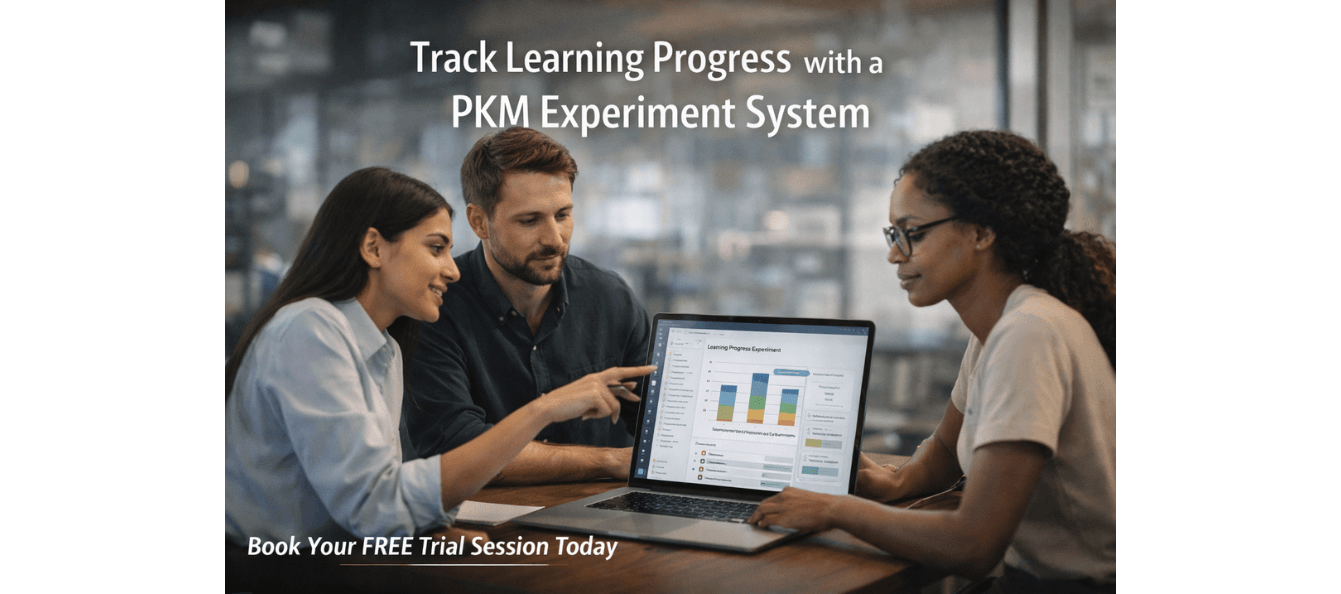
Track Learning Progress with a PKM Experiment System
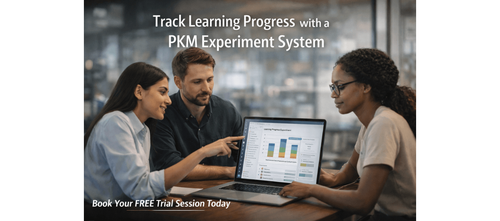

PKM Experiment Tracker, How to Build a Personal Knowledge System That Actually Works for Your Career
In today’s information-heavy work environment, most professionals are not struggling to learn—they are struggling to apply what they learn. You read articles, attend meetings, take notes, and explore new tools, yet when it’s time to use that knowledge in real decisions or communication, it often feels out of reach.
This isn’t a productivity issue or a memory problem. It’s a system problem.
Many professionals jump between tools, try new methods for a few days, and abandon them when they don’t immediately work. Over time, this leads to frustration, inconsistency, and a growing gap between effort and results. You collect information, but you don’t convert it into impact.
This is exactly where the PKM Experiment Tracker changes the game. Instead of searching for a perfect system, it helps you build your own—through structured, low-risk experiments that reveal what actually works for your thinking style, workflow, and career goals.
Download these resources and apply them alongside your daily work for improved clarity, productivity, and professional growth. You can also book a free trial to gain expert guidance and enhance your communication, problem-solving, and decision-making skills. The materials are designed in a clear, structured format to help professionals learn efficiently and implement insights with confidence.
Who Is This Blog For?
- Working professionals overwhelmed by information and tools
- Managers and leaders looking to improve decision-making clarity
- Consultants and analysts handling large volumes of knowledge
- Career switchers building new learning systems
- Lifelong learners who want to turn knowledge into measurable outcomes
Why This Topic Matters Today?
Modern professionals consume more information than ever—but retention and application remain major challenges.
Key issues highlighted in the tracker include:
- Frequent switching between tools without clear results
- PKM systems that are abandoned after a short period
- Lack of clarity on whether a method is actually effective
- Knowledge being collected but rarely applied
- No structured way to evaluate and improve learning systems
In a competitive professional landscape, the ability to build a system that consistently converts knowledge into results is a major advantage. Without it, even high effort leads to limited impact.
Core Concept or Framework Explained
The PKM Experiment Tracker is built on two core frameworks:
The Five Zones of Knowledge Management
Every effective knowledge system operates across five zones:
Capture
Collecting ideas, insights, and information quickly and efficiently.
Organise
Structuring knowledge so it is easy to retrieve and use.
Connect
Linking ideas across domains to generate deeper insights.
Review
Revisiting knowledge regularly to improve retention and relevance.
Express
Turning knowledge into output such as decisions, communication, and content.
Most professionals focus on one or two zones, which is why their system breaks down. A complete system requires all five.
The Experiment Framework
Instead of guessing what works, the tracker uses a structured experiment cycle:
- Design a clear hypothesis
- Run the experiment for 7–21 days
- Measure results against predefined criteria
- Decide whether to keep, modify, pause, or discard the method
This approach ensures that your system evolves based on evidence, not assumptions.
How This Blog and Guidebook Help You?
This blog and tracker provide a practical system for building a high-performance knowledge workflow:
- A structured method to test and refine PKM tools and habits
- Clear evaluation criteria to measure effectiveness
- A repeatable experiment framework for continuous improvement
- A system that adapts to your professional context
The result is a personalised PKM system that improves learning, decision-making, and communication.
Step-by-Step Breakdown
Step 1: Identify Your Weakest PKM Zone
Before running experiments, you need clarity on where your system is breaking.
Ask yourself:
- Do I capture ideas but never use them?
- Do I struggle to organise and retrieve information?
- Do I rarely connect ideas across domains?
- Do I skip reviewing past knowledge?
- Do I fail to express what I know in my work?
Choose one zone to focus on—this ensures your experiment is targeted and effective.
Step 2: Design a Clear Experiment
Every experiment starts with a structured setup.
Define:
- Experiment name and duration (7–21 days)
- The PKM zone you are targeting
- The tool or method you are testing
- A clear hypothesis in one sentence
- Three measurable success criteria
- A realistic daily time budget
Avoid changing multiple variables at once. Focus on one change to get meaningful results.
Step 3: Run the Experiment Consistently
Execution is where most experiments fail.
Follow these principles:
- Stick to the method for the full duration
- Keep daily effort small and manageable
- Avoid switching tools mid-experiment
- Focus on consistency over perfection
A two-week experiment is enough to generate useful insights without overwhelming your schedule.
Step 4: Maintain a Daily Experiment Log
Tracking your experience is essential for learning.
Each day, record:
- Whether you followed the method
- One to two observations
- Friction level (1 to 5)
- Any notable breakthroughs or issues
Keep it brief—three to five minutes is enough. The goal is data, not detailed journaling.
Step 5: Conduct a Structured Debrief
The debrief is where real learning happens.
Follow four phases:
Review
Go through your daily logs and identify patterns.
Score
Evaluate your success criteria on a scale of 0 to 3.
Decide
Choose one outcome: keep, modify, pause, or discard.
Extract
Write the single most important learning from the experiment.
This step ensures that your effort translates into actionable decisions.
Step 6: Build Your Personal PKM System Over Time
A strong system emerges through multiple experiments.
Example progression:
- Test a capture tool and refine it
- Improve organisation through small adjustments
- Add a review habit for retention
- Build an expression habit for output
Over time, these experiments combine into a system that fits your workflow naturally.
Step 7: Apply the System in Real Work
A real-world example shows the impact:
A professional ran multiple experiments over 90 days, testing different tools and habits. By tracking friction, measuring results, and making clear decisions, they built a system that improved how they captured insights and expressed ideas. As a result, their work outputs became more structured, insightful, and impactful.
This demonstrates how experimentation leads to practical, measurable improvement.
Common Mistakes or Pitfalls to Avoid
Many professionals struggle because of avoidable errors:
- Changing multiple variables at once
- Running experiments without clear success criteria
- Skipping the debrief phase
- Abandoning experiments under pressure
- Writing long logs instead of quick observations
- Expecting immediate perfection from a system
A better approach is to treat experiments as learning tools, not performance tests.
How Should You Use This Guidebook Effectively?
To get maximum value, follow this workflow:
- Identify one friction point in your current system
- Design a simple 7–14 day experiment
- Track your experience daily
- Conduct a structured debrief
- Apply your learning to the next experiment
Suggested time investment:
- 5 minutes daily for logging
- 30 minutes at the end for debrief
- 7–21 days per experiment cycle
Consistency and iteration are the keys to success.
Key Takeaways
- PKM is a system, not a single tool
- The five zones ensure knowledge flows from input to impact
- Structured experiments replace guesswork with evidence
- One variable per experiment leads to clear insights
- Daily logs provide valuable data for decision-making
- The debrief phase converts data into action
- Failed experiments still provide valuable learning
- Expression is the ultimate measure of system effectiveness
- Continuous experimentation leads to a personalised, high-performing system
Your Next Step: Accelerate Your Career with PlanetSpark
Creating an impact-driven resume is not just about landing your next job—it’s about owning your professional story and presenting it with clarity, confidence, and credibility. When your resume clearly communicates value, results, and impact, opportunities follow naturally.
At PlanetSpark, we are committed to empowering working professionals with practical, outcome-focused resources that drive real career growth. From resume building and workplace communication to leadership presence and professional writing, our programs are designed to help you succeed in today’s fast-evolving job market.
Visit https://www.planetspark.in/resources to explore:
- Career and resume-building guides
- Workplace communication and professional writing resources
- Skill-development tools curated for working professionals
Want a deeper, hands-on experience?
You can also book a free trial session to learn more about PlanetSpark’s Working Professional Courses, designed to accelerate your career through personalised coaching, real-world practice, and expert guidance.
Your career deserves more than generic advice.
It deserves clarity, confidence, and measurable impact.
Start building that advantage today—with PlanetSpark.
Personalized Communication Roadmaps
Record a video to get a AI generated personalized communication reports