
How to Find the Right Career Fit Through Smart Experimentation
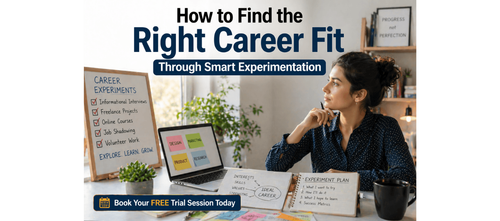

Keeping Track of Identity Experiments: A Practical Framework to Discover What Truly Fits Your Career
You’re doing well on paper. Stable role, decent growth, clear responsibilities. But something feels slightly off. Not wrong enough to quit—but not right enough to feel confident about your next move.
This is where most professionals get stuck.
You’re expected to make big career decisions—switch roles, pursue leadership, explore new domains—based on limited self-awareness. You rely on assumptions like “I think I’ll enjoy this” or “This seems like the next logical step.”
But without real evidence, these decisions often lead to more confusion.
That’s exactly the problem this guidebook solves.
“Tracking Identity Experiments to Discover What Fits You Best” introduces a structured, evidence-based approach to career clarity. Instead of guessing what suits you, it helps you test, observe, and learn from real experiences—so you can make decisions backed by data, not assumptions.
Download these resources and apply them alongside your daily work for improved clarity, productivity, and professional growth. You can also book a free trial to gain expert guidance and enhance your communication, problem-solving, and decision-making skills. The materials are designed in a clear, structured format to help professionals learn efficiently and implement insights with confidence.
Who Is This Blog For?
- Working professionals with 0–15 years of experience seeking clarity in their career direction
- Individuals feeling stuck, disengaged, or uncertain about their next move
- Career switchers exploring new roles without wanting to take high risks
- Professionals considering internal transitions or leadership roles
- High performers who feel competent but not fulfilled
- Anyone who wants to make career decisions based on real evidence rather than assumptions
Why This Topic Matters Today?
Modern careers are no longer linear.
Roles evolve rapidly. New skills emerge constantly. What worked for you two years ago may not energise you today. Yet, most professionals still approach career decisions as one-time choices instead of ongoing experiments.
The result?
- Professionals make decisions based on assumptions instead of experience
- Many feel disengaged despite being successful on paper
- Career switches often feel risky because they lack validation
- People struggle to differentiate between what they are good at and what they truly enjoy
The guidebook highlights a critical shift: identity is not something you discover once—it is something you continuously build through experience.
Without a system to track and interpret those experiences, valuable insights get lost in day-to-day work.
Core Concept
At the heart of this guidebook is the Identity Experiment System—a simple yet powerful framework that helps you test career assumptions in a structured way.
Instead of overthinking your next move, you run small, low-risk experiments to answer a key question:
What would it feel like to be someone who does this kind of work?
The system operates through four core phases:
Design
You define a clear hypothesis about yourself. For example, “I want to test whether I thrive when leading teams.”
Act
You perform a real-world activity that allows you to test this hypothesis within your current environment.
Observe
You track your internal signals—energy, engagement, meaning, feedback, and growth—on a weekly basis.
Reflect
You analyse your experience to identify patterns and draw conclusions based on evidence.
The key idea is simple but powerful: success is not the goal—insight is.
Even discomfort, confusion, or low energy are valuable data points that help you understand what doesn’t fit.
Over time, these experiments build a clear, evidence-based picture of your professional identity.
How This Blog and Guidebook Help You?
This framework shifts you from passive thinking to active discovery.
Instead of asking “What should I do next?”, you start asking “What does my real experience tell me?”
Here’s what you gain:
- Clarity about what types of work energise and drain you
- Confidence in career decisions backed by real data
- A low-risk way to explore new roles or responsibilities
- Strong self-awareness about your strengths, preferences, and values
- A repeatable system you can use throughout your career
Most importantly, it eliminates guesswork and replaces it with structured learning.
Step-by-Step Breakdown
How do you design an identity experiment?
Every experiment begins with a clear hypothesis.
You define what you want to test about yourself. For example, whether you enjoy mentoring, strategic thinking, or independent work.
Next, you choose a specific action that allows you to test this hypothesis in a real-world setting. This could include leading a meeting, mentoring a colleague, or presenting to stakeholders.
You then define your success signals. These are not external outcomes but internal experiences such as:
- Energy before and after the activity
- Engagement during the task
- Satisfaction after completing it
Finally, you set a clear duration—typically 2 to 4 weeks—to ensure the experiment remains focused and measurable.
How do you track your experience effectively?
The guidebook introduces a weekly experiment log—a simple but powerful tracking system.
Each week, you evaluate your experience across five dimensions:
- Energy: Did the activity energise or drain you?
- Engagement: Were you focused and absorbed?
- Feedback: What did others observe or say?
- Meaning: Did the work feel purposeful?
- Growth: Did you feel challenged in a positive way?
This weekly reflection ensures that insights are captured in real time rather than forgotten.
How do you interpret your results?
At the end of each experiment, you move into reflection.
You analyse your weekly logs to identify patterns such as:
- High-energy moments and what caused them
- Low-energy experiences and their root causes
- The intersection between engagement and meaning
You then summarise your findings into a one-paragraph evidence statement.
For example: “When I mentored junior team members, I felt energised and engaged, which suggests I thrive in coaching-oriented roles.”
This statement becomes a data-backed insight about your professional identity.
What is an Identity Map and why does it matter?
After completing multiple experiments, you begin building your Identity Map.
This is a living document that captures:
- What energises you consistently
- What drains you repeatedly
- The environments where you perform best
- The types of work that feel meaningful
Unlike a resume, which shows what you’ve done, the Identity Map shows who you are at your best.
Over time, this becomes one of the most powerful tools for making confident career decisions.
Common Mistakes
The guidebook highlights several critical mistakes professionals often make:
- Relying on assumptions instead of testing real experiences
- Skipping weekly tracking and losing valuable insights
- Interpreting one bad week as a final conclusion
- Confusing external success with internal satisfaction
- Running too many experiments at once without focus
- Ignoring reflection, which is where real learning happens
Avoiding these mistakes ensures that your experiments generate meaningful, actionable insights.
How Should You Use This Guidebook Effectively?
To get the most value, follow a simple workflow:
Start by reading the entire guidebook once to understand the system.
Then design your first identity experiment with a clear hypothesis and defined action.
Block a recurring 10-minute weekly slot to log your experience consistently.
At the end of the experiment, complete the reflection process and document your insights.
Update your Identity Map after each experiment to build a growing evidence base.
Plan your next experiment based on what you’ve learned.
This process requires minimal time investment but delivers compounding clarity over weeks and months.
Key Takeaways
- Career clarity comes from testing, not overthinking
- Identity is built through experience, not discovered instantly
- Small, low-risk experiments can lead to major insights
- Energy is the most reliable signal of career fit
- Weekly tracking captures insights that would otherwise be lost
- Reflection transforms raw data into meaningful direction
- An Identity Map helps you make confident, evidence-based decisions
- Consistency matters more than intensity in this process
Your Next Step: Accelerate Your Career with PlanetSpark
Creating an impact-driven resume is not just about landing your next job—it’s about owning your professional story and presenting it with clarity, confidence, and credibility. When your resume clearly communicates value, results, and impact, opportunities follow naturally.
At PlanetSpark, we are committed to empowering working professionals with practical, outcome-focused resources that drive real career growth. From resume building and workplace communication to leadership presence and professional writing, our programs are designed to help you succeed in today’s fast-evolving job market.
Visit https://www.planetspark.in/resources to explore:
- Career and resume-building guides
- Workplace communication and professional writing resources
- Skill-development tools curated for working professionals
Want a deeper, hands-on experience?
You can also book a free trial session to learn more about PlanetSpark’s Working Professional Courses, designed to accelerate your career through personalised coaching, real-world practice, and expert guidance.
Your career deserves more than generic advice.
It deserves clarity, confidence, and measurable impact.
Personalized Communication Roadmaps
Record a video to get a AI generated personalized communication reports