
Transitioning to Strategic Communication Mastery for Professionals
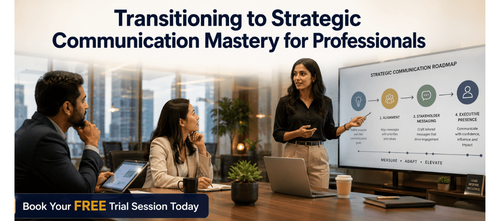

Evolve from Reactive Communication to Strategic Communication Mastery
In today’s professional world, how you communicate can be the key to unlocking career opportunities, building strong relationships, and leading with influence. However, most professionals are never formally taught how to communicate strategically. Instead, they often operate in a reactive communication mode, responding to whatever lands in front of them without clear intention, audience awareness, or a defined outcome.
This approach limits professional growth and can hinder your ability to influence decision-making, build trust, and make an impact. Strategic communication, on the other hand, is about communicating with clarity, purpose, and precision. It’s about saying the right thing, to the right person, at the right moment, with a clear outcome in mind. In this playbook, we’ll guide you through the journey from reactive to strategic communication mastery.
Download these resources and apply them alongside your daily work for improved clarity, productivity, and professional growth. You can also book a free trial to gain expert guidance and enhance your communication, problem-solving, and decision-making skills. The materials are designed in a clear, structured format to help professionals learn efficiently and implement insights with confidence.
Who Is This Blog For?
- Career switchers and early-to-mid-career professionals
- Consultants and managers aiming to enhance their communication strategies
- Anyone who feels caught off-guard in high-stakes situations and wants to lead with intention
- Professionals who wish to communicate with purpose, influence, and clarity
Why This Topic Matters Today?
In today’s competitive workplace, influence and visibility are crucial to career success. Reactive communication, where you simply respond to what’s happening around you, can limit your ability to lead, influence, and achieve your professional goals. This style often leads to missed opportunities, misunderstandings, and stalled progress.
Strategic communication isn’t just about delivering information—it’s about shaping how you present your ideas and ensuring they resonate with your audience. Professionals who master strategic communication are not just participants in conversations; they lead them. They are the ones who are remembered, trusted, and promoted.
Core Concept or Framework Explained
The journey to strategic communication mastery involves evolving from a reactive communication style to a proactive, intentional approach. There are three key phases in this evolution:
Understanding where you currently operate in terms of communication style—reactive, transitioning, or strategic mastery.
Learning how to apply a strategic communication framework to prepare for and navigate interactions with purpose.
Continuously refining your communication strategy to align with both your personal goals and the needs of your audience.
This framework provides a clear path from identifying your default communication habits to applying tools that help you communicate with intention and clarity in every professional interaction.
How This Blog and Guidebook Help You?
This blog and its accompanying guidebook provide actionable tools and frameworks to help you develop strategic communication mastery. The guide will help you:
- Understand your current communication default and how to shift it
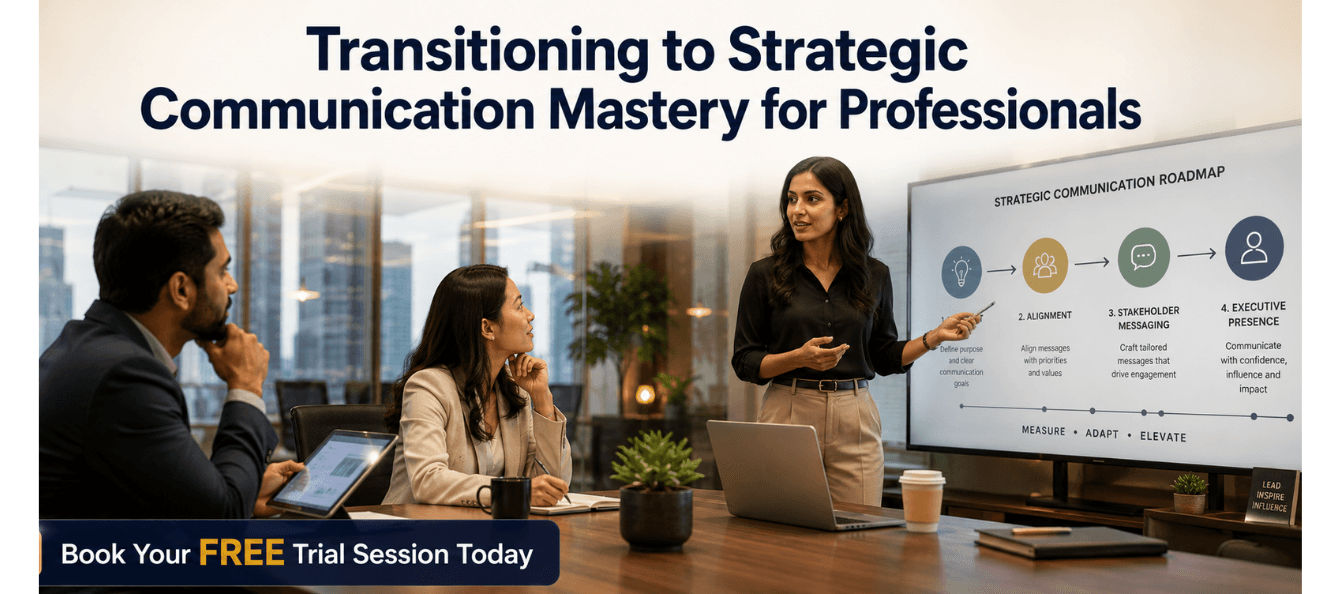
- Learn the four pillars of strategic communication: Purpose, Audience, Message, and Timing
- Adapt your communication style to different audiences to improve your influence
- Handle high-stakes conversations with confidence and clarity using the PREP-ACT model
- Write with strategic intent using proven techniques like BLUF (Bottom Line Up Front)
Step-by-Step Breakdown
Step 1: Awareness – Understand Your Current Communication Default
Before you can shift to strategic communication, you need an honest picture of where you currently operate. Most professionals are somewhere between reactive and strategic communication, and awareness of your default patterns is the first step.
- Reactive Communication: Responds to pressure, avoids difficult conversations, and measures success by survival.
- Transitioning Communication: Occasionally pauses to prepare, is aware of audience but inconsistent, and reflects after interactions.
- Strategic Mastery: Leads with intention, adapts style fluidly, and defines clear outcomes.
Step 2: Application – The Strategic Communication Framework
The strategic communication framework is built on four pillars:
Define your desired outcome before you communicate. What do you want the other person to think, feel, or do after this interaction?
Understand who you’re speaking to—their communication style, priorities, and what matters most to them.
Craft your core message with precision. Lead with the most important point using the BLUF principle.
Choose the right moment and medium. Some conversations deserve privacy, while others may need a public setting.
This framework serves as a pre-communication checklist to ensure you approach every interaction with clarity and strategic intent.
Step 3: Application – Adapting Your Style to Your Audience
One of the most important skills in strategic communication is adapting your style to your audience. Not everyone responds to the same approach. Strategic communicators read their audience and adjust their style accordingly.
By identifying your audience’s style and adapting accordingly, you lead the conversation rather than simply participating in it.
Step 4: Application – Navigating High-Stakes Conversations
High-stakes conversations—such as performance reviews, salary negotiations, or client escalations—demand strategic preparation. The PREP-ACT model is a powerful tool for these situations:
Define your single most important outcome.
Gather context and data to understand the other person’s position.
Identify and regulate your emotional state.
Craft your first two sentences to set the tone.
Prepare for the three most likely reactions—agreement, resistance, or deflection.
Define the next step or action.
Step 5: Mastery – Strategic Communication in Writing
In modern workplaces, written communication often plays a more permanent role than verbal communication. To communicate strategically in writing, use the following principles:
State your request or key point in the first sentence.
Avoid combining multiple topics in one message.
Use headers, bullet points, and bold text to guide the reader.
Every written communication should end with a clear call to action.
Step 6: Real-World Application – From Reactive to Strategic
Take Priya, for example. A mid-level project manager, Priya was technically excellent but lacked influence with senior stakeholders. By adopting strategic communication practices, including proactive communication and the BLUF principle, she dramatically shifted her professional presence and earned a promotion.
Common Mistakes or Pitfalls to Avoid
Always define your desired outcome before significant conversations.
Adapt your approach based on the other person’s communication style.
Be proactive in communicating and providing updates.
Use the PREP-ACT model to prepare thoroughly.
How Should You Use This Guidebook Effectively?
To make the most of this playbook:
- Start by assessing your current communication habits.
- Apply the four pillars framework before each significant interaction.
- Practice adapting your communication style based on your audience.
- Use the PREP-ACT model for high-stakes conversations.
Key Takeaways
- Strategic communication is a learnable skill that can transform your professional presence
- Preparation and audience awareness are key to successful communication
- Writing and verbal communication should be aligned and strategically structured
- Proactive communication is essential for building visibility and influence
Your Next Step: Accelerate Your Career with PlanetSpark
Creating an impact-driven resume is not just about landing your next job—it’s about owning your professional story and presenting it with clarity, confidence, and credibility. When your resume clearly communicates value, results, and impact, opportunities follow naturally.
At PlanetSpark, we are committed to empowering working professionals with practical, outcome-focused resources that drive real career growth. From resume building and workplace communication to leadership presence and professional writing, our programs are designed to help you succeed in today’s fast-evolving job market.
Visit https://www.planetspark.in/resources to explore:
- Career and resume-building guides
- Workplace communication and professional writing resources
- Skill-development tools curated for working professionals
Want a deeper, hands-on experience?
You can also book a free trial session to learn more about PlanetSpark’s Working Professional Courses, designed to accelerate your career through personalised coaching, real-world practice, and expert guidance.
Your career deserves more than generic advice.
It deserves clarity, confidence, and measurable impact.
Personalized Communication Roadmaps
Record a video to get a AI generated personalized communication reports