
Ultimate Decision-Making Toolkit for Working Professionals
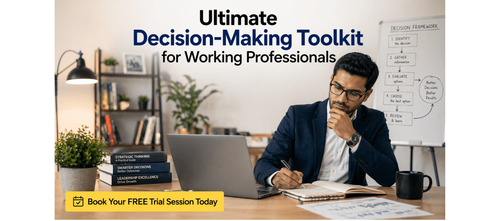

Mastering Decision-Making
Every day, professionals are faced with decisions—some minor, others major. Whether it's choosing a new project approach, deciding on career opportunities, or managing team conflicts, the choices you make directly impact your success. Yet, most professionals were never formally taught how to make decisions well. They learn by trial, error, and the occasional mistake that affects their career. The result? Missed opportunities, eroded trust, and stalled career growth. What sets successful professionals apart is their ability to make decisions with clarity, confidence, and purpose.
This is where structured decision-making frameworks can make a difference. By applying proven decision-making strategies, you can move from uncertainty to confident, strategic decisions that accelerate your career.
Download these resources and apply them alongside your daily work for improved clarity, productivity, and professional growth. You can also book a free trial to gain expert guidance and enhance your communication, problem-solving, and decision-making skills. The materials are designed in a clear, structured format to help professionals learn efficiently and implement insights with confidence.

Who Is This Blog For?
- Career changers navigating new roles
- Managers and consultants seeking to enhance leadership decisions
- Mid-career professionals striving for more confident decision-making
- Early-career professionals looking to master high-stakes choices
- Teams and stakeholders involved in group decision-making
Why This Topic Matters Today?
In a competitive job market, the ability to make decisions efficiently is not just a skill—it's a differentiator. According to research, professionals who make strong decisions are more likely to advance in their careers, maintain client trust, and achieve business goals. However, many professionals fall into common decision-making pitfalls—such as analysis paralysis or over-reliance on gut feelings—leading to poor outcomes. By adopting a structured decision-making process, you can avoid these traps and make smarter choices, faster.
Core Concept or Framework Explained
The backbone of effective decision-making lies in understanding your personal decision-making style and applying proven frameworks. The toolkit provides a systemized approach that helps you:
- Know Your Decision Style: Identifying your default decision-making style (Analyst, Intuitor, Collaborator, Avoider) is crucial for understanding your strengths and blind spots. By knowing how you approach decisions, you can better adapt to various situations.
- Use Proven Frameworks: The toolkit introduces three key decision-making frameworks—The Decision Matrix, the 10/10/10 Rule, and the Reversibility Test—designed to help you evaluate options, handle uncertainty, and manage high-stakes decisions effectively.
How This Blog and Guidebook Help You?
This blog and its guidebook equip you with:
- Structured decision-making frameworks to streamline your process
- Tools to assess and refine your decision-making style
- Methods to mitigate cognitive biases that can skew your judgment
- A five-step decision process that balances analytical rigor and emotional intelligence
The result? Better decisions, more confident leadership, and the ability to navigate high-pressure situations with clarity and purpose.
Step-by-Step Breakdown
Step 1: Know Your Decision Style
Before making any decision, identify your decision-making style. Do you overthink (Analyst), trust your gut (Intuitor), rely on others for input (Collaborator), or avoid making tough calls (Avoider)? Understanding your style helps you recognize where you may need to adjust your approach to make better decisions.
Step 2: Apply the Decision Matrix
When faced with multiple options, use the Decision Matrix to evaluate each option against key criteria. Whether it’s choosing between job offers or project approaches, this framework allows you to make clear, data-backed choices.
Step 3: Use the 10/10/10 Rule
When making high-emotion decisions, ask yourself how you will feel about the decision in 10 minutes, 10 months, and 10 years. This temporal shift helps you see the long-term implications of your choices and gain perspective during stressful moments.
Step 4: Use the Reversibility Test
Not every decision requires the same level of investment. The Reversibility Test helps you decide whether to move quickly or slow down. Use it to gauge the weight of your decision and ensure you allocate the right amount of time and energy to it.
Step 5: Implement the 5-Step Decision Process
Use a repeatable process for every decision. From defining the real problem to committing and reviewing your choice, the 5-step checklist helps you remain systematic, clear, and confident.
Common Mistakes or Pitfalls to Avoid
Despite your best efforts, some common decision-making mistakes are hard to avoid:
- Confirmation Bias: Focusing only on evidence that confirms your existing beliefs. Combat this by asking a team member to play devil’s advocate.
- Anchoring: Relying too heavily on the first piece of information you receive. Counter this by making your own independent assessment before seeing any proposals.
-Sunk Cost Fallacy: Continuing down a failing path because of past investment. To fix this, ask yourself if you would make the same decision if you started from scratch today.
How Should You Use This Guidebook Effectively?
To maximize the value of this guidebook:
- Read through the full toolkit to understand your default decision style.
- Apply the frameworks to real scenarios you face at work or in your career decisions.
- Make a habit of using the 5-step decision process for every important decision you encounter.
- Set a time to review your decisions using a decision journal, ensuring you learn and adapt continuously.
Key Takeaways
- Decision-making is a skill you can master with practice and the right tools.
- Understanding your decision-making style is the first step to improving your choices.
- Frameworks like the Decision Matrix and 10/10/10 Rule help you make clearer, data-driven decisions.
- Recognizing and avoiding cognitive biases ensures better judgment in high-pressure situations.
- A consistent decision-making process leads to more confident, effective decisions over time.
Your Next Step: Accelerate Your Career with PlanetSpark
Creating an impact-driven resume is not just about landing your next job—it’s about owning your professional story and presenting it with clarity, confidence, and credibility. When your resume clearly communicates value, results, and impact, opportunities follow naturally.
At PlanetSpark, we are committed to empowering working professionals with practical, outcome-focused resources that drive real career growth. From resume building and workplace communication to leadership presence and professional writing, our programs are designed to help you succeed in today’s fast-evolving job market.
Visit https://www.planetspark.in/resources to explore:
- Career and resume-building guides
- Workplace communication and professional writing resources
- Skill-development tools curated for working professionals
Want a deeper, hands-on experience?
You can also book a free trial session to learn more about PlanetSpark’s Working Professional Courses, designed to accelerate your career through personalised coaching, real-world practice, and expert guidance.
Your career deserves more than generic advice.
It deserves clarity, confidence, and measurable impact
Personalized Communication Roadmaps
Record a video to get a AI generated personalized communication reports