
Ultimate Guide for Working Professionals to Showcase Global Experience
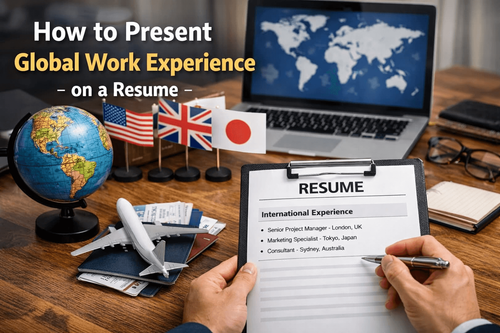

How to Present Global Work Experience on a Resume: The Ultimate Guide to Showcasing International Impact
In today’s globalised job market, having international work experience should be a powerful advantage. Yet, many professionals struggle to present it effectively. Instead of standing out, their resumes often confuse hiring managers with unfamiliar company names, unclear contexts, or scattered global exposure. The reality is simple: global experience is only valuable if it is clearly communicated. Recruiters are not just impressed by where you have worked—they care about what you achieved, how you navigated complexity, and whether your experience translates to their context. This guide transforms your international career journey into a compelling, structured narrative that hiring managers instantly understand and value.
Who Is This Blog For?
This blog and guidebook are designed for:
- Working professionals with international exposure across roles, projects, or geographies
- Career changers repositioning global experience for new industries or markets
- Mid-career professionals targeting leadership roles in multinational environments
- Consultants, freelancers, and portfolio professionals working across borders
- Job seekers struggling to explain non-linear or globally diverse career paths
Why This Topic Matters Today?
Globalisation has reshaped hiring expectations. Employers increasingly value professionals who can operate across cultures, manage distributed teams, and deliver results in diverse environments. However, global experience can also become a disadvantage if poorly presented. Hiring managers often struggle with:
- Unfamiliar company names and markets
- Metrics in different currencies or formats
- Difficulty assessing relevance to their local context
The result? Strong candidates get overlooked simply because their experience is not clearly translated.
A well-structured global resume eliminates confusion and answers three critical questions every recruiter asks:
- Can you operate effectively in our environment?
- Can your impact be verified and understood?
- Is your experience relevant to our context?
Core Concept or Framework Explained
The foundation of presenting global experience lies in strategic storytelling, not just listing roles.
The guide introduces the Three-Layer Framework, which ensures every resume entry communicates complete value:
- Context: Where you worked, company scale, and geographic scope
- Contribution: What you delivered and achieved
- Competence: Skills and capabilities developed that are transferable
This layered approach transforms vague statements into clear, impactful narratives.
For example, instead of simply stating a role, a strong entry combines location, measurable outcomes, and cross-cultural complexity. This ensures hiring managers do not need to interpret your experience—they immediately understand it.
How This Blog and Guidebook Help You?
This blog and guidebook help you turn your global experience into a competitive advantage by enabling you to:
- Identify and organise all forms of international exposure
- Translate complex global work into simple, recruiter-friendly language
- Quantify achievements in a way that is universally understood
- Structure your resume for clarity across different markets
- Tailor your profile for domestic, multinational, or international roles
The result is a resume that communicates global value clearly, confidently, and convincingly.
Step-by-Step Breakdown
Step 1: Understand What Hiring Managers Want
Before writing your resume, shift your perspective to the recruiter’s mindset. Hiring managers evaluating global profiles are focused on clarity, relevance, and proof.
They want to know:
- Whether your experience translates to their role
- Whether your achievements are measurable and credible
- Whether your skills are transferable across markets Your resume should proactively answer these questions instead of leaving room for interpretation.
Step 2: Conduct a Global Experience Audit
Most professionals underestimate their international exposure. Start by capturing everything without filtering:
- Countries where you worked, studied, or collaborated
- Organisations, industries, and role contexts
- Projects involving cross-border coordination
- Quantifiable outcomes such as revenue, growth, or efficiency
- Skills developed through global exposure
This step builds a comprehensive inventory that forms the foundation of your resume.
Step 3: Categorise and Prioritise Your Experience
Not all global experience carries the same weight. The guide categorises experience into different levels of impact:
- High-value signals such as expatriate roles and cross-border leadership
- Strong signals like international client management and global team collaboration
- Supporting signals including certifications abroad and language skills
Prioritising helps you focus on what truly strengthens your profile.
Step 4: Apply the Three-Layer Framework to Each Role
Every resume entry should include:
- Context: Company, geography, and scale
- Contribution: Specific actions and outcomes
- Competence: Transferable skills gained
This ensures your experience is complete, credible, and relevant. Missing any layer weakens your impact.
Step 5: Write High-Impact Bullet Points
Strong bullet points follow a structured formula:
- Start with a strong action verb
- Introduce the global context early
- Quantify outcomes wherever possible
- Highlight complexity such as time zones, regulations, or cultural differences
- Translate unfamiliar elements for the target audience
This approach ensures clarity while showcasing sophistication.
Step 6: Choose the Right Resume Structure
Your resume structure should reflect how your global experience fits into your career:
- Integrated approach for professionals with consistent international exposure
- Highlighted approach for those with selective global experience
- Functional hybrid for fragmented or consulting-based careers
Choosing the right format improves readability and strategic positioning.
Step 7: Tailor Your Resume for Different Markets
A single resume does not work across all markets. Adapt your presentation based on your target:
For domestic roles:
- Translate international experience into local relevance
- Provide company context and simplify metrics
For multinational companies:
- Emphasise scale, complexity, and global frameworks
- Highlight cross-cultural leadership
For international roles:
- Focus on adaptability and transferability
- Showcase language skills and global exposure prominently
Step 8: Present Cross-Cultural Skills with Evidence
Avoid vague claims such as “strong global mindset.” Instead, demonstrate skills through examples:
- Show how you managed international teams
- Highlight outcomes achieved in diverse environments
- Provide context that proves adaptability and communication ability
Evidence builds credibility far more effectively than generic statements.
Step 9: Handle Common Global Resume Challenges
Global careers often come with complexities. Address them strategically:
- Explain employment gaps due to relocation clearly
- Group short-term international roles where necessary
- Add descriptors for unknown companies
- Convert currencies or use percentage-based metrics
These small adjustments significantly improve clarity and trust.
Step 10: Align Your Resume with LinkedIn
Your LinkedIn profile should reinforce your resume:
- Use a headline that reflects your global identity
- Tell your international story in the About section
- Mirror resume achievements in the Experience section
- Highlight global competencies in skills
Consistency across platforms strengthens your professional brand.
Common Mistakes or Pitfalls to Avoid
Avoid these common errors that weaken global resumes:
- Listing countries without explaining roles or achievements
- Assuming company recognition across markets
- Burying global experience in secondary sections
- Using the same resume for every application
- Failing to explain the impact of international work
Each of these reduces clarity and can cost you opportunities.
How Should You Use This Guidebook Effectively?
To maximise results, follow a structured approach:
- Read the guide once to understand the full framework
- Complete the global experience inventory in detail
- Rewrite key resume sections using the frameworks
- Tailor your resume for specific roles and markets
- Allocate focused time across 24–48 hours for implementation
Revisit the guide regularly as your career evolves or when targeting new markets.
Key Takeaways
- Translate global experience into clear, relevant narratives
- Use the Three-Layer Framework for every role
- Quantify achievements to improve credibility
- Prioritise high-impact international experience
- Tailor your resume for each target market
- Support cross-cultural skills with evidence, not claims
- Align your resume and LinkedIn for consistency
Your Next Step: Accelerate Your Career with Planet Spark
Creating an impact-driven resume is not just about landing your next job—it’s about owning your professional story and presenting it with clarity, confidence, and credibility. When your resume clearly communicates value, results, and impact, opportunities follow naturally. At Planet Spark, we are committed to empowering working professionals with practical, outcome-focused resources that drive real career growth. From resume building and workplace communication to leadership presence and professional writing, our programs are designed to help you succeed in today’s fast-evolving job market.
Visit https://www.planetspark.in/resources to explore:
- Career and resume-building guides
- Workplace communication and professional writing resources
- Skill-development tools curated for working professionals
Want a deeper, hands-on experience?
You can also book a free trial session to learn more about Planet Spark’s Working Professional Courses, designed to accelerate your career through personalised coaching, real-world practice, and expert guidance. Your career deserves more than generic advice.
It deserves clarity, confidence, and measurable impact.
Personalized Communication Roadmaps
Record a video to get a AI generated personalized communication reports