
Ultimate Guide to Academic CVs for Interdisciplinary Researchers
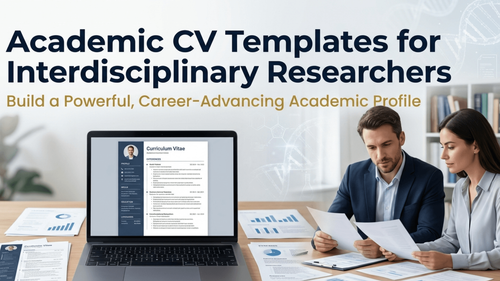

Academic CV Templates for Interdisciplinary Researchers: Build a Powerful, Career-Advancing Academic Profile
If you’re an academic or researcher, you already know this: writing a CV is not the hard part—structuring it strategically is.
Unlike a standard resume, an academic CV is a living, evolving document that captures your intellectual contributions—publications, research, teaching, grants, and impact. But for interdisciplinary researchers, the challenge becomes even more complex. You’re not just presenting achievements—you’re connecting multiple domains, audiences, and expectations into one coherent narrative.
This is where most professionals struggle.
The Academic CV Template Pack for Interdisciplinary Researchers solves this problem by giving you structured, recruiter-ready formats tailored to real academic and career scenarios. With 10 specialised templates, it eliminates guesswork and helps you present your work with clarity, precision, and credibility.
Who Is This Blog For?
- PhD candidates and postdoctoral researchers entering the academic job market
- Interdisciplinary researchers working across multiple domains
- Academics applying for grants, fellowships, or international positions
- Professionals transitioning from academia to industry or policy roles
- Senior faculty and consultants building high-impact academic portfolios
- Researchers aiming to improve CV clarity, structure, and positioning
Why This Topic Matters Today?
The academic and research landscape has changed dramatically. Today, hiring committees, funding panels, and institutions are not just evaluating qualifications—they are assessing clarity, impact, and relevance.
Key challenges professionals face include:
- Difficulty structuring complex, multi-field research profiles
- Inconsistent formatting that weakens credibility
- Poor translation of academic work into industry or policy language
- Lack of alignment with specific application goals
For interdisciplinary professionals, the stakes are even higher. You must communicate across fields while maintaining depth and coherence. As highlighted in the guidebook, your CV is no longer just a record—it is a strategic narrative of your intellectual contributions.
Core Concept or Framework Explained
At the heart of this resource is a powerful idea: one CV does not fit all.
Instead of a generic format, the template pack provides scenario-specific CV structures tailored to different career stages and goals. Each template is designed to align with a specific professional context, ensuring your CV speaks directly to its intended audience.
The framework operates on three core principles:
Context-Based Structuring
Each template is built for a distinct purpose—whether it’s a grant application, teaching role, or industry transition. This ensures your CV highlights the most relevant information first.
Clarity Through Structure
Templates eliminate the blank-page problem and provide predefined sections such as research experience, publications, teaching, and impact metrics. This allows you to focus on content instead of formatting.
Strategic Positioning
Rather than listing achievements randomly, the templates guide you to position your work strategically—showing impact, relevance, and progression across your career.
How This Blog and Guidebook Help You?
This blog helps you understand not just what to include in your CV, but how to position it for maximum impact.
By using the template pack, you can:
- Save time by eliminating formatting decisions
- Present your interdisciplinary work clearly and convincingly
- Align your CV with specific career goals or applications
- Improve your chances of selection in competitive environments
- Translate academic achievements into real-world impact
Ultimately, this resource helps you move from “listing information” to “telling a compelling professional story.”
Step-by-Step Breakdown
Understanding the 10 Strategic CV Templates
The template pack includes 10 distinct CV formats, each tailored to a specific career scenario.
Foundational Academic CV
Designed for early-stage researchers, this template focuses on education, research output, and emerging academic identity.
Interdisciplinary Research CV
This template helps you frame work across multiple fields as a strength by clearly defining primary and secondary domains, shared methodologies, and cross-disciplinary contributions.
Grant and Fellowship Application CV
Optimised for funding applications, this format highlights research vision, funding track record, and measurable impact metrics such as citations and grants secured.
Teaching-Focused Academic CV
Ideal for lecturer roles, this template prioritises teaching philosophy, curriculum development, and student mentorship.
Academia-to-Industry Transition CV
This format translates academic experience into industry-relevant language, focusing on transferable skills, measurable outcomes, and stakeholder impact.
Senior Faculty and Full Professor CV
A comprehensive format for experienced academics, showcasing leadership roles, major research programmes, publications, and institutional impact.
Postdoctoral Researcher CV
Balances research excellence with future potential, highlighting current research, publications, and technical expertise.
Independent Research Consultant CV
A hybrid structure that combines academic credibility with client-facing impact, ideal for consultants and advisory professionals.
International Academic CV
Tailored for global applications, this template accounts for regional differences in CV expectations and presentation styles.
Digital and Public Scholar CV
Designed for academics with strong public engagement, this format integrates digital presence, media contributions, and community impact.
How to Use the Templates Effectively
The guidebook outlines a simple but powerful workflow:
- Choose the template that matches your career goal
- Replace all placeholders with your information
- Customise sections based on relevance
- Export or convert into the required format
Each template uses clearly labelled placeholders like name, publication details, or project descriptions, making the process fast and intuitive.
What to Include in Each Section
Across templates, key sections include:
- Research interests and specialisations
- Education and academic background
- Publications and conference presentations
- Research experience and projects
- Teaching experience and mentorship
- Awards, grants, and fellowships
- Professional affiliations and collaborations
The structure ensures that every section contributes to a cohesive narrative of your expertise and impact.
Common Mistakes or Pitfalls to Avoid
Even highly qualified professionals often weaken their CVs with avoidable mistakes.
Leaving Placeholder Text
Failing to replace template placeholders signals carelessness and can lead to rejection.
Using a Generic CV for Every Application
Different opportunities require different emphasis. A teaching role and a grant application demand entirely different narratives.
Overloading with Irrelevant Information
Including every detail without prioritisation makes your CV difficult to read and reduces impact.
Poor Formatting and Inconsistency
Inconsistent layouts or cluttered sections reduce credibility, especially when committees review multiple applications.
Not Translating Interdisciplinary Work Clearly
Failing to connect multiple fields into a coherent story can make your profile seem unfocused instead of versatile.
How Should You Use This Guidebook Effectively?
To get the most value from this resource, follow a structured approach:
Start with Clarity
Identify your target role or opportunity before selecting a template.
Invest Focused Time
Set aside 2 to 3 hours to fully customise your CV rather than rushing through it.
Tailor Every Application
Adjust your CV slightly for each application to align with expectations.
Review and Refine
Double-check formatting, remove irrelevant sections, and ensure consistency across pages.
Export Professionally
Always export your final CV as a clean PDF to maintain formatting integrity.
Key Takeaways
- Academic CVs require strategic structuring, not just content listing
- Interdisciplinary researchers must communicate across multiple domains clearly
- Scenario-specific templates significantly improve clarity and effectiveness
- Customisation and relevance are critical for success
- A well-structured CV can directly influence career opportunities
Your Next Step: Accelerate Your Career with PlanetSpark
Creating an impact-driven resume is not just about landing your next job—it’s about owning your professional story and presenting it with clarity, confidence, and credibility. When your resume clearly communicates value, results, and impact, opportunities follow naturally.
At PlanetSpark, we are committed to empowering working professionals with practical, outcome-focused resources that drive real career growth. From resume building and workplace communication to leadership presence and professional writing, our programs are designed to help you succeed in today’s fast-evolving job market.
Visit https://www.planetspark.in/resources to explore:
- Career and resume-building guides
- Workplace communication and professional writing resources
- Skill-development tools curated for working professionals
Want a deeper, hands-on experience?
You can also book a free trial session to learn more about PlanetSpark’s Working Professional Courses, designed to accelerate your career through personalised coaching, real-world practice, and expert guidance.
Your career deserves more than generic advice.
It deserves clarity, confidence, and measurable impact.
Personalized Communication Roadmaps
Record a video to get a AI generated personalized communication reports