
Ultimate Guide to Designing Parallel Career Paths Before Making the Switch


Learn to Design Parallel Career Paths Before Fully Switching For Safer, Smarter Career Transitions
Switching careers doesn’t always require a sudden leap. In fact, the most strategic professionals rarely abandon their current roles overnight. Instead, they build parallel career paths—developing skills, gaining experience, and testing new directions while still maintaining financial stability.
The challenge is that many professionals treat career transitions as all-or-nothing decisions. This creates unnecessary pressure, risk, and uncertainty. Without a structured approach, they either delay transitions indefinitely or make abrupt moves without sufficient preparation.
Designing parallel career paths solves this problem. It allows you to explore new opportunities, validate your interests, and build credibility before fully committing. Rather than relying on assumptions, you create a gradual transition supported by real-world experience.
This guide provides a structured system to help you design, manage, and optimise parallel career paths so you can transition with confidence and minimal risk.
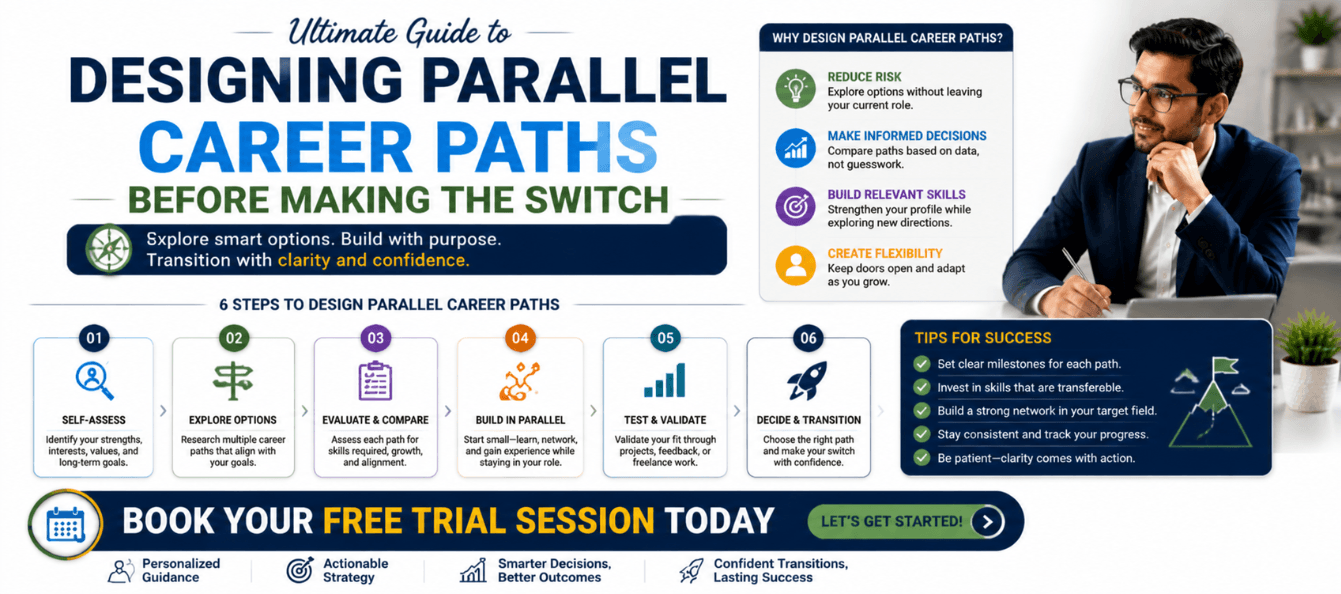
Download these resources and apply them alongside your daily work for improved clarity, productivity, and professional growth. You can also book a free trial to gain expert guidance and enhance your communication, problem-solving, and decision-making skills. The materials are designed in a clear, structured format to help professionals learn efficiently and implement insights with confidence.
Who Is This Blog For?
- Working professionals exploring a career switch but not ready to leave their current role
- Individuals seeking low-risk ways to test new career directions
- Mid-career professionals balancing financial stability with growth ambitions
- Job seekers wanting to build experience before applying to new roles
- Professionals aiming to validate career decisions before committing fully
Why This Topic Matters Today?
In today’s dynamic job market, career transitions are frequent but often uncertain. Professionals face increasing pressure to adapt, reskill, and stay competitive—while also managing financial and personal responsibilities.
Common challenges include:
- Fear of losing financial stability during a transition
- Lack of real-world experience in a new field
- Uncertainty about whether a new career path is the right fit
- Difficulty balancing current responsibilities with future goals
- Limited opportunities to test new roles before committing
Parallel career paths offer a practical solution. They allow professionals to reduce risk, gain clarity, and build momentum without making irreversible decisions.
Core Concept or Framework Explained
Designing parallel career paths involves building a secondary career direction alongside your current role, allowing gradual transition and validation.
Instead of making a single high-risk move, you create two tracks:
- Primary track: Your current job or career path that provides stability
- Parallel track: Your target career path that you develop progressively
The framework includes:
- Exploration: Identifying potential career paths of interest
- Skill development: Building relevant capabilities for the new path
- Experience creation: Gaining practical exposure through projects or part-time work
- Validation: Testing your interest and market fit
- Transition readiness: Preparing to shift fully when the time is right
For example, a finance professional interested in data analytics may start learning tools, working on projects, and freelancing before applying for full-time roles.
How This Blog and Guidebook Help You?
This blog translates the concept of parallel career paths into actionable strategies. By applying this approach, you will:
- Reduce the risk associated with career transitions
- Gain practical experience before switching
- Validate your interests and capabilities
- Build confidence and readiness for new opportunities
- Transition smoothly without starting from scratch
Instead of making uncertain leaps, you will create a structured path toward your new career.
Step-by-Step Breakdown
Identify Your Target Career Path
Start by clearly defining the career you want to explore.
Ask:
- What role or industry am I interested in?
- What motivates this transition?
- What skills are required for this path?
Clarity ensures focused effort.
Assess Your Current Resources and Constraints
Evaluate what you can realistically commit.
Consider:
- Available time outside your current job
- Financial stability
- Existing skills and experience
- Personal responsibilities
This helps you design a practical and sustainable plan.
Build Relevant Skills Gradually
Start developing the skills required for your target role.
Focus on:
- Online courses and certifications
- Practical learning through projects
- Industry-specific tools and techniques
Consistency is more important than intensity.
Create Real-World Experience
Experience builds credibility.
Options include:
- Freelance work or part-time roles
- Personal or simulated projects
- Volunteering or collaborations
Example:
A marketing professional can start managing social media for small businesses as a side project.
Test and Validate Your Interest
Before committing fully, ensure that the new path aligns with your expectations.
Ask:
- Do I enjoy the work involved?
- Am I able to perform effectively?
- Is there demand for this role in the market?
Validation reduces the risk of making the wrong choice.
Build a Transition Timeline
Define a realistic timeline for your transition.
Include:
- Skill development milestones
- Experience targets
- Financial readiness
- Job application timeline
A timeline keeps you accountable and focused.
Leverage Networking for Opportunities
Networking accelerates your progress.
Actions include:
- Connecting with professionals in your target field
- Seeking mentorship or guidance
- Exploring hidden opportunities
Strong networks create access to real-world insights and roles.
Prepare for the Final Transition
When you reach readiness, prepare to switch fully.
Ensure:
- You have sufficient skills and experience
- Your resume reflects your new positioning
- You have validated your career choice
This preparation increases your chances of success.
Common Mistakes or Pitfalls to Avoid
- Trying to do too much and burning out
- Lack of consistency in skill-building efforts
- Ignoring validation before committing
- Underestimating time and effort required
- Failing to plan the transition timeline
Avoiding these mistakes ensures a smoother transition.
How Should You Use This Guidebook Effectively?
To maximise the benefits of this guidebook, follow a disciplined approach:
- Allocate fixed weekly hours for your parallel path
- Set clear, measurable milestones
- Track your progress consistently
- Seek feedback from industry professionals
- Adjust your strategy based on results
A structured system ensures steady and sustainable progress.
Key Takeaways
- Parallel career paths reduce risk during transitions
- Maintain your current role while building a new direction
- Focus on gradual skill development and experience creation
- Validate your interest and market fit before switching
- Use timelines and milestones to stay on track
- Leverage networking to accelerate opportunities
- Transition only when you are fully prepared
Your Next Step: Accelerate Your Career with PlanetSpark
Creating an impact-driven resume is not just about landing your next job—it’s about owning your professional story and presenting it with clarity, confidence, and credibility. When your resume clearly communicates value, results, and impact, opportunities follow naturally.
At PlanetSpark, we are committed to empowering working professionals with practical, outcome-focused resources that drive real career growth. From resume building and workplace communication to leadership presence and professional writing, our programs are designed to help you succeed in today’s fast-evolving job market.
Visit https://www.planetspark.in/resources to explore:
- Career and resume-building guides
- Workplace communication and professional writing resources
- Skill-development tools curated for working professionals
Want a deeper, hands-on experience?
You can also book a free trial session to learn more about PlanetSpark’s Working Professional Courses, designed to accelerate your career through personalised coaching, real-world practice, and expert guidance.
Your career deserves more than generic advice.
It deserves clarity, confidence, and measurable impact.
Start building that advantage today—with PlanetSpark.
Personalized Communication Roadmaps
Record a video to get a AI generated personalized communication reports