
Ultimate Guide to First Principles Thinking for Career Growth


First Principles Thinking for Professionals: A Step-by-Step Framework to Solve Complex Problems with Clarity and Confidence
You’ve followed best practices. You’ve applied proven strategies. You’ve even taken advice from experienced professionals. Yet, some problems just refuse to move.
This is a common reality for working professionals today. Whether it’s a stalled project, a confusing career decision, or a strategy that isn’t delivering results, the usual playbooks often fall short. The real issue? Most decisions are built on inherited assumptions rather than verified truths.
In fast-changing work environments, relying on “what worked before” is no longer enough. You need a way to think clearly, challenge assumptions, and build solutions that actually fit your situation.
That’s exactly what First Principles Thinking offers. This guidebook is designed to help you break down complex problems to their core truths and rebuild solutions from scratch—so you can make smarter decisions, faster.
Download these resources and apply them alongside your daily work for improved clarity, productivity, and professional growth. You can also book a free trial to gain expert guidance and enhance your communication, problem-solving, and decision-making skills. The materials are designed in a clear, structured format to help professionals learn efficiently and implement insights with confidence.
Who Is This Blog For?
- Working professionals with 0–15 years of experience facing complex decisions
- Managers and team leaders dealing with ambiguity and high-stakes challenges
- Consultants and strategists solving business or organisational problems
- Career switchers evaluating new paths or industries
- Product, marketing, and operations professionals handling stalled outcomes
- Anyone who feels stuck because conventional approaches are not working
Why This Topic Matters Today?
Modern workplaces are built on speed, scale, and constant change. Yet most professionals are trained to rely on patterns, templates, and past solutions.
This creates a gap.
When you face a new or complex problem, applying old solutions often leads to repeated failures. Many professionals spend months solving the wrong problem simply because they didn’t define it correctly or challenge their assumptions.
The guidebook highlights a critical insight: most problems are not difficult because of complexity, but because they are built on unexamined assumptions.
In such an environment, first principles thinking becomes a competitive advantage. It allows you to:
- Break free from outdated thinking patterns
- Identify what is actually true versus what is assumed
- Build solutions tailored to your exact situation
Core Concept
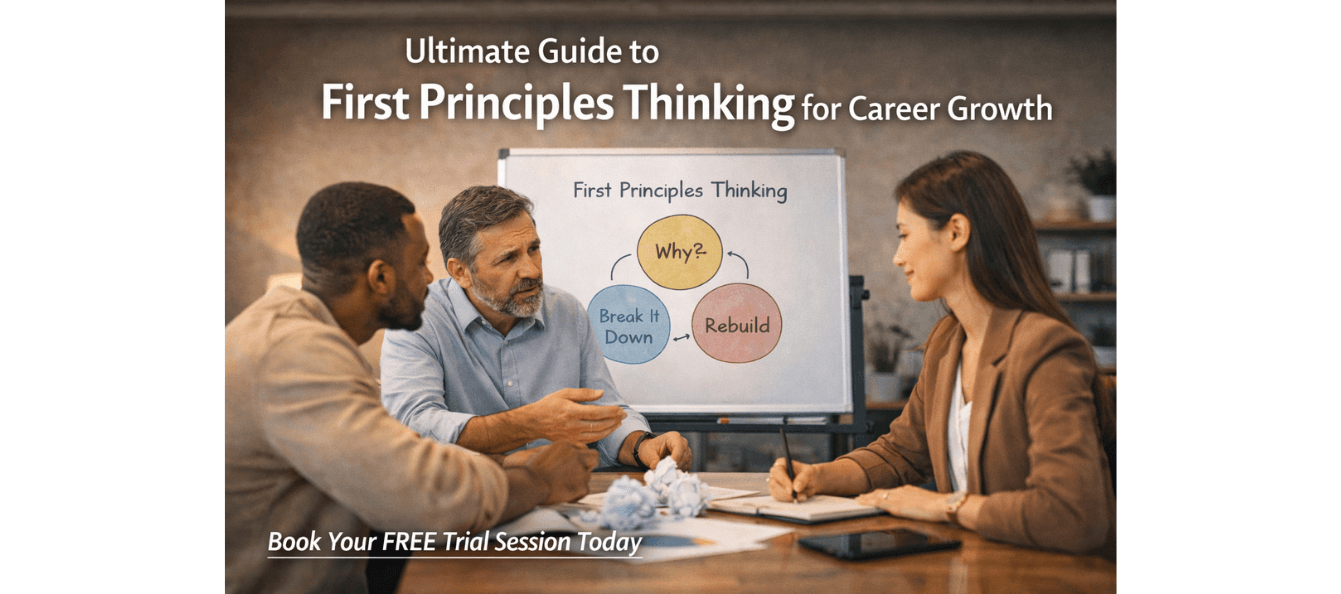
First principles thinking is a structured method of problem-solving that focuses on breaking down a problem into its most fundamental truths and rebuilding solutions from the ground up.
Instead of asking, “How have others solved this?”, you ask, “What is actually true here?”
The guidebook introduces a powerful five-step framework:
Define → Identify Assumptions → Decompose to Bedrock → Rebuild → Test
This framework shifts your thinking from analogy-based reasoning to truth-based reasoning.
For example, in one case study, a marketing professional assumed her only growth path was within her current field. By breaking down her situation, she realised her actual value lay in measurable business impact, not her job title. This led her to pivot into a higher-paying role in a different sector.
The transformation didn’t come from working harder—it came from thinking differently.
How This Blog and Guidebook Help You?
This blog and the underlying guidebook help you upgrade how you approach problems.
Instead of reacting to challenges, you learn to analyse them with clarity and structure.
Key benefits include:
- Clear problem definition, avoiding wasted effort
- Ability to identify and challenge hidden assumptions
- Stronger decision-making under uncertainty
- More innovative and effective solutions
- Increased confidence in high-stakes situations
Over time, this approach doesn’t just solve problems—it improves how you think.
Step-by-Step Breakdown
Define the Problem with Precision
Most professionals jump into solving without clearly defining the problem. This leads to misaligned efforts.
The guidebook emphasises defining the gap between what is happening and what should be happening. This includes:
- Describing the current situation factually
- Defining the desired outcome clearly
- Separating the problem from potential solutions
Techniques like the “5 Whys” help uncover root causes rather than surface symptoms.
Surface and Interrogate Assumptions
Every problem is surrounded by assumptions—about resources, people, timelines, and constraints.
The guidebook recommends listing at least 8–12 assumptions and questioning each one:
- Is this actually true?
- What evidence supports it?
- Has this been tested recently?
Assumptions are then classified as confirmed, unconfirmed, or disproven. This step alone often changes how you see the problem.
Break It Down to Bedrock Truths
Once assumptions are identified, the next step is to find what is undeniably true.
Bedrock truths are:
- Verifiable facts
- Independent of opinion or convention
- Applicable across contexts
For example, instead of assuming “customers don’t engage,” a bedrock truth might be “attention spans are limited and subject lines are evaluated in seconds.”
This shift leads to better strategies.
Rebuild Solutions from Scratch
With clear truths in place, you can now rebuild solutions.
This involves two stages:
- Divergence: generating multiple ideas without filtering
- Convergence: selecting the best options based on feasibility and impact
The guidebook suggests generating at least 10 solutions to move beyond conventional thinking.
Designing solutions from truth—not assumption—leads to more effective outcomes.
Test, Iterate, and Refine
The final step is validation.
Instead of fully implementing a solution immediately, you:
- Define clear success criteria
- Run a small, controlled test
- Gather feedback and refine
This ensures your solution works in real-world conditions and allows continuous improvement.
Common Mistakes
The guidebook highlights several common errors professionals make:
- Skipping problem definition and jumping to solutions
- Treating assumptions as facts without verification
- Stopping analysis too early without reaching core truths
- Generating solutions before completing assumption checks
- Using the framework for trivial decisions instead of complex ones
- Ignoring testing and validation
Avoiding these mistakes significantly improves the effectiveness of your thinking.
How Should You Use This Guidebook Effectively?
To get the best results, use a structured approach:
- Start by reading the guidebook to understand the full framework
- Choose one real problem you are currently facing
- Block 30–60 minutes for focused thinking
- Work through the worksheet step by step
- Write down your assumptions and challenge them
- Identify bedrock truths before generating solutions
- Test your chosen approach with a small experiment
For long-term benefits:
- Practice daily assumption checks before important decisions
- Conduct weekly audits of recurring processes
- Apply the full framework monthly to complex challenges
Consistency is what turns this into a powerful skill.
Key Takeaways
- Most problems are built on unexamined assumptions
- First principles thinking helps you identify what is actually true
- Clear problem definition prevents wasted effort
- Challenging assumptions unlocks better solutions
- Generating multiple options improves decision quality
- Testing ensures solutions work in real-world conditions
- Regular practice builds stronger thinking habits
Your Next Step: Accelerate Your Career with PlanetSpark
Creating an impact-driven resume is not just about landing your next job—it’s about owning your professional story and presenting it with clarity, confidence, and credibility. When your resume clearly communicates value, results, and impact, opportunities follow naturally.
At PlanetSpark, we are committed to empowering working professionals with practical, outcome-focused resources that drive real career growth. From resume building and workplace communication to leadership presence and professional writing, our programs are designed to help you succeed in today’s fast-evolving job market.
Visit https://www.planetspark.in/resources to explore:
- Career and resume-building guides
- Workplace communication and professional writing resources
- Skill-development tools curated for working professionals
Want a deeper, hands-on experience?
You can also book a free trial session to learn more about PlanetSpark’s Working Professional Courses, designed to accelerate your career through personalised coaching, real-world practice, and expert guidance.
Your career deserves more than generic advice.
It deserves clarity, confidence, and measurable impact.
Personalized Communication Roadmaps
Record a video to get a AI generated personalized communication reports