
Ultimate Guide to Knowledge Lifecycle Management for Professionals
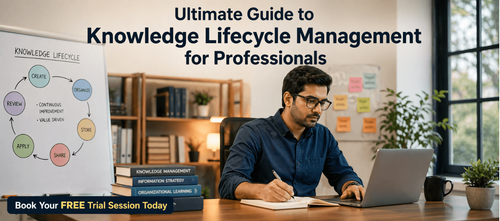

How to Use a Knowledge Lifecycle Management System to Turn Learning into Long-Term Career Growth
You are constantly learning—through projects, meetings, courses, and conversations. But how much of that knowledge actually stays with you? More importantly, how much of it actively improves your work?
For most professionals, the answer is surprisingly little. Valuable insights are forgotten within days, lessons from past projects are rarely reused, and hard-earned experience often disappears when roles change or teams evolve. The issue is not effort—it is the absence of a structured system to manage knowledge across its entire lifecycle.
This is exactly where Knowledge Lifecycle Management (KLM) becomes a game-changer. Instead of treating learning as a one-time event, KLM provides a structured, repeatable system to capture, organise, apply, share, and continuously improve what you know—ensuring that your knowledge compounds over time instead of fading away.
Download these resources and apply them alongside your daily work for improved clarity, productivity, and professional growth. You can also book a free trial to gain expert guidance and enhance your communication, problem-solving, and decision-making skills. The materials are designed in a clear, structured format to help professionals learn efficiently and implement insights with confidence.
Who Is This Blog For?
- Working professionals looking to turn learning into measurable results
- Managers aiming to retain and leverage team knowledge
- Consultants handling multiple projects and client insights
- Career switchers building structured professional expertise
- Early to mid-career professionals focused on long-term growth
Why This Topic Matters Today?
In today’s fast-moving professional environment, knowledge is one of the most valuable assets you have—but only if you manage it effectively.
Most professionals face challenges such as:
- Losing critical insights after meetings, projects, or courses
- Repeating the same work due to lack of knowledge reuse
- Struggling to articulate expertise in high-stakes situations
- Operating without a structured knowledge system
Without a lifecycle approach, knowledge leaks at every stage:
- Forgetting due to lack of capture
- Disorganisation that prevents retrieval
- Missed application opportunities
- Limited sharing that restricts impact
The result is lost productivity, slower growth, and reduced professional visibility.
Core Concept or Framework Explained
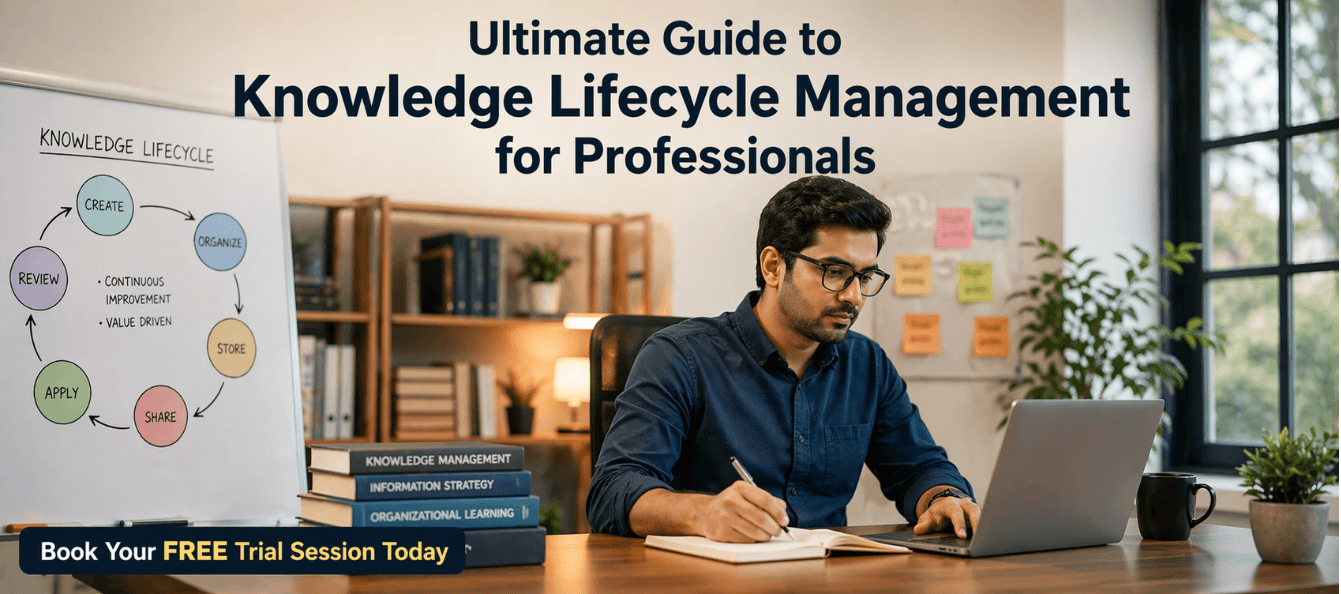
Knowledge Lifecycle Management is built around a six-stage system that ensures knowledge flows effectively from learning to impact:
Acquire
Learning with intention by identifying what knowledge is most valuable for your goals
Capture
Documenting key insights, decisions, and experiences before they are forgotten
Organise
Structuring knowledge so it is searchable, accessible, and usable
Apply
Using knowledge in real work scenarios to drive outcomes
Share
Distributing knowledge to multiply its impact across teams and networks
Renew
Continuously updating, refining, and challenging knowledge to keep it relevant
Each stage represents both an opportunity and a risk. When managed well, knowledge compounds. When ignored, it disappears.
How This Blog and Guidebook Help You?
This blog and the guidebook provide a complete, practical system to manage your knowledge effectively.
You gain:
- A clear end-to-end framework for knowledge management
- Practical tools and habits for each lifecycle stage
- Strategies to improve retention, application, and impact
- A repeatable system for long-term professional growth
The outcome is a professional who works smarter, learns faster, and delivers higher-value results consistently.
Step-by-Step Breakdown
Step 1: Knowledge Acquisition — What Should You Learn?
Learning becomes powerful when it is intentional.
Instead of passive consumption, focus on:
- Defining clear learning goals
- Choosing high-value sources
- Connecting new information to real work scenarios
A useful technique is the Learning Intent Statement:
By the end of this, I want to be able to [specific action] so that [specific outcome]
This ensures every learning effort has a purpose.
Step 2: Knowledge Capture — How Do You Prevent Forgetting?
Without capture, most knowledge is lost quickly.
Effective capture involves:
- Documenting insights immediately
- Focusing on key ideas, decisions, and lessons
- Capturing both explicit and tacit knowledge
A powerful habit is the 3-2-1 method:
- Three learnings
- Two unanswered questions
- One key insight
Done daily, this builds a valuable knowledge log over time.
Step 3: Knowledge Organisation — How Do You Structure Information?
Captured knowledge must be organised for retrieval.
The guide recommends the PARA method:
- Projects: Active work
- Areas: Ongoing responsibilities
- Resources: Reference material
- Archive: Inactive content
Supporting practices include:
- Consistent tagging
- Progressive summarisation
- Organising for retrieval, not storage
A well-organised system ensures you can find what you need quickly.
Step 4: Knowledge Application — How Do You Use What You Know?
Application is where knowledge creates value.
The APPLY framework helps guide this process:
- Assess the situation
- Pull relevant knowledge
- Link it to context
- Yield a decision or output
- Yoke in reflection
Key habits include:
- Checking your knowledge system before external research
- Reusing templates and past insights
- Maintaining decision journals
This ensures your knowledge actively supports your work.
Step 5: Knowledge Sharing — How Do You Multiply Impact?
Sharing knowledge increases its value exponentially.
Effective methods include:
- Peer knowledge exchanges
- Knowledge briefs summarising key insights
- Internal presentations or workshops
- External sharing through articles or professional platforms
A simple rule to follow:
Share one piece of knowledge for every ten you capture.
This builds credibility and strengthens your professional network.
Step 6: Knowledge Renewal — How Do You Stay Relevant?
Knowledge has a shelf life and must be updated regularly.
A structured renewal cycle includes:
- Daily capture and updates
- Weekly reviews to identify patterns
- Monthly audits to refine your system
- Quarterly reviews to assess gaps
- Annual strategic knowledge planning
An important practice is the “Unlearning Audit”—actively questioning outdated beliefs and approaches.
This keeps your knowledge current and effective.
Common Mistakes or Pitfalls to Avoid
Even with the right framework, professionals often make predictable mistakes:-
Building complex systems before developing capture habits
- Treating knowledge capture as the final goal
- Ignoring tacit knowledge from experience
- Skipping regular review and renewal
- Hoarding knowledge instead of sharing it
- Trying to implement everything at once
A better approach is to:
- Start simple and build gradually
- Focus on consistency over perfection
- Apply and share knowledge regularly
How Should You Use This Guidebook Effectively?
To implement Knowledge Lifecycle Management successfully:
- Start with one habit, such as daily capture
- Build your system stage by stage
- Use the 30-day plan to develop consistency
- Schedule regular reviews and audits
Recommended workflow:
- Daily: 10 minutes for capture and quick review
- Weekly: 20 minutes to organise and reflect
- Monthly: 45 minutes for system maintenance
- Quarterly: 90 minutes for strategic review
The key is consistency—small daily actions create long-term impact.
Key Takeaways
- Knowledge without management quickly fades and loses value
- A structured lifecycle approach ensures knowledge compounds over time
- Capture and organisation are critical for retention and usability
- Application is the most important step for creating real impact
- Sharing knowledge builds credibility and multiplies value
- Regular renewal keeps your knowledge relevant and effective
- Consistent habits outperform complex systems
Your Next Step: Accelerate Your Career with PlanetSpark
Creating an impact-driven resume is not just about landing your next job—it’s about owning your professional story and presenting it with clarity, confidence, and credibility. When your resume clearly communicates value, results, and impact, opportunities follow naturally.
At PlanetSpark, we are committed to empowering working professionals with practical, outcome-focused resources that drive real career growth. From resume building and workplace communication to leadership presence and professional writing, our programs are designed to help you succeed in today’s fast-evolving job market.
Visit https://www.planetspark.in/resources to explore:
- Career and resume-building guides
- Workplace communication and professional writing resources
- Skill-development tools curated for working professionals
Want a deeper, hands-on experience?
You can also book a free trial session to learn more about PlanetSpark’s Working Professional Courses, designed to accelerate your career through personalised coaching, real-world practice, and expert guidance.
Your career deserves more than generic advice.
It deserves clarity, confidence, and measurable impact.
Start building that advantage today—with PlanetSpark.
Personalized Communication Roadmaps
Record a video to get a AI generated personalized communication reports