
Ultimate Guide to Multi-Region Leadership for Professionals 2026
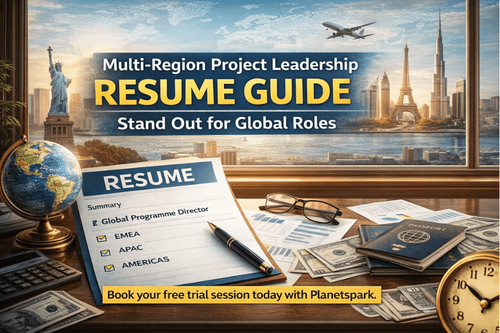

Multi-Region Project Leadership Resume Guide: Stand Out for Global Roles
In today’s global job market, professionals managing projects across multiple countries face a unique challenge—communicating the true scale and complexity of their work on a resume. Many experienced leaders unintentionally undersell their cross-border impact by using generic formats that fail to highlight regional scope, stakeholder diversity, and measurable outcomes.
When your work spans APAC, EMEA, and the Americas, a standard resume simply does not do justice to your capabilities. Hiring managers are not just looking for experience—they are scanning for proof of global leadership, multi-region execution, and measurable business impact.
This is exactly where a structured, scenario-driven resume template becomes critical. It helps transform scattered experiences into a compelling narrative that clearly communicates your global leadership value.
Book your free trial session today with Planetspark.
Download for more details or PDF file.

Who Is This Blog For?
- Programme managers handling multi-country initiatives
- Project managers transitioning to global or regional roles
- Consultants managing cross-border client engagements
- Delivery heads leading distributed teams across geographies
- Operations and supply chain leaders with international exposure
- Mid-career professionals aiming to expand into global mandates
Why This Topic Matters Today?
Globalisation has transformed how businesses operate. Organisations now run programmes across multiple regions simultaneously, requiring professionals who can navigate complexity across cultures, regulations, and time zones.
However, most resumes fail to reflect this complexity effectively. According to the guide, traditional chronological resumes were designed for single-market careers, making them inadequate for professionals with multi-region experience.
Hiring managers evaluating global roles are specifically looking for:
- Budget ownership across regions
- Distributed team management
- Regulatory navigation across countries
- Measurable regional impact
If these signals are not clearly visible, your profile may appear local instead of global—costing you valuable opportunities.
Core Concept or Framework Explained
The core idea behind this guidebook is simple but powerful: your resume must reflect your professional scenario, not just your job history.
Instead of using a generic template, the resource provides 10 scenario-specific resume templates, each aligned to a real-world professional situation.
These templates are designed to:
- Highlight cross-border complexity clearly
- Structure achievements based on regional impact
- Ensure ATS compatibility for better visibility
- Present leadership in a way hiring managers can quickly interpret
Each template is tailored to a specific role type, such as Global Programme Director, PMO Lead, Technology Rollout Lead, or Remote Distributed Delivery Leader. This ensures your resume communicates relevance instantly.
How This Blog and Guidebook Help You?
This guidebook helps you move from a generic resume to a strategic career asset.
By using the templates effectively, you can:
- Position yourself as a global leader rather than a local contributor
- Clearly communicate scale, scope, and impact of your work
- Improve ATS performance and recruiter visibility
- Align your resume with international hiring expectations
- Increase your chances of securing interviews for senior roles
Ultimately, it enables you to tell your professional story with clarity, confidence, and measurable impact.
Step-by-Step Breakdown
- Understanding the Right Resume Scenario
The first step is identifying which professional scenario best represents your experience.
The guide provides 10 distinct templates, including:
- Global Programme Director for senior leaders managing multi-region programmes
- Cross-Border PMO Lead for governance and delivery standardisation
- Emerging Markets Expansion PM for market-entry programmes
- Technology Rollout Lead for digital transformations across regions
- Remote Distributed Delivery Lead for fully virtual global teams
Each scenario ensures your resume aligns with the expectations of specific roles.
- Structuring Your Resume for Global Impact
A key element of these templates is structured presentation.
For example, the Global Programme Director template includes:
- Core competencies focused on multi-region leadership
- Regions of operation with specific countries
- Programme leadership experience with quantified outcomes
- Budget, stakeholder, and governance details
This structure ensures hiring managers can quickly identify your global leadership capabilities.
- Highlighting Multi-Region Experience Effectively
One of the biggest mistakes professionals make is listing regions without context.
Instead, the guide emphasises:
- Number of countries managed
- Budget size across regions
- Team distribution and reporting structures
- Regulatory environments navigated
- Measurable outcomes achieved
For example, instead of saying “worked with international teams,” a stronger statement would describe leading programmes across multiple countries with specific results.
- Quantifying Your Achievements
Quantification is a critical differentiator in global resumes.
The guide strongly recommends attaching numbers to every claim, such as:
- Programme value in USD or other currencies
- Number of countries or regions covered
- Percentage improvements in delivery outcomes
- Team size across geographies
This transforms your resume from descriptive to data-driven, making it far more compelling.
- Adapting for Different Global Markets
Different regions have different hiring expectations.
The guide suggests:
- Using PRINCE2 or MSP terminology for UK roles
- Highlighting PMP and PMI frameworks for US roles
- Emphasising cultural adaptability for APAC roles
Tailoring language ensures your resume resonates with the target market.
- Ensuring ATS Compatibility
All templates are built with ATS-friendly structures, avoiding complex formatting that can confuse automated systems.
Before submitting, you should:
- Include relevant keywords from job descriptions
- Maintain clean formatting
- Use clear headings and structured sections
This improves your chances of passing initial screening.
Common Mistakes or Pitfalls to Avoid
The guide highlights several critical mistakes that can weaken your resume:
- Listing regions without explaining scope or impact
- Using vague phrases like “worked with international teams”
- Ignoring time zone coordination and cultural navigation
- Failing to distinguish leadership from coordination roles
- Not adapting resume language to target regions
Avoiding these mistakes ensures your resume communicates clarity and authority.
How Should You Use This Guidebook Effectively?
To get maximum value from this resource, follow a structured approach:
- Select the template that best matches your primary career scenario
- Replace all placeholders with accurate and verifiable data
- Quantify every aspect of your multi-region experience
- Tailor your resume to the specific role and geography
- Validate ATS compatibility before submitting
The guide also recommends the “two-read rule”:
- First read: A 7-second recruiter scan where key metrics must stand out
- Second read: A deeper review where your leadership narrative must be clear and compelling
Key Takeaways
- Multi-region experience requires a specialised resume approach
- Generic resumes often hide your most valuable achievements
- Scenario-based templates help position your experience clearly
- Quantification is essential to demonstrate impact
- Tailoring your resume to regions improves success rates
- ATS optimisation is critical for visibility
- Clear structure and storytelling increase interview chances
Your Next Step: Accelerate Your Career with PlanetSpark
Creating an impact-driven resume is not just about landing your next job—it’s about owning your professional story and presenting it with clarity, confidence, and credibility. When your resume clearly communicates value, results, and impact, opportunities follow naturally.
At PlanetSpark, we are committed to empowering working professionals with practical, outcome-focused resources that drive real career growth. From resume building and workplace communication to leadership presence and professional writing, our programs are designed to help you succeed in today’s fast-evolving job market.
Visit https://www.planetspark.in/resources to explore:
- Career and resume-building guides
- Workplace communication and professional writing resources
- Skill-development tools curated for working professionals
Want a deeper, hands-on experience?
You can also book a free trial session to learn more about PlanetSpark’s Working Professional Courses, designed to accelerate your career through personalised coaching, real-world practice, and expert guidance.
Your career deserves more than generic advice.
It deserves clarity, confidence, and measurable impact.
Personalized Communication Roadmaps
Record a video to get a AI generated personalized communication reports