
Ultimate Guide to Strategic Thinking Skills for Professionals

How to Think Strategically and Make High-Impact Decisions at Work
Most professionals work hard, stay busy, and deliver results—but not all of them move forward at the same pace in their careers. The difference often comes down to one critical skill: strategic thinking.
Strategic thinkers do not just focus on tasks—they focus on outcomes, priorities, and long-term impact. They see patterns, anticipate challenges, and make decisions that align with bigger goals. Without this ability, professionals often get stuck in execution mode, constantly reacting rather than leading.
If you’ve ever felt like you’re doing a lot but not making meaningful progress, the missing piece might be your approach to thinking. This Strategic Thinking Complete Guide is designed to help you shift from reactive execution to intentional, high-impact decision-making.
It provides a structured framework to help you analyse situations, prioritise effectively, and align your actions with long-term success.
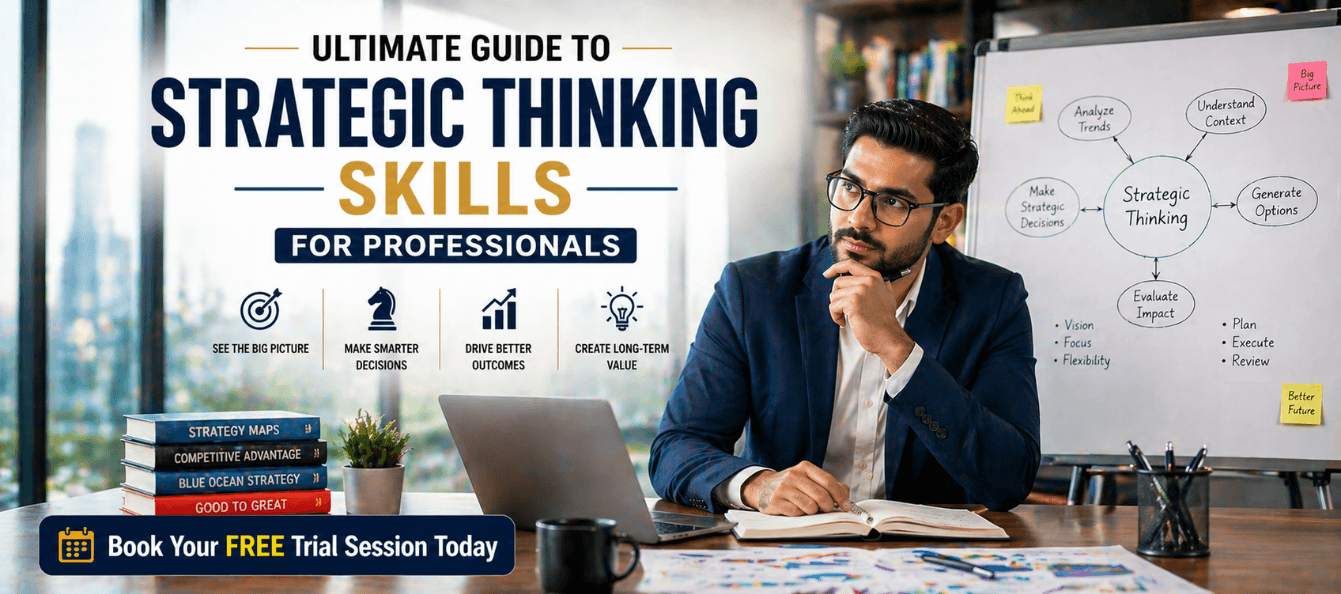
Download these resources and apply them alongside your daily work for improved clarity, productivity, and professional growth. You can also book a free trial to gain expert guidance and enhance your communication, problem-solving, and decision-making skills. The materials are designed in a clear, structured format to help professionals learn efficiently and implement insights with confidence.
Who Is This Blog For?
- Working professionals who want to move from execution to strategy
- Managers and team leaders responsible for planning and prioritisation
- Mid-career professionals preparing for leadership roles
- Individuals who struggle with prioritisation and long-term thinking
- Professionals aiming to improve decision-making and business impact
Why This Topic Matters Today?
In today’s dynamic work environment, organisations value professionals who can think beyond tasks and contribute to bigger goals. Strategic thinking is no longer limited to senior leadership—it is expected at all levels.
However, many professionals face challenges such as:
- Focusing on tasks without understanding broader objectives
- Struggling to prioritise effectively
- Making decisions without considering long-term impact
- Reacting to situations instead of planning proactively
- Difficulty aligning actions with organisational goals
These challenges lead to inefficiency, misalignment, and slower career growth. Strategic thinking helps professionals navigate complexity, make better decisions, and create meaningful impact.
Core Concept or Framework Explained
The Strategic Thinking Complete Guide is built on a structured approach that helps professionals think clearly, prioritise effectively, and act with purpose.
The framework focuses on three core elements:
Big-picture thinking
Understanding the broader context, goals, and direction ensures that your actions align with organisational objectives.
Prioritisation and focus
Strategic thinking requires identifying what matters most and allocating time and resources accordingly.
Forward planning
Anticipating future scenarios, risks, and opportunities allows you to act proactively rather than reactively.
For example, instead of completing tasks as they come, a strategic thinker evaluates which tasks contribute most to key goals and focuses effort accordingly.
This approach ensures that your work delivers maximum impact.
How This Blog and Guidebook Help You?
This guidebook provides practical tools to develop and apply strategic thinking in your daily work.
By using this approach, you will:
- Gain clarity on priorities and objectives
- Make decisions that align with long-term goals
- Improve your ability to analyse complex situations
- Allocate time and resources more effectively
- Build a strong reputation as a strategic and reliable professional
Over time, these skills lead to better performance, stronger leadership presence, and accelerated career growth.
Step-by-Step Breakdown
Understand the Bigger Picture
Strategic thinking begins with clarity about the overall direction.
- What are the key goals of your organisation or team?
- How does your role contribute to these goals?
- What are the current challenges and opportunities?
Understanding the bigger picture ensures that your actions are aligned with broader objectives.
Define Clear Objectives
Once you understand the context, define specific goals for your work.
- What outcomes are you aiming to achieve?
- How will success be measured?
- What priorities should guide your actions?
Clear objectives provide direction and focus.
Analyse the Situation
Before taking action, evaluate the current situation thoroughly.
- What data or information is available?
- What are the key factors influencing the situation?
- What risks or constraints exist?
This analysis helps you make informed decisions.
Prioritise Effectively
Not all tasks are equally important. Strategic thinking requires focusing on high-impact activities.
- Identify tasks that contribute most to key goals
- Eliminate or delegate low-value activities
- Allocate resources based on priority
Effective prioritisation ensures optimal use of time and effort.
Develop a Strategic Plan
Create a structured plan to achieve your objectives.
- Define key actions and milestones
- Assign responsibilities
- Set timelines
A clear plan provides a roadmap for execution.
Anticipate Risks and Opportunities
Strategic thinkers look ahead to prepare for different scenarios.
- What challenges might arise?
- What opportunities can be leveraged?
- How can you mitigate risks?
This proactive approach improves resilience and adaptability.
Execute and Monitor Progress
Execution is critical for achieving results.
- Track progress against goals
- Adjust plans as needed
- Ensure alignment with objectives
Monitoring ensures that your strategy remains effective.
Review and Refine
Continuous improvement is essential for strategic thinking.
- Evaluate outcomes
- Identify lessons learned
- Refine your approach for future situations
This step strengthens your ability to think strategically over time.
Common Mistakes or Pitfalls to Avoid
While developing strategic thinking, avoid these common mistakes.
Focusing only on tasks
Ignoring the bigger picture limits impact.
Poor prioritisation
Spending time on low-value activities reduces effectiveness.
Lack of planning
Acting without a clear plan leads to confusion.
Ignoring risks
Failing to anticipate challenges can disrupt progress.
Inflexibility
Rigid plans can fail in dynamic environments.
Avoiding these pitfalls ensures that your approach remains effective and adaptable.
How Should You Use This Guidebook Effectively?
To maximise the value of this guide, apply it consistently in your work.
- Use the framework for planning and decision-making
- Spend time analysing and prioritising before acting
- Review your progress regularly
- Adapt your approach based on outcomes
- Practice strategic thinking in both small and large tasks
With consistent application, strategic thinking becomes a natural part of how you work.
Key Takeaways
- Strategic thinking focuses on long-term impact and big-picture alignment
- Clear objectives and prioritisation drive effective action
- Analysing situations improves decision quality
- Planning and execution are both essential for success
- Anticipating risks and opportunities enhances resilience
- Continuous improvement strengthens strategic capability
- Strong strategic thinking skills accelerate career growth
Your Next Step: Accelerate Your Career with PlanetSpark
Creating an impact-driven resume is not just about landing your next job—it’s about owning your professional story and presenting it with clarity, confidence, and credibility. When your resume clearly communicates value, results, and impact, opportunities follow naturally.
At PlanetSpark, we are committed to empowering working professionals with practical, outcome-focused resources that drive real career growth. From resume building and workplace communication to leadership presence and professional writing, our programs are designed to help you succeed in today’s fast-evolving job market.
Visit https://www.planetspark.in/resources to explore:
- Career and resume-building guides
- Workplace communication and professional writing resources
- Skill-development tools curated for working professionals
Want a deeper, hands-on experience?
You can also book a free trial session to learn more about PlanetSpark’s Working Professional Courses, designed to accelerate your career through personalised coaching, real-world practice, and expert guidance.
Your career deserves more than generic advice.
It deserves clarity, confidence, and measurable impact.
Start building that advantage today—with PlanetSpark.
Personalized Communication Roadmaps
Record a video to get a AI generated personalized communication reports