
Ultimate Guide to Structuring Resumes for Global Leadership Roles
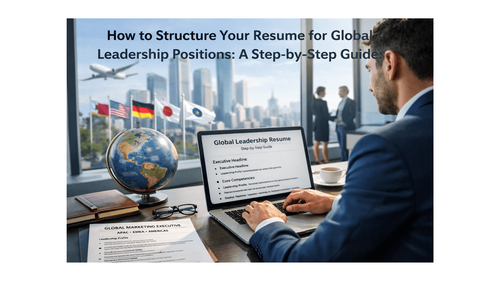

Table of Contents
How to Structure Your Resume for Global Leadership Positions: A Step-by-Step Guide
Introduction
Are you ready to step onto the global stage? As multinational companies seek top leadership talent, your resume must reflect more than just a record of job titles—it should clearly communicate your ability to lead at scale, manage across borders, and drive results on an international level. However, many professionals still present their experience in a way that works for domestic roles but fails to impress global hiring committees. This guide shows you how to transform your resume into a compelling document that positions you as a global leader ready to take on the world's challenges.
Book your free trial session today with Planetspark.
Download for more details or PDF file.
Who Is This Resource For?
This blog is specifically tailored to
professionals aiming for senior roles in multinational organizations or leadership positions with global responsibilities. It is ideal for:
- Career switchers looking to pivot into global leadership roles
- Early- to mid-career professionals with 3–15 years of experience targeting senior or global-facing positions
- Consultants, managers, and professionals with experience managing cross-border teams or operations
- Professionals who are ready to showcase their ability to lead at scale and across multiple functions and markets
Why This Topic Matters Today?
In today’s job market, global leadership roles are more accessible than ever, but they also come with heightened expectations. Hiring committees for multinational corporations, executive search firms, and international recruiters are trained to look for specific signals in a resume. These signals include geographic scope, leadership impact, cross-functional coordination, and measurable outcomes on a global scale. If your resume doesn't speak their language—emphasizing your leadership across regions, cultures, and functions—it will get overlooked, no matter how qualified you are.
This guide is essential for those who are targeting global leadership roles, as it provides a detailed, step-by-step approach to structuring your resume so that it aligns with the expectations of global hiring committees.
Core Concept or Framework Explained
The key concept for structuring a global leadership resume is positioning it as a "leadership narrative" rather than a "career history document". The core idea is that every decision you make in the resume—whether it's the headline, profile, competencies, or experience bullets—should answer the question: *Is this person ready to lead at scale, across borders, and under complexity?*
Global leadership resumes are built on a "five-layer architecture":
1. Executive Headline: This is the first thing a global recruiter will see. Your headline must immediately communicate your leadership seniority and geographic scope.
2. Leadership Profile: This section summarizes who you are as a leader, your experience across borders, and your unique value proposition to a global organization.
3. Core Competencies: A list of key skills—both functional and leadership-oriented—that signal your readiness for global leadership.
4. Career Experience: Your professional experience, with an emphasis on impact and scale, not just job duties.
5. Global Credentials: This section showcases your international experience, language proficiency, and any global certifications or academic qualifications.
The challenge is not to just present what you’ve done but to show how what you've done positions you to lead at a global level. This involves showcasing measurable results, demonstrating cross-border leadership, and using strategic language that highlights your global readiness.
How This Blog and Guidebook Help You?
This blog and guidebook will help you:
- Position yourself for global roles by restructuring your resume to highlight your leadership experience at scale and across borders.
- Attract the attention of multinational recruiters by using language and formatting that aligns with their expectations for senior leadership roles.
- Present measurable, impactful results that demonstrate your ability to drive business success on an international level.
- Ensure that your resume passes Applicant Tracking Systems (ATS) used by multinational employers to scan resumes for specific keywords and competencies.
Step-by-Step Breakdown
1. Craft Your Executive Headline
The headline is crucial because it’s the first thing a recruiter sees. Your headline must:
- Signal seniority and geographic scope (e.g., “Global Marketing Executive | APAC · EMEA · Americas”)
- Reflect the strategic nature of your leadership (e.g., “Driving Cross-Border Growth and Market Expansion”)
- Be short and impactful, capturing your value proposition at a glance
2. Write Your Leadership Profile
This 3–4 sentence section should:
- Establish who you are as a professional (your leadership identity)
- Show the scale at which you’ve operated (cross-functional teams, multi-market operations)
- Highlight the value you bring to global organizations, focusing on measurable outcomes
Example:
*“Strategic operations leader with 10 years of experience scaling supply chain functions across North America, Europe, and Asia. Led global teams of 200+ people, driving $120M in cost savings and improving operational efficiency by 30% across 4 continents. Seeking to leverage expertise in international business operations and team leadership in a VP-level role at a Fortune 500 company.”*
3. Build Your Core Competencies Section
List your top skills under three categories:
- Functional Expertise: Core professional skills relevant to your domain (e.g., P&L Management, Digital Transformation, Go-to-Market Strategy)
- Leadership Capabilities: How you lead people and organizations (e.g., Executive Team Leadership, Organizational Design, Stakeholder Influence)
- Global-Specific Skills: Capabilities that demonstrate your readiness for cross-border complexity (e.g., Cross-Cultural Team Management, International Market Entry, Global Vendor Negotiation)
Be specific and avoid generic buzzwords like “strategic thinker” or “team player.”
4. Write High-Impact Experience Bullets
Use the CAR-G formula (Context, Action, Result, Global marker) to frame each bullet:
- Context: Define the scope of your responsibility (e.g., managed a $40M P&L across 5 regions)
- Action: What did you specifically do?
- Result: Quantify the impact you achieved (e.g., reduced operational costs by 20%)
- Global marker: Highlight any cross-border or multicultural elements in your work (e.g., leading a team of 30 in 4 different countries)
Example:
*“Led a cross-functional team of 40 in 6 countries to redesign global supply chain operations, achieving $15M in annual savings and reducing delivery time by 25%.”*
5. Highlight Your Global Credentials
- Languages: List your language proficiency levels (Native, Fluent, Conversational).
- Certifications & Education: Include global certifications (e.g., PMP, CFA) and international academic programs.
- Geographic Work History: Clearly state the countries or regions where you’ve worked or led teams (e.g., “Managed operations across 5 countries in the EMEA region”).
Common Mistakes or Pitfalls to Avoid
1. Domestically Framed Headline: Ensure your headline includes geographic scope, seniority, and function.
2. Operational Language Instead of Leadership Language: Use strong action verbs like “Led,” “Transformed,” “Scaled.”
3. Missing Quantification: Always include numbers to validate your achievements—team size, budget, revenue impact, etc.
4. Generic Competencies: Replace vague terms like “Strategic Thinker” with specific skills that reflect global readiness.
5. Burying Global Experience: Make your international experience visible by placing it front and center in your resume.
6. One-Size-Fits-All Resume: Tailor your resume for each global role by using specific language that aligns with the job description.
7. Neglecting the Digital Footprint Alignment: Ensure your LinkedIn profile aligns with your resume’s global positioning.
How Should You Use This Guidebook Effectively?
1. Read through the entire guide to understand the global leadership framework.
2. Complete the worksheets provided, especially the Global Positioning Worksheet, to identify the strongest elements of your experience.
3. Refine each section of your resume using the step-by-step instructions and checklists from the guide.
4. Use the audit checklist to ensure that your resume is complete and optimized for global leadership positions.
Key Takeaways
- Lead with geographic scope and seniority in your headline and profile.
- Replace job descriptions with impact statements using the CAR-G formula.
- Quantify everything to demonstrate your impact—whether it’s cost savings, team size, or market reach.
- Make your global credentials unmissable, including languages and international certifications.
- Balance functional expertise, leadership capabilities, and global-specific skills in your competencies section.
- Tailor your resume for each global leadership role you apply for, and ensure your LinkedIn profile matches your resume.
Your Next Step: Accelerate Your Career with PlanetSpark
Creating an impact-driven resume is not just about landing your next job—it’s about owning your professional story and presenting it with clarity, confidence, and credibility. When your resume clearly communicates value, results, and impact, opportunities follow naturally.
At PlanetSpark, we are committed to empowering working professionals with practical, outcome-focused resources that drive real career growth. From resume building and workplace communication to leadership presence and professional writing, our programs are designed to help you succeed in today’s fast-evolving job market.
Visit https://www.planetspark.in/resources to explore:
- Career and resume-building guides
- Workplace communication and professional writing resources
- Skill-development tools curated for working professionals
Want a deeper, hands-on experience?
You can also book a free trial session to learn more about PlanetSpark’s Working Professional Courses, designed to accelerate your career through personalised coaching, real-world practice, and expert guidance.
Your career deserves more than generic advice.
It deserves clarity, confidence, and measurable impact.