
Uncover Hidden Workplace Motivations and Act Strategically
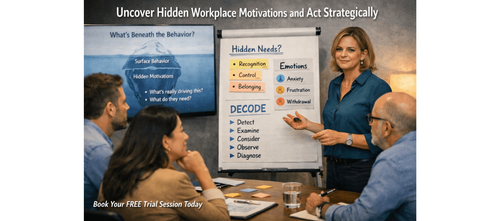

Interpreting Hidden Intentions Behind Workplace Behaviors: A Practical DECODE Framework for Professionals
Have you ever worked with someone who constantly interrupts, resists change, or withdraws during important discussions—and wondered what’s really going on? Most professionals respond to what they see: the behaviour, the tone, the outcome. But very few pause to ask a deeper question: what is driving this behaviour?
This gap is where misunderstandings grow, conflicts escalate, and opportunities for influence are lost. A colleague who appears difficult may actually be protecting a need for fairness. A manager who micromanages may be driven by a need for control or fear of failure. When you respond only to the surface, you miss the real issue.
This guide helps you go beyond assumptions. It provides a structured, practical framework to decode hidden motivations, so you can respond with clarity, empathy, and strategic intent in any workplace situation.
Download these resources and apply them alongside your daily work for improved clarity, productivity, and professional growth. You can also book a free trial to gain expert guidance and enhance your communication, problem-solving, and decision-making skills. The materials are designed in a clear, structured format to help professionals learn efficiently and implement insights with confidence.
Who Is This Blog For?
- Working professionals dealing with difficult team dynamics
- Managers and leaders aiming to improve team understanding and influence
- Consultants and client-facing professionals navigating complex relationships
- Individuals struggling with workplace conflicts or miscommunication
- Professionals looking to strengthen emotional intelligence and people skills
Why This Topic Matters Today?
Modern workplaces are increasingly complex, fast-paced, and relationship-driven. Yet, most professionals are trained to focus on tasks, not human behaviour.
Common challenges include:
- Misinterpreting colleagues’ actions and intentions
- Escalating conflicts due to surface-level reactions
- Struggling to influence without authority
- Feeling frustrated by repeated behavioural patterns in teams
- Losing trust due to poor communication
The reality is simple: people don’t resist change—they resist losing something important to them. When you understand what that “something” is, your entire approach changes.
Recognising hidden motivations allows you to move from reactive responses to intentional leadership. It transforms conflict into collaboration and confusion into clarity.
Core Concept or Framework Explained
At the heart of this guide is the DECODE Model—a structured 5-layer framework designed to help you interpret workplace behaviour more accurately.
DECODE stands for:
- Detect: Observe behaviour objectively
- Examine: Identify patterns over time
- Consider: Understand context and environment
- Observe: Notice emotional cues
- Diagnose: Identify the underlying need
- Engage: Respond intentionally
This model works because it slows down your thinking. Instead of jumping to conclusions, it guides you through a logical process—from observation to insight to action.
The framework is built on a key principle: behaviour is a signal, not the problem. When you understand the signal, you can respond effectively rather than react impulsively.
How This Blog and Guidebook Help You?
By applying this framework, you will:
- Improve your ability to read people accurately
- Reduce workplace conflict and miscommunication
- Respond more effectively in difficult situations
- Build stronger relationships and trust
- Increase your influence without relying on authority
The outcome is a shift from reactive behaviour to strategic communication—making you a more effective and respected professional.
Step-by-Step Breakdown
Step 1: Detect the Behaviour — See It Clearly Before You Judge It
The first step is simple but powerful: separate observation from interpretation.
Instead of thinking:
“He’s disrespectful”
Focus on:
“He interrupted three times during the meeting”
Detection involves:
- Noting exact behaviour
- Recording when and where it occurs
- Identifying frequency
- Avoiding assumptions about intent
This creates a factual foundation for understanding.
Step 2: Examine the Pattern — Is It a One-Off or Recurring?
A single event is not enough to draw conclusions. Patterns reveal deeper meaning.
Look for:
- Repeated behaviours across situations
- Triggers such as pressure or authority
- Consistency over time
For example:
- Behaviour across all situations suggests deeper values or fears
- Behaviour in specific contexts indicates situational triggers
- Occasional behaviour may simply be stress-driven
Tracking patterns helps you move from guesswork to insight.
Step 3: Consider the Context — What’s Shaping the Behaviour?
Context determines meaning. The same behaviour can have different interpretations depending on the environment.
Key factors include:
- Organisational culture
- Team dynamics and trust levels
- Recent changes or pressures
- Individual history and experiences
- Power structures within the team
Before judging behaviour, ask:
“Would most people act this way in this situation?”
If yes, context—not personality—is driving the behaviour.
Step 4: Observe Emotional Cues — What Isn’t Being Said?
Words are only part of communication. Emotional cues reveal deeper truths.
Pay attention to:
- Tone changes
- Silence or hesitation
- Body language
- Micro-expressions
- Sudden energy shifts
For example:
- Silence may signal discomfort or disagreement
- Tone shifts may indicate emotional triggers
- Withdrawal may reflect disengagement
These cues provide critical insight into underlying emotions.
Step 5: Diagnose the Root Need — What’s Driving the Behaviour?
Most workplace behaviours are driven by six core psychological needs:
- Safety: Need for stability and predictability
- Recognition: Need for visibility and appreciation
- Control: Need to influence outcomes
- Belonging: Need for inclusion and connection
- Fairness: Need for equity and justice
- Growth: Need for development and progress
For example:
- Resistance to change may signal a need for safety
- Credit-seeking may reflect a need for recognition
- Micromanagement may indicate a need for control
This step transforms your understanding from surface-level to strategic.
Step 6: Engage With Intention — Respond to the Need, Not the Behaviour
Once you understand the underlying need, your response becomes more effective.
Use the Name–Acknowledge–Redirect approach:
- Name: State the behaviour objectively
- Acknowledge: Validate the underlying need
- Redirect: Guide toward a constructive outcome
Example:
“I’ve noticed you’ve raised concerns about the timeline several times. It sounds like clarity is important here. Let’s walk through what’s fixed and what’s flexible.”
This approach reduces defensiveness and builds trust.
Common Mistakes or Pitfalls to Avoid
- Projecting your own motivations onto others
- Jumping to conclusions based on a single incident
- Labeling personality instead of observing behaviour
- Addressing symptoms instead of root causes
- Taking behaviour personally instead of objectively
Avoiding these mistakes ensures your responses are accurate and effective.
How Should You Use This Guidebook Effectively?
To apply this framework successfully:
- Start with observation before interpretation
- Track patterns over a 2–4 week period
- Use worksheets to structure your thinking
- Practise the NAR approach in low-stakes situations
- Reflect on your own biases and blind spots
Suggested workflow:
- Week 1: Observe behaviours without judgement
- Week 2: Identify patterns and possible needs
- Week 3: Practise intentional responses
- Week 4: Apply the full DECODE framework in real situations
Consistency is key. One intentional conversation per week can create visible change within a month.
Key Takeaways
- Every workplace behaviour has a deeper motivation
- Observation should come before interpretation
- Patterns reveal more than isolated incidents
- Context plays a critical role in behaviour
- Six core needs drive most workplace actions
- Intentional engagement improves communication outcomes
- Small, consistent practice builds mastery over time
- Understanding people increases your influence and leadership effectiveness
Your Next Step: Accelerate Your Career with PlanetSpark
Creating an impact-driven resume is not just about landing your next job—it’s about owning your professional story and presenting it with clarity, confidence, and credibility. When your resume clearly communicates value, results, and impact, opportunities follow naturally.
At PlanetSpark, we are committed to empowering working professionals with practical, outcome-focused resources that drive real career growth. From resume building and workplace communication to leadership presence and professional writing, our programs are designed to help you succeed in today’s fast-evolving job market.
Visit https://www.planetspark.in/resources to explore:
- Career and resume-building guides
- Workplace communication and professional writing resources
- Skill-development tools curated for working professionals
Want a deeper, hands-on experience?
You can also book a free trial session to learn more about PlanetSpark’s Working Professional Courses, designed to accelerate your career through personalised coaching, real-world practice, and expert guidance.
Your career deserves more than generic advice.
It deserves clarity, confidence, and measurable impact.
Personalized Communication Roadmaps
Record a video to get a AI generated personalized communication reports