
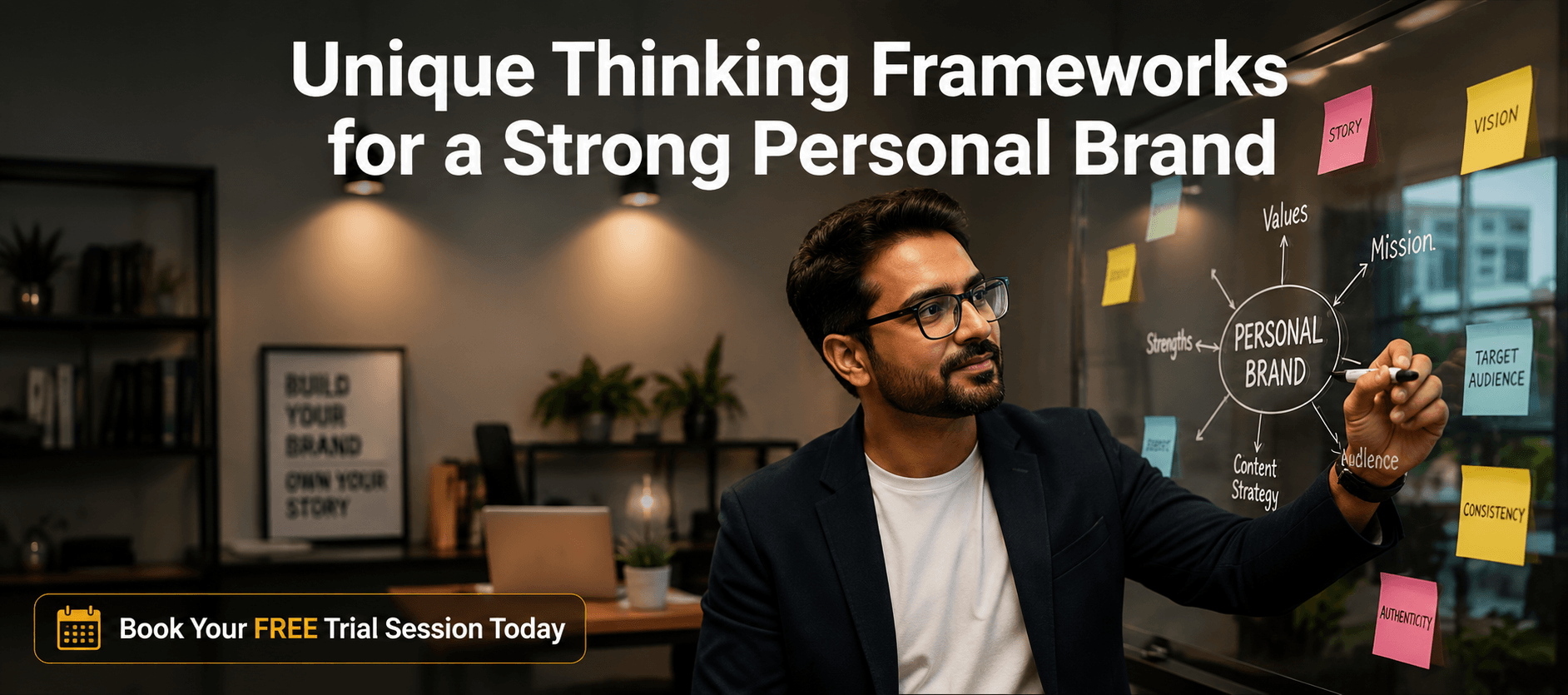
Unique Thinking Frameworks for a Strong Personal Brand


Build a Personal Brand Around Your Unique Thinking Frameworks
In a crowded professional world, credentials, job titles, and years of experience are no longer enough to make you stand out. Many working professionals have strong expertise, but their value remains hidden because they only communicate what they have done, not how they think. This is where personal branding becomes more strategic. Your unique thinking frameworks are not just internal tools. They are proof of your judgement, problem-solving style, and intellectual authority.
The guidebook Building a Personal Brand Around Your Unique Thinking Frameworks shows professionals how to articulate, publish, and monetise their distinctive mental models. It positions thinking frameworks as the intellectual fingerprint of a career and explains how documenting them can help professionals move from being service providers to recognised thought leaders with proprietary methodologies. :contentReference[oaicite:0]{index=0}
The guidebook is built around 10 scenario-specific templates that help you explain the origin of your framework, present your methodology to clients, write LinkedIn articles, build portfolio pages, prepare workshops, pitch thought leadership opportunities, validate ideas, craft brand statements, create courses, and track framework evolution over time.
Download these resources and apply them alongside your daily work for improved clarity, productivity, and professional growth. You can also book a free trial to gain expert guidance and enhance your communication, problem-solving, and decision-making skills. The materials are designed in a clear, structured format to help professionals learn efficiently and implement insights with confidence.
Who Is This Blog For?
This blog is for working professionals who want their personal brand to be built around original thinking, not just work history.
It is especially useful for:
- Consultants and freelancers who want to demonstrate proprietary methodology
- Managers and leaders who use repeatable approaches to solve team or business problems
- Job seekers who want portfolios that show strategic thinking depth
- Career switchers who need to prove how they think across domains
- Professionals writing LinkedIn articles, newsletters, or thought leadership posts
- Experts preparing workshops, training programmes, or client onboarding sessions
- Coaches, advisors, and educators who want to convert expertise into structured learning
- Professionals pitching podcast appearances, speaking slots, or guest articles
- Anyone who has an approach they use repeatedly but has not yet named, documented, or published it
Why This Topic Matters Today?
Professional visibility increasingly depends on intellectual distinction. Many people can list responsibilities, certifications, and tools. Far fewer can clearly explain the thinking system they use to diagnose problems, make decisions, guide clients, or create results.
The guidebook makes a powerful point: personal branding is not just a cosmetic exercise. Updating a LinkedIn photo, polishing a bio, or writing generic leadership posts does not create lasting authority. The deeper opportunity is to document the mental models you already use and make them visible.
When your thinking framework becomes clear, it can support multiple career outcomes. It can help you win consulting engagements, because prospective clients can see how you work. It can help you stand out in job searches, because hiring managers can evaluate your strategic approach. It can help you publish stronger content, because your ideas have a consistent intellectual centre. It can also help you build courses, workshops, and training products because your expertise becomes teachable.
The guidebook also warns against waiting until a framework is perfect. A useful framework does not need to be an academic masterpiece. It needs to be repeatable, practical, clearly named, and tested in real situations. The professionals who build strong thought leadership brands are not always the ones with the most content. They are the ones whose content consistently reflects a distinctive way of thinking.
Core Concept or Framework Explained
The core concept of the guidebook is that your thinking framework can become the centre of your personal brand.
A thinking framework is not simply a checklist. A checklist tells someone what to do. A framework tells someone how to think. It gives structure to judgement, diagnosis, decision-making, prioritisation, or problem-solving. When you document that framework, your audience can see the intellectual method behind your results.
The guidebook presents a journey from private thinking to recognised authority. At Stage 1, you are a practitioner. Your frameworks are informal and mostly internal. At Stage 2, you become a documenter. Your frameworks are captured in writing and shared with selected people. At Stage 3, you become a publisher. Your frameworks appear in articles, posts, workshops, and public content. At Stage 4, you become an authority. People seek you out because of your specific methodology. At Stage 5, you become a category creator. Your framework becomes associated with a niche standard.
The turning point is public documentation. Many professionals already use strong frameworks privately, but they never name them, test them, or publish them. As a result, their thinking does not compound into authority. Once a framework becomes searchable, shareable, and consistently applied across content, proposals, workshops, and portfolios, it starts building brand equity.
How This Blog and Guidebook Help You?
This blog helps you turn the guidebook into a practical action plan for building a personal brand around your unique way of thinking.
The guidebook helps you:
- Identify the thinking frameworks already present in your work
- Give your framework a clear name, origin story, and structure
- Explain your methodology to clients, employers, teams, and collaborators
- Use your framework to write stronger LinkedIn articles and thought leadership content
- Build a portfolio section that demonstrates strategic thinking, not just experience
- Introduce frameworks in workshops and client sessions
- Pitch speaking, podcast, or guest article opportunities with a distinctive angle
- Validate your framework before publishing it widely
- Convert your framework into a concise personal brand statement
- Turn a framework into a course, workshop, or training programme
- Track how your intellectual approach evolves over time
The main benefit is differentiation. Instead of sounding like another experienced professional in your field, you become known for a specific way of seeing and solving problems.
Step-by-Step Breakdown
Step 1: Start by Naming Your Framework
The first step is to identify the approach you already use repeatedly. Look for a pattern in your work. Do you use the same diagnostic process with clients? Do you ask the same sequence of questions before making decisions? Do you have a mental model that helps teams move from confusion to clarity?
The Framework Origin Story Card helps you turn this informal thinking into a memorable intellectual asset. It asks you to capture your name, role, framework name, and tagline. The framework name should be distinctive and ownable, but it should not be named after you too early. The guidebook recommends naming the framework after what it does or produces.
For example, a decision-making framework might be called The Clarity Loop. A diagnostic approach might be called The 3-Lens Audit. A product strategy approach might be called The Problem-First Lens.
Your tagline should explain what the framework helps people do. A strong tagline might say: A decision-making model that turns complexity into clear next actions.
Step 2: Write the Origin Story
A framework becomes more memorable when people understand where it came from. The guidebook asks you to explain the problem that started it, the turning point that shaped it, and the professional situations where it has been applied.
This matters because frameworks without context can feel abstract. A strong origin story makes your methodology credible and human.
For example, the guidebook gives the idea of a professional realising after multiple failed product launches that the real issue was not execution, but problem definition. That insight becomes the seed of a framework. The story shows that the framework emerged from experience, not theory alone.
When writing your origin story, focus on:
- The repeated professional challenge that forced you to think differently
- The moment when your approach became clear
- The real contexts where you applied it
- The measurable or observable results it created
Step 3: Turn Your Methodology Into a One-Pager
The Proprietary Methodology One-Pager is designed for consultants, advisors, and freelancers who need to show prospective clients exactly how they work.
This template helps you define the core problem your methodology solves, why standard approaches fail, and how your process creates better outcomes. The guidebook uses a simple methodology flow: Diagnose, Define, Design, Deploy. Each stage should produce a concrete deliverable the client can use independently.
This is important because clients do not only buy expertise. They buy confidence in your process. A one-page methodology gives them confidence that your work is structured, repeatable, and outcome-oriented.
Use this template before discovery calls, proposals, RFP responses, or advisory pitches. It helps you move from saying I can help to showing how your thinking creates value.
Step 4: Use Your Framework for Thought Leadership Content
The Framework-Led LinkedIn Article Outline helps professionals turn a mental model into a long-form article that establishes authority.
The guidebook recommends opening with the reader’s problem or a bold claim, not with yourself. Then you set up the problem, introduce your framework, explain each step, share a real-world application story, and close with a direct call to action.
This structure works because it gives your content a clear purpose. You are not writing generic advice. You are teaching readers how to think through a specific problem using your framework.
A strong framework-led article should include:
- A clear audience problem
- A named framework
- A simple explanation of how it works
- A real example or case story
- A practical question readers can apply
- A direct next step
Over time, repeated content around the same framework builds recognition.
Step 5: Build a Framework Portfolio Page
For job seekers, career switchers, and professionals building a personal website or PDF portfolio, the Thinking Framework Portfolio Page is especially useful.
Most portfolios show work samples. A framework portfolio page shows how you think. It allows you to present 2–3 core frameworks with definitions, use cases, steps, and proof of impact.
This helps hiring managers or collaborators evaluate your strategic thinking. Instead of simply reading that you worked in product, operations, strategy, or marketing, they can see how you approach recurring problems in those domains.
Each framework block should include:
- Framework name
- What it is
- When you use it
- How it works
- Proof of impact
The guidebook also recommends using consistent formatting and adding a small visual such as a diagram, icon, or framework map if converting the portfolio into a designed PDF or website page.
Step 6: Introduce the Framework in Workshops
The Client Workshop Framing Document helps consultants and managers introduce a thinking framework before applying it to a live business problem.
This matters because teams need context before they can use a framework productively. Without framing, participants may spend the first part of a session trying to understand what the facilitator is doing and why.
The template includes workshop identity, facilitator details, client organisation, number of participants, desired workshop outcome, framework summary, origin, core premise, and why this specific framework fits the session.
A strong workshop framing document should answer:
- What framework will we use?
- Where did it come from?
- What does it help us do?
- Why is it relevant to this specific team or challenge?
- What should participants be able to decide or do by the end?
This turns your framework from a personal idea into a shared working language.
Step 7: Validate Before Publishing Widely
The Framework Validation Feedback Form helps you test whether your framework is clear, original, useful, and ready for public use.
The guidebook recommends sending the form to 3–5 trusted peers, mentors, or target-audience members. Reviewers are asked to assess clarity, naming, originality, usefulness, practical relevance, redundant components, strongest element, most important fix, and likely audience.
This prevents one of the biggest mistakes in framework-based branding: publishing before testing. A framework that has only worked in one situation may fail when others apply it in different contexts. Testing helps you refine language, remove unnecessary steps, sharpen the name, and strengthen proof.
Use validation before publishing a public article, pitching a client, building a course, or presenting your methodology as definitive.
Step 8: Craft a Framework-Anchored Brand Statement
The Personal Brand Positioning Statement Builder helps you connect your framework directly to your professional identity.
The guidebook asks you to capture four pieces of raw material:
- Your core domain
- Your signature problem
- Your thinking differentiator
- Your best proof point
Then it gives a full positioning statement structure: I am a professional who helps a specific audience achieve a specific outcome by using a distinctive framework or approach. Unlike the standard approach in my field, my framework creates a specific difference. My work is grounded in a core belief, and the people I work with typically experience a specific result.
This is much stronger than a generic bio because it makes your thinking visible. It also creates versions for LinkedIn headlines, verbal pitches, email signatures, and website headers.
Step 9: Convert the Framework Into a Course or Workshop
The Framework-to-Course Conversion Blueprint is for experienced professionals who want to turn a thinking framework into structured learning.
A framework becomes productisable when others can learn and apply it independently. The guidebook recommends translating your framework into a programme with clear outcomes, modules, exercises, assignments, and common sticking points.
The module structure includes Foundation, Application, Personalisation, and Integration. This ensures learners do not just understand the model intellectually. They practise it, adapt it, and embed it into daily professional work.
This is especially valuable for coaches, consultants, trainers, leaders, and subject-matter experts who want to monetise expertise through workshops, online courses, or corporate training.
Step 10: Track Framework Evolution Over Time
The Annual Framework Evolution Log helps you treat your framework as a living intellectual asset.
This template asks you to track the frameworks actively in use, frameworks retired, new frameworks developed, key applications, challenges encountered, insights that changed the framework, structural updates, publication results, and learning from audience response.
This matters because frameworks should not remain frozen. A framework that never evolves can signal that the thinker stopped learning. By tracking changes, you demonstrate intellectual growth and create material for future content, performance reviews, client renewals, speaking applications, and strategic planning.
Common Mistakes or Pitfalls to Avoid
The guidebook identifies several mistakes that weaken framework-based personal brands.
One major mistake is naming the framework after yourself too early. Unless your name already carries strong recognition, this can sound self-promotional. It is better to name the framework after the transformation it creates.
Another mistake is claiming originality without acknowledging influences. No framework appears in isolation. Referencing the experiences, thinkers, or methods that shaped your approach can increase credibility.
Over-complicating the framework is also risky. The guidebook warns that frameworks with more than 5–6 steps are rarely adopted. The most useful frameworks can be explained on a whiteboard in under 3 minutes.
A common mistake is confusing a process with a framework. A process tells people what to do. A framework helps people think more clearly. If your model is only a task list, it may not build intellectual brand equity.
Publishing without testing is another problem. Before presenting your framework publicly, test it in at least 2–3 real situations.
Inconsistent terminology also weakens brand equity. If you call the same framework by different names across LinkedIn, your website, proposals, and podcast interviews, your audience will not remember it.
The guidebook also warns against building content without a clear audience, leaving out a call to action, and sharing frameworks without proof of impact.
How Should You Use This Guidebook Effectively?
Use the guidebook as a staged system, not a random collection of templates.
Start with Template 07, the Framework Validation Feedback Form. This helps you stress-test your idea before investing time in public-facing assets. Then complete Template 01, the Framework Origin Story Card. This becomes the foundation for your narrative. Next, complete Template 08, the Personal Brand Positioning Statement Builder, so your framework is connected to a clear professional identity.
After that, choose your next template based on your immediate goal. If you are pitching clients, use the Proprietary Methodology One-Pager. If you are publishing content, use the LinkedIn Article Outline. If you are preparing a workshop, use the Client Workshop Framing Document. If you are building a portfolio, use the Framework Portfolio Page. If you are seeking speaking or media opportunities, use the Thought Leadership Pitch Email.
For best results, follow the guidebook’s customisation priority order:
- Replace identity fields first, including your name, role, framework name, and tagline
- Customise section headers to match your domain language
- Complete high-specificity fields before generic fields
- Review the completed template aloud for tone consistency
- Share the draft with one trusted peer before public use
- Keep a version history as your framework evolves
- Align terminology across every template and platform
Key Takeaways
- Your thinking framework is one of your strongest personal brand assets
- A framework shows how you think, not just what you have done
- Strong frameworks are useful, repeatable, clearly named, and tested
- Public documentation turns private expertise into searchable authority
- The Framework Origin Story Card helps make your methodology memorable
- A Proprietary Methodology One-Pager can differentiate you in consulting and client pitches
- Framework-led content builds stronger thought leadership than generic advice
- A portfolio page can showcase strategic thinking depth during job searches or career pivots
- Frameworks should be validated before they are published widely
- Your positioning statement should connect your role, audience, outcome, and distinctive approach
- A strong framework can become a course, workshop, newsletter, podcast angle, or speaking topic
- Frameworks should evolve over time and be reviewed quarterly or annually
- Consistent terminology across platforms builds long-term brand equity
Your Next Step: Accelerate Your Career with PlanetSpark
Creating an impact-driven resume is not just about landing your next job—it’s about owning your professional story and presenting it with clarity, confidence, and credibility. When your resume clearly communicates value, results, and impact, opportunities follow naturally.
At PlanetSpark, we are committed to empowering working professionals with practical, outcome-focused resources that drive real career growth. From resume building and workplace communication to leadership presence and professional writing, our programs are designed to help you succeed in today’s fast-evolving job market.
Visit https://www.planetspark.in/resources to explore:
- Career and resume-building guides
- Workplace communication and professional writing resources
- Skill-development tools curated for working professionals
Want a deeper, hands-on experience?
You can also book a free trial session to learn more about PlanetSpark’s Working Professional Courses, designed to accelerate your career through personalised coaching, real-world practice, and expert guidance.
Your career deserves more than generic advice.
It deserves clarity, confidence, and measurable impact.
Personalized Communication Roadmaps
Record a video to get a AI generated personalized communication reports