
Weekly Job Application Tracker for Career Growth in 2026
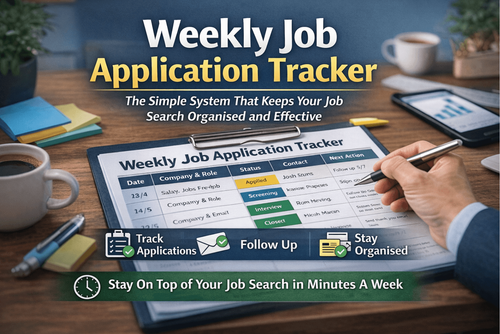

Weekly Job Application Tracker: The Simple System That Keeps Your Job Search Organised and Effective
Many professionals start a job search with enthusiasm but quickly lose control of the process. Applications are sent late at night, recruiter emails get buried in inboxes, and follow-ups are forgotten. Weeks later, when an interview opportunity appears, candidates often struggle to remember the job description they applied for or the salary range they discussed.
The problem is not lack of effort. It is lack of organisation.
A modern job search is essentially a project. Like any professional project, it requires structure, visibility, and consistent tracking. Without a system, applications become scattered, follow-ups are missed, and valuable opportunities slip through the cracks.
The Weekly Job Application Tracker provides a practical solution. It gives professionals a structured, reusable template that helps them track applications, follow up strategically, and maintain momentum throughout the job search process. :contentReference[oaicite:0]{index=0}
This blog explains how professionals can use a weekly application tracking system to manage their job search with clarity, discipline, and confidence.
Who Is This Blog For?
- Working professionals actively applying for new roles
- Career changers transitioning into new industries or functions
- Consultants building a structured pipeline of opportunities
- Mid-career professionals exploring roles while employed
- Early-career professionals navigating competitive hiring markets
Why This Topic Matters Today?
In today’s hiring environment, a job search can involve dozens of applications, multiple recruiter conversations, and several interview rounds running simultaneously.
Without a tracking system, professionals often face these problems:
- Forgetting which roles they applied to
- Missing follow-up opportunities with recruiters
- Repeating generic applications without improvement
- Losing track of interview preparation details
- Feeling uncertain about the health of their job search pipeline
A structured tracking system transforms the process. Instead of reacting to opportunities randomly, professionals can manage their job search strategically.
According to the PlanetSpark Weekly Job Application Tracker resource, a structured application log helps candidates follow up at the right time, tailor messaging for employers, and stay organised throughout the hiring pipeline.
Core Concept or Framework Explained
At the heart of the Weekly Job Application Tracker is a simple idea: every job application follows a lifecycle.
An application typically moves through several stages:
Applied → Recruiter Contact → Screening → Interview → Offer → Closed
The tracking system captures this lifecycle using a structured spreadsheet that records important information for every application.
Instead of relying on memory, professionals maintain a central record of:
- Where they applied
- When they applied
- Who they spoke with
- What stage the application is in
- What action should happen next
This transforms the job search into a clear pipeline rather than a collection of disconnected applications.
How This Blog and Guidebook Help You?
Using a job application tracker provides several advantages:
- Maintains a clear overview of every active application
- Ensures follow-ups happen at the right time
- Helps identify which job search channels are most effective
- Makes interview preparation easier by recording key information
- Creates measurable data to improve future applications
For professionals managing a job search alongside a full-time job, the system requires as little as 20 minutes per week to maintain. :contentReference[oaicite:2]{index=2}
Step-by-Step Breakdown
Understanding the Five Core Columns That Run Your Tracker
The foundation of a strong job search tracker is its structure. According to the guide, five columns form the backbone of an effective application tracking system.
Company and Role
This column records the company name, the job title, and a link to the original job posting.
Saving the job description link is critical because many postings disappear after a few weeks. Having the original details helps candidates prepare for interviews later.
Application Date
This column records the exact date when the application was submitted.
The application date is important because it determines follow-up timing. Most recruiters recommend sending a follow-up message around five to seven business days after applying.
Status or Stage
The status column tracks the current stage of each application.
Typical stages include:
- Applied
- Screening scheduled
- Interview round
- Offer stage
- Closed or rejected
A quick glance at this column reveals which applications are active and which ones require attention.
Contact Person
Whenever possible, candidates should record the name and LinkedIn profile of the recruiter, hiring manager, or internal referral connected to the role.
Follow-ups referencing a real person are significantly more effective than generic messages sent to anonymous inboxes.
Next Action and Date
This is the most important column in the tracker.
Every application should have a clearly defined next step, such as:
- Send follow-up email
- Prepare interview answers
- Schedule recruiter call
- Send thank-you message
The next action column ensures that no application becomes inactive or forgotten.
Setting Up Your Master Application Sheet
Your master sheet acts as a complete overview of your job search.
The tracker should include columns such as:
- Company and role
- Application date
- Source of application
- Stage of hiring process
- Contact name
- Next action
- Notes
The guide also recommends using colour-coded status labels to quickly scan the pipeline.
For example:
- Yellow for awaiting response
- Blue for interviews in progress
- Green for offers
- Grey for closed applications
This visual system allows professionals to assess their job search progress instantly.
Running a Weekly Review Ritual
The tracker becomes powerful only when it is updated consistently.
The guide recommends a simple weekly review ritual that takes approximately 20 minutes each Monday morning. :contentReference[oaicite:4]{index=4}
During this weekly review, professionals should:
- Scan all applications with pending next actions
- Update the status of ongoing conversations
- Send follow-up messages when required
- Log any new applications submitted during the week
- Set new next actions for each active application
This short weekly review prevents applications from silently expiring and ensures continuous momentum.
Tracking Application Quality Instead of Just Quantity
Many job seekers measure success by the number of applications they send.
However, the guide encourages professionals to track conversion rates instead.
Three metrics are particularly important:
Application to Screening Rate
This measures how many applications lead to recruiter calls.
Screening to Interview Rate
This measures how many initial screenings convert into interviews.
Interview to Offer Rate
This measures how many interviews ultimately lead to job offers.
Tracking these metrics helps professionals identify where improvements are needed.
For example:
- A low application-to-screening rate may indicate resume issues
- A low screening-to-interview rate may suggest weak positioning
- A low interview-to-offer rate may indicate interview preparation gaps
Following Up at the Right Time
Follow-up is one of the most underused strategies in job searching.
A simple follow-up system can significantly increase response rates.
The recommended timeline is:
Day 0
Application submitted and logged in the tracker.
Day 6 or 7
Send the first follow-up email expressing continued interest.
Day 14
Send a final follow-up message if there has been no response.
Day 21
If no response arrives, mark the application as closed and move forward.
Tracking follow-ups in the spreadsheet prevents duplicate emails and maintains professionalism.
Using Weekly Checklists and Reflection Questions
A powerful addition to the tracker is a weekly reflection process.
Each Friday, professionals can complete a quick checklist to ensure they have completed key tasks.
Examples include:
- Logging every application sent during the week
- Updating the status of interview processes
- Sending thank-you notes after interviews
- Recording the CV version used for each application
- Adding new networking contacts
Reflection questions can also help improve the job search strategy.
For example:
- Which applications felt most aligned with my target role
- Where did I spend the most time during the search
- What feedback did I receive this week
These reflections encourage continuous improvement.
Common Mistakes or Pitfalls to Avoid
Even well-intentioned professionals sometimes misuse their job search tracker.
Logging Applications Late
Logging applications days later often leads to missing key details about the role or recruiter.
Applications should be logged immediately after submission.
Treating “Applied” as the Final Step
Submitting an application is only the beginning of the process.
Every row in the tracker should include a next action.
Prioritising Quantity Over Quality
Sending dozens of applications rarely produces strong results.
A smaller number of targeted applications often generates more interviews.
Ignoring Data Insights
If referral applications generate more interviews than job boards, candidates should allocate more time to networking.
Deleting Closed Applications
Closed applications contain valuable data about the job search process.
Instead of deleting them, professionals should archive them for future reference.
How Should You Use This Guidebook Effectively?
To use the tracker effectively, professionals should follow a simple weekly workflow.
Daily Activity
Log every application immediately after submitting it.
Weekly Activity
Run a 20-minute Monday review to update statuses and send follow-ups.
Friday Activity
Complete the weekly checklist and reflect on progress.
Monthly Activity
Review application data to identify the most effective job search channels.
By maintaining these simple habits, professionals can run a disciplined and organised job search.
Key Takeaways
- A structured tracker transforms a chaotic job search into a manageable pipeline
- Five core columns capture the essential information for every application
- Weekly reviews ensure that follow-ups and next actions are never missed
- Conversion metrics reveal where improvements are needed in the job search funnel
- Referral applications often convert significantly better than cold applications
- Logging applications immediately prevents information gaps later in the process
- Consistent tracking helps professionals maintain confidence and momentum
Your Next Step: Accelerate Your Career with PlanetSpark
Creating an impact-driven resume is not just about landing your next job—it’s about owning your professional story and presenting it with clarity, confidence, and credibility. When your resume clearly communicates value, results, and impact, opportunities follow naturally.
At PlanetSpark, we are committed to empowering working professionals with practical, outcome-focused resources that drive real career growth. From resume building and workplace communication to leadership presence and professional writing, our programs are designed to help you succeed in today’s fast-evolving job market.
Visit https://www.planetspark.in/resources to explore:
- Career and resume-building guides
- Workplace communication and professional writing resources
- Skill-development tools curated for working professionals
Want a deeper, hands-on experience?
You can also book a free trial session to learn more about PlanetSpark’s Working Professional Courses, designed to accelerate your career through personalised coaching, real-world practice, and expert guidance.
Your career deserves more than generic advice.
It deserves clarity, confidence, and measurable impact.
Personalized Communication Roadmaps
Record a video to get a AI generated personalized communication reports