
What Working Professionals Must Carry to In-Person Interviews
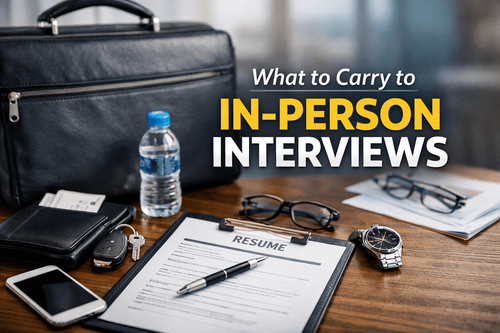
List of Essential Things to Carry to In-Person Interviews and Grab the Opportunity
You have prepared your answers. You
have researched the company. You have rehearsed your introduction.
Then you arrive at the interview venue—and realise you forgot a printed resume. Or a notepad. Or a required document.
Small logistical mistakes can quietly undermine an otherwise strong candidate. In in-person interviews, preparedness is not judged only by your answers. It is reflected in how organised, composed, and detail-oriented you appear from the moment you arrive.
Carrying the right materials signals professionalism, seriousness, and respect for the opportunity. This guide provides a structured checklist of what to carry to in-person interviews—so you walk in confident, prepared, and fully in control.
Who Is This Blog For?
This blog and the accompanying guidebook are designed for:
- Working professionals attending on-site interviews
- Candidates appearing for final rounds or panel interviews
- Professionals returning to interviews after a long gap
- Job seekers who want to avoid last-minute stress
- Early and mid-career professionals aiming to project strong presence
Why This Topic Matters Today?
In an increasingly digital world, many interviews are virtual—but in-person interviews still carry significant weight, especially for senior, client-facing, or leadership roles.
In these settings, details matter. Hiring managers often subconsciously evaluate:
- Organisation and preparedness
- Attention to detail
- Professional presentation
- Ability to handle logistics independently
Arriving unprepared—even for small things—can create subtle doubts about reliability. On the other hand, arriving fully organised creates an immediate positive impression before the interview even begins.
Core Concept or Framework Explained
The guide organises interview materials into four essential categories:
1. Essential documents
2. Professional tools
3. Personal presentation essentials
4. Practical contingency items
The goal is not to carry everything possible, but to carry what demonstrates readiness without appearing cluttered.
Preparedness reflects professionalism. Minimalism with completeness reflects maturity.
How This Blog and Guidebook Help You?
Together, this blog and guidebook help you:
- Avoid forgetting critical documents
- Project organisation and credibility
- Reduce pre-interview anxiety
- Handle unexpected situations smoothly
- Create a strong first impression before speaking
When logistics are handled, mental bandwidth is free to focus on performance.
Step-by-Step Breakdown
Step 1: Carry Multiple Copies of Your Resume
Even if the interviewer already has your resume, carry at least two to three printed copies.
Why this matters:
- Panel interviews may involve additional stakeholders
- Printed copies allow interviewers to reference details easily
- Offering a resume confidently shows preparation
Ensure resumes are:
- Updated
- Printed on clean, professional-quality paper
- Free from folds or damage
Keep them inside a professional folder.
Step 2: Bring Required Supporting Documents
Depending on the role, carry relevant documents such as:
- Portfolio samples
- Certifications
- Identity proof
- Experience letters
- Academic transcripts
Do not overwhelm the interviewer by presenting everything immediately. Carry them neatly and provide only if requested.
Step 3: Carry a Professional Notepad and Pen
A small notepad demonstrates engagement and seriousness.
Use it to:
- Note key points about the role
- Write names of panel members
- Capture next steps
Avoid writing excessively. Use it strategically.
Carry a reliable pen. Borrowing one may seem minor but subtly signals lack of preparedness.
Step 4: Bring a Structured Portfolio Folder
Use a clean, professional folder or slim briefcase. Avoid overstuffed bags.
Your folder should contain:
- Resume copies
- Document sleeves
- Notepad
- Business cards if applicable
Organisation reflects clarity of thinking.
Step 5: Carry Business Cards if Relevant
If you are a mid-to-senior professional, consultant, or client-facing specialist, business cards can be useful.
Offer them naturally if appropriate—not forcefully.
Step 6: Personal Presentation Essentials
In-person interviews evaluate visual professionalism. Carry essentials such as:
- Grooming items for quick touch-ups
- Breath mints
- Handkerchief or tissues
Ensure attire is:
- Clean and well-fitted
- Role-appropriate
- Comfortable enough to maintain confident posture
Confidence improves when you feel physically prepared.
Step 7: Practical Contingency Items
Unexpected situations can arise. Prepare lightly for contingencies:
- Fully charged phone
- Interview address and contact details saved
- Extra time buffer for travel
- Water bottle if appropriate
Arrive at least 10–15 minutes early. Being late—even for uncontrollable reasons—creates unnecessary negative impact.
Common Mistakes or Pitfalls to Avoid
The guide highlights common preparation errors:
- Assuming digital copies are sufficient
- Carrying loose documents without a folder
- Overpacking unnecessary materials
- Forgetting a pen or notepad
- Arriving exactly on time instead of early
- Dressing too casually for the company culture
Small preparation gaps can create large perception gaps.
How Should You Use This Guidebook Effectively?
To maximise preparedness:
- Review the checklist one day before the interview
- Pack your folder the night prior
- Lay out your attire in advance
- Print fresh resume copies
- Double-check venue details and travel time
Allocate 20–30 minutes for structured preparation.
Think of in-person interview readiness as operational excellence. When logistics are flawless, performance becomes sharper.
Key Takeaways
- Preparation extends beyond answers
- Carry multiple clean resume copies
- Organise supporting documents professionally
- Bring a notepad and reliable pen
- Maintain polished personal presentation
- Prepare for small contingencies
- Arrive early and composed
When you walk into an interview fully prepared, your confidence shifts visibly. You are no longer reacting to circumstances—you are managing them. That control strengthens your presence and sets the tone for a successful conversation.
Your Next Step: Accelerate Your Career with PlanetSpark
Creating an impact-driven resume is not just about landing your next job—it’s about owning your professional story and presenting it with clarity, confidence, and credibility. When your resume clearly communicates value, results, and impact, opportunities follow naturally.
At PlanetSpark, we are committed to empowering working professionals with practical, outcome-focused resources that drive real career growth. From resume building and workplace communication to leadership presence and professional writing, our programs are designed to help you succeed in today’s fast-evolving job market.
Visit https://www.planetspark.in/resources to explore:
- Career and resume-building guides
- Workplace communication and professional writing resources
- Skill-development tools curated for working professionals
Want a deeper, hands-on experience?
You can also book a free trial session to learn more about PlanetSpark’s Working Professional Courses, designed to accelerate your career through personalised coaching, real-world practice, and expert guidance.
Your career deserves more than generic advice.
It deserves clarity, confidence, and measurable impact.
Start building that advantage today—with PlanetSpark.