
Why Routines Fail: Fix Your Systems for Better Productivity


Why Your Routines Keep Breaking Down: A Practical Framework to Build Habits That Actually Survive Real Life
You start with motivation.
A new morning routine. A workout plan. A weekly planning ritual. A learning habit. For a few days—or even a few weeks—everything works beautifully. You feel organised, productive, and in control.
Then real life happens.
A stressful project. A late-night meeting. Travel. Family responsibilities. Low energy. One missed day becomes several. Eventually, the routine disappears completely.
And the worst part?
You blame yourself.
As explained in the guide, most professionals wrongly assume routine breakdown is caused by lack of discipline or motivation. In reality, routines usually fail because of poor system design, environmental friction, unrealistic expectations, or missing recovery mechanisms.
This changes the conversation completely.
You do not need more guilt.
You need a better diagnosis.
This framework helps professionals identify exactly why routines collapse—and how to redesign them so they actually survive real-world conditions.
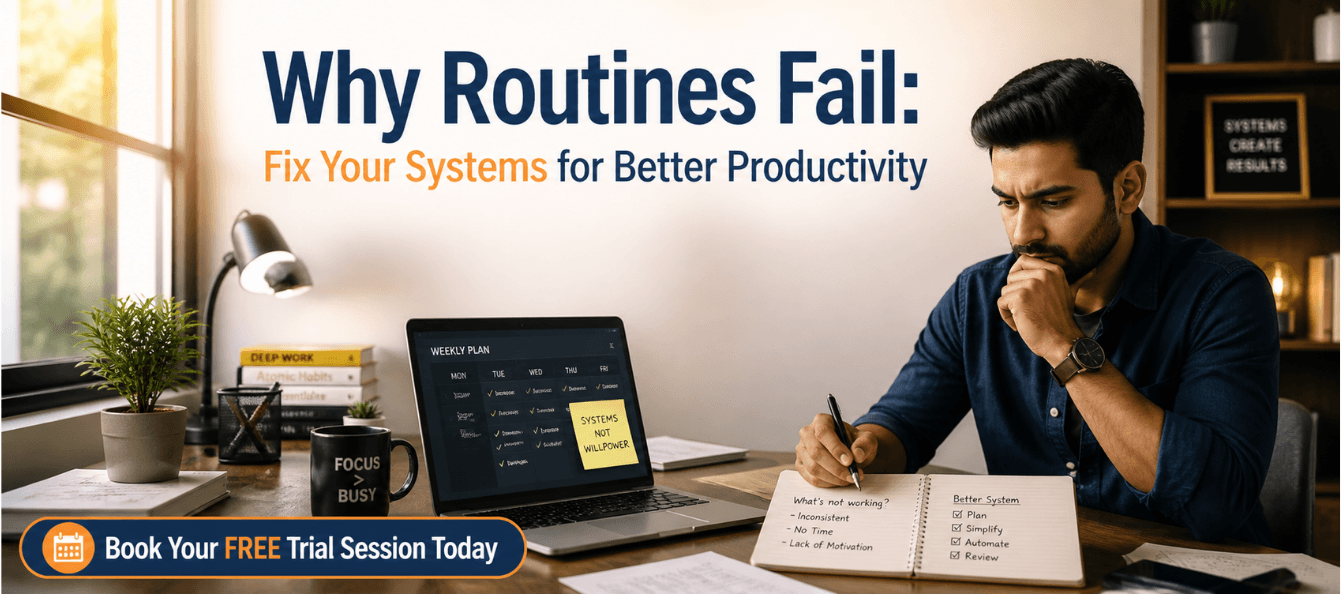
Download these resources and apply them alongside your daily work for improved clarity, productivity, and professional growth. You can also book a free trial to gain expert guidance and enhance your communication, problem-solving, and decision-making skills. The materials are designed in a clear, structured format to help professionals learn efficiently and implement insights with confidence.
Who Is This Blog For?
- Working professionals struggling to maintain consistency
- Managers balancing routines with unpredictable workloads
- Professionals restarting the same habits repeatedly
- Individuals frustrated by cycles of motivation and burnout
- Career-focused professionals trying to build sustainable systems
- Anyone who wants routines that survive stressful, imperfect weeks
Why This Topic Matters Today?
Modern professional life is highly unstable.
As highlighted throughout the assessment framework on page 2 and page 3, routines today are constantly disrupted by:
- Work pressure
- Travel
- Context switching
- Digital distractions
- Emotional exhaustion
- Unpredictable schedules
The common response is usually:
- Download another productivity app
- Increase discipline
- Create stricter routines
But stricter systems often collapse faster.
The guide introduces a critical insight:
Routine failure is usually a design problem—not a character problem.
That distinction matters because it shifts the focus from guilt to diagnosis.
Core Concept or Framework Explained
The framework identifies five root causes behind routine breakdown, explained on page 3.
These are:
- Design Overload
- Environmental Friction
- Identity Mismatch
- Recovery Gap
- Contextual Volatility
Each failure type has:
- A different behavioural pattern
- A different emotional response
- A different solution
This is why generic productivity advice fails—it treats every routine problem the same way.
How This Blog and Guidebook Help You?
This framework helps you:
- Diagnose why routines repeatedly fail
- Understand your personal breakdown pattern
- Build routines that survive stress and disruption
- Create restart systems after missed days
- Reduce guilt and increase sustainability
Most importantly, it helps you stop rebuilding broken routines from scratch over and over again.
Step-by-Step Breakdown
Identify Your Routine Breakdown Pattern
The first step is self-diagnosis.
The Routine Autopsy Worksheet on page 4 asks professionals to evaluate:
- Which routine failed
- How long it lasted
- What triggered the breakdown
- What emotional response followed
This process reveals important patterns professionals often ignore.
For example:
- Did the routine fail during stress?
- Was the routine too demanding?
- Did one missed day become total abandonment?
Clarity comes before solutions.
Understand the Five Root Causes
Design Overload
This happens when routines demand too much energy, focus, or time.
According to the guide on page 3:
The routine works on ideal days but collapses under pressure.
Common examples:
- 2-hour morning routines
- Complex workout schedules
- Unrealistic daily commitments
The routine was designed for your “best self,” not your normal life.
Environmental Friction
This occurs when your environment makes routines difficult to start.
Examples include:
- Tools not prepared
- Too many setup steps
- Frequent interruptions
- Lack of visual reminders
As explained on page 7, friction dramatically reduces consistency.
Identity Mismatch
Some routines fail because they do not align with who you actually are—or who you want to become.
The guide explains on page 6:
Professionals often follow routines because they “should,” not because they feel personally meaningful.
Without identity alignment:
- Habits feel forced
- Motivation fades quickly
- Consistency becomes emotionally exhausting
Recovery Gap
This is one of the most common breakdown patterns.
The guide explains:
One missed day becomes a complete collapse.
There is no recovery mechanism.
Professionals say things like:
- “I’ll restart Monday.”
- “I already failed.”
Without a restart protocol, small disruptions become permanent interruptions.
Contextual Volatility
Some routines only work in stable environments.
But real life includes:
- Travel
- Busy seasons
- Family demands
- Project deadlines
As highlighted on page 3 and page 8, routines need adaptive versions for unstable conditions.
Apply the Precision Fix Framework
The guide introduces targeted interventions on page 7.
For Design Overload: Use Minimum Viable Routines (MVR)
The solution is creating a “floor version” of the habit.
Examples:
- Full workout → 5-minute walk
- Full journaling → one sentence
- Full reading session → one page
The goal:
Consistency under pressure.
For Environmental Friction: Use Cue Engineering
Reduce every unnecessary barrier.
Examples:
- Lay out clothes beforehand
- Keep journal visible
- Make healthy choices easier to access
Good environments reduce reliance on willpower.
For Identity Mismatch: Use Identity Reframing
Shift the language from outcomes to identity.
Instead of:
“I work out to lose weight.”
Use:
“I am someone who values energy and strength.”
Identity-driven habits last longer because they feel personally meaningful.
For Recovery Gap: Use the 24-Hour Restart Rule
This is one of the strongest concepts in the framework.
According to page 7 and page 15:
Never wait for Monday.
After a missed day:
- Restart within 24 hours
- Use the Minimum Viable Version immediately
The key metric becomes:
Never miss twice in a row.
For Contextual Volatility: Build a Travel Version
Every routine needs three versions:
- Full Version
- Minimum Viable Version
- Travel/Disruption Version
This ensures continuity during unstable periods.
Stress-Test Your Routine
Page 8 introduces five stress tests.
Your routine should survive:
- Bad days
- Travel
- Illness
- Peak workload periods
- Motivation dips
If it fails most tests, redesign it before committing.
This prevents fragile routines that collapse during normal life events.
Learn from Real-World Application
The Aarav case study on page 11 demonstrates how redesigning routines creates sustainability.
His original routine failed because:
- It demanded 2.5 hours every morning
- It assumed perfect sleep and low stress
- It had no recovery mechanism
After redesigning:
- Wake-up flexibility improved sustainability
- MVR routines maintained continuity
- Restart protocols prevented collapse
The result:
Four months of consistency despite workload disruptions.
Use the Routine Health Checklist
The checklist on page 14 helps evaluate whether a routine is realistic before committing.
Questions include:
- Does it have an MVR version?
- Does it survive stress?
- Is there a restart protocol?
- Does the environment support it?
- Is it identity-aligned?
This transforms routine-building from emotional motivation into intentional system design.
Common Mistakes or Pitfalls to Avoid
- Restarting the exact same failed routine repeatedly
- Building routines for ideal conditions only
- Stacking multiple habits simultaneously
- Measuring success as “never missing”
- Relying entirely on motivation
- Ignoring environmental friction
- Waiting for perfect timing to restart
These mistakes create repeated cycles of frustration and abandonment.
How Should You Use This Guidebook Effectively?
To get the best results:
- Start with one failed routine only
- Complete the diagnostic questionnaire honestly
- Identify your primary breakdown pattern
- Build Full, MVR, and Travel versions
- Write a restart protocol immediately
- Track consistency for 30 days
Suggested implementation process:
- Week 1: Diagnosis and redesign
- Week 2: Environmental improvements
- Week 3: Stress-testing and adaptation
- Week 4: Tracking and calibration
This phased approach improves long-term adherence significantly.
Key Takeaways
- Routine breakdown is usually a design problem, not a discipline problem
- Every routine needs Full, MVR, and Travel versions
- Environmental friction destroys consistency
- Identity alignment increases long-term adherence
- The second missed day matters more than the first
- Restart systems are essential for sustainability
- Stress-testing routines prevents future collapse
- Consistency under imperfect conditions matters more than perfection
- Sustainable systems outperform motivational streaks every time
Your Next Step: Accelerate Your Career with PlanetSpark
Creating an impact-driven resume is not just about landing your next job—it’s about owning your professional story and presenting it with clarity, confidence, and credibility. When your resume clearly communicates value, results, and impact, opportunities follow naturally.
At PlanetSpark, we are committed to empowering working professionals with practical, outcome-focused resources that drive real career growth. From resume building and workplace communication to leadership presence and professional writing, our programs are designed to help you succeed in today’s fast-evolving job market.
Visit https://www.planetspark.in/resources to explore:
- Career and resume-building guides
- Workplace communication and professional writing resources
- Skill-development tools curated for working professionals
Want a deeper, hands-on experience?
You can also book a free trial session to learn more about PlanetSpark’s Working Professional Courses, designed to accelerate your career through personalised coaching, real-world practice, and expert guidance.
Your career deserves more than generic advice.
It deserves clarity, confidence, and measurable impact.
Start building that advantage today—with PlanetSpark.
Personalized Communication Roadmaps
Record a video to get a AI generated personalized communication reports