
Workplace Conflict Mistakes to Avoid: Pro Checklist

Workplace Conflict Management Guide: Avoid Common Mistakes and Handle Difficult Conversations with Confidence
If you’ve ever walked into a workplace conversation hoping to resolve an issue—but walked out feeling frustrated, misunderstood, or even worse—you’ve experienced the real cost of poorly handled conflict.
In today’s fast-paced professional environment, conflict is not an exception—it’s a constant. Whether it’s disagreements with colleagues, tension with managers, or misalignment within teams, difficult conversations are part of everyday work life. Yet, most professionals are never formally trained to handle them. Instead, they rely on instinct—reacting emotionally, avoiding issues, or escalating prematurely.
The result? Damaged relationships, reduced trust, missed opportunities, and long-term career setbacks.
The “Workplace Conflict Mistakes Checklist” is designed to change that. It provides a structured, practical approach to identifying and avoiding the most common mistakes professionals make before, during, and after conflict. More importantly, it equips you with clear, actionable fixes that help you handle conversations with confidence, clarity, and professionalism.
Download these resources and apply them alongside your daily work for improved clarity, productivity, and professional growth. You can also book a free trial to gain expert guidance and enhance your communication, problem-solving, and decision-making skills. The materials are designed in a clear, structured format to help professionals learn efficiently and implement insights with confidence.
Who Is This Blog For?
- Early-career professionals learning to navigate workplace dynamics
- Mid-level professionals managing teams or cross-functional relationships
- Managers and team leads handling performance and interpersonal issues
- Consultants and client-facing professionals dealing with high-stakes conversations
- Professionals who avoid conflict or struggle to address issues directly
- Individuals aiming to build stronger communication and leadership skills
Why This Topic Matters Today?
Workplace conflict is no longer limited to formal meetings or performance reviews. With hybrid work environments, fast-paced collaboration, and increased pressure to deliver results, misunderstandings and disagreements arise more frequently than ever.
The real issue is not conflict itself—it is how it is handled.
Many professionals:
- React emotionally in high-pressure situations
- Assume intent without verifying facts
- Avoid addressing issues until they escalate
- Fail to follow through after conversations
These patterns lead to recurring conflicts, strained relationships, and reduced professional credibility. In a competitive work environment, the ability to handle conflict effectively is no longer optional—it is a core career skill.
Core Concept
The guidebook is built around a powerful yet simple idea: conflict is not a single moment—it is a process.
Most professionals focus only on what happens during the conversation. However, the guide highlights that mistakes occur across three critical phases:
Before the conflict
During the conflict
After the conflict
Each phase has its own risks, behaviours, and opportunities for improvement.
Before the conversation, your preparation determines your clarity and emotional control.
During the conversation, your communication style determines whether the issue escalates or resolves.
After the conversation, your follow-through determines whether the conflict is truly resolved or simply postponed.
This three-phase framework shifts your mindset from reactive behaviour to intentional strategy, helping you manage conflict as a structured process rather than an unpredictable event.
How This Blog and Guidebook Help You?
This guidebook helps you move from instinct-driven reactions to structured, professional responses.
You will:
- Improve emotional regulation before difficult conversations
- Communicate more clearly and reduce defensiveness during discussions
- Build stronger listening and empathy skills
- Resolve conflicts without damaging relationships
- Develop a repeatable system for handling workplace challenges
- Strengthen your professional credibility and leadership presence
Over time, these improvements compound—helping you build trust, influence, and long-term career growth.
Step-by-Step Breakdown
Understanding the Three Phases of Conflict
Conflict is cumulative. What you do before, during, and after a conversation directly impacts the outcome. Ignoring any one phase increases the likelihood of escalation or unresolved issues.
Phase 1: Before the Conversation
Most conflict failures begin before the conversation even starts. Poor preparation, emotional reactions, and assumptions create the foundation for negative outcomes.
Key preparation principles include:
- Allowing time to cool down instead of reacting immediately
- Avoiding assumptions about the other person’s intent
- Deciding whether the issue truly needs to be addressed
- Clarifying your desired outcome before entering the discussion
For example, reacting to an email while emotionally triggered often leads to regret. A simple delay can completely change the tone and direction of the conversation.
The preparation checklist in the guide ensures you enter conversations with clarity, control, and purpose.
Phase 2: During the Conversation
This is where most professionals believe they perform well—but it is also where the most damaging mistakes occur.
Common challenges include:
- Using absolute language that triggers defensiveness
- Bringing up multiple issues at once
- Listening only to respond rather than understand
- Turning the conversation into a debate instead of a resolution
Effective communication during conflict requires:
- Using specific, observable examples
- Practicing reflective listening
- Staying focused on one issue at a time
- Maintaining a calm and respectful tone
For instance, replacing general accusations with specific examples can immediately reduce defensiveness and open the door to constructive dialogue.
Phase 3: After the Conversation
Many professionals treat the conversation as the finish line—but real resolution happens after.
Without follow-through:
- Agreements are forgotten
- Behaviour does not change
- Trust is not rebuilt
- Conflicts resurface
Effective post-conflict actions include:
- Setting clear agreements with timelines
- Following up consistently
- Reflecting on your own role in the situation
- Making a conscious effort to rebuild trust
The guide’s reflection worksheet encourages you to evaluate your actions objectively and improve over time.
Common Mistakes
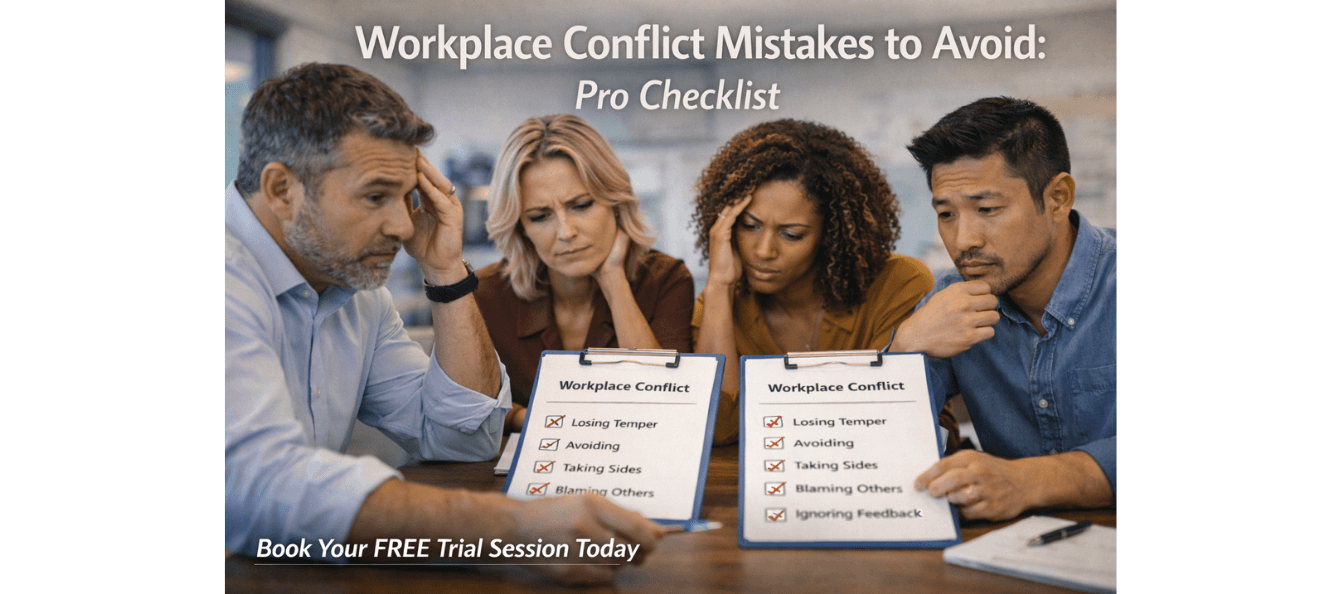
The guide identifies 12 high-impact mistakes that professionals frequently make.
Some of the most critical ones include:
- Reacting while emotionally overwhelmed instead of pausing
- Assuming intent without understanding the other perspective
- Avoiding important conversations entirely
- Using accusatory or absolute language
- Bringing in unrelated past issues
- Listening defensively rather than openly
- Trying to “win” the conversation instead of resolving it
- Using passive-aggressive communication
- Escalating issues too early by involving others
- Failing to follow up after agreements
- Holding grudges despite resolution
- Avoiding self-reflection
Each of these mistakes not only damages the immediate conversation but also impacts long-term professional relationships and reputation.
How Should You Use This Guidebook Effectively?
To maximise value, treat this guide as a working tool rather than a one-time read.
Recommended approach:
- Spend 20–30 minutes reading through the full guide to understand the framework
- Before any difficult conversation, review the preparation checklist
- During conversations, mentally apply the communication principles
- Within 48 hours, complete the reflection worksheet to reinforce learning
You can also revisit specific sections based on your needs:
- Preparation checklist before important discussions
- Communication checklist during active conflicts
- Reflection worksheet after challenging situations
Consistency is key. The more you use the guide, the more these behaviours become natural.
Key Takeaways
- Conflict is inevitable, but poor handling is avoidable
- Effective conflict management requires preparation, communication, and follow-through
- Emotional control before conversations significantly improves outcomes
- Specific, clear communication reduces defensiveness and builds trust
- Listening to understand is more powerful than arguing to win
- Follow-up and accountability are essential for lasting resolution
- Self-reflection is critical for continuous improvement
- Small improvements in conflict handling can create significant career advantages
Your Next Step: Accelerate Your Career with PlanetSpark
Creating an impact-driven resume is not just about landing your next job—it’s about owning your professional story and presenting it with clarity, confidence, and credibility. When your resume clearly communicates value, results, and impact, opportunities follow naturally.
At PlanetSpark, we are committed to empowering working professionals with practical, outcome-focused resources that drive real career growth. From resume building and workplace communication to leadership presence and professional writing, our programs are designed to help you succeed in today’s fast-evolving job market.
Visit https://www.planetspark.in/resources to explore:
- Career and resume-building guides
- Workplace communication and professional writing resources
- Skill-development tools curated for working professionals
Want a deeper, hands-on experience?
You can also book a free trial session to learn more about PlanetSpark’s Working Professional Courses, designed to accelerate your career through personalised coaching, real-world practice, and expert guidance.
Your career deserves more than generic advice.
It deserves clarity, confidence, and measurable impact.
Personalized Communication Roadmaps
Record a video to get a AI generated personalized communication reports