
Active Listening Skills Development Worksheet

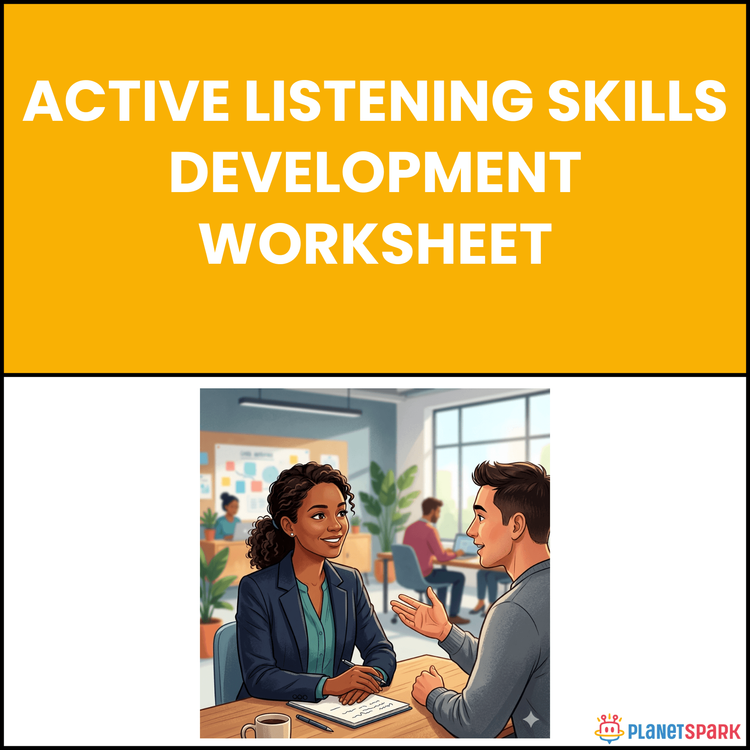
Active Listening Skills Development Worksheet
Active Listening Skills for Working Professionals: A Practical Worksheet to Improve Communication, Build Trust, and Lead Better Conversations
If you’ve ever walked out of a meeting thinking, “I should have asked better questions,” or “I think I missed something important,” you’re not alone. Most professionals are trained to speak, present, and respond—but not to truly listen.
In fast-paced, meeting-heavy work environments, listening often becomes passive. You hear words, but miss intent. You respond quickly, but don’t fully understand. Over time, this leads to miscommunication, weak relationships, and missed opportunities.
That’s exactly why the “Active Listening Skills Development Worksheet” exists. It’s a practical, action-oriented resource designed to help working professionals build one of the most underrated yet powerful career skills—active listening.
This is not theory. It’s a structured system you can apply immediately to improve conversations, strengthen relationships, and become more effective in any professional setting.
Who Is This Resource For?
This worksheet is especially valuable if you are:
- A working professional with 0–15 years of experience
- A manager leading teams and wanting to improve communication quality
- A consultant or client-facing professional handling complex conversations
- A job seeker preparing for interviews or networking conversations
- A career switcher navigating new environments and relationships
- Someone who has received feedback about being distracted, interruptive, or not fully present
If your work involves meetings, collaboration, feedback, or decision-making (which it almost certainly does), this resource is highly relevant to you.
What Does This Resource Contain?
This worksheet is designed as a complete skill-building system—not just a guide.
Inside, you’ll find:
- A clear breakdown of what active listening actually means (beyond just “hearing”)
- A self-assessment tool to evaluate your current listening habits
- The Five Pillars of Active Listening: Presence, Attention, Comprehension, Reflection, and Response
- A pre-conversation preparation framework to help you show up ready to listen
- The HEAR framework (Hold back, Explore, Acknowledge, Respond) for real-time conversations
- Practical in-conversation checklists to improve awareness and behavior
- Powerful language tools and phrases to improve how you respond
- A structured post-conversation reflection system to reinforce learning
- Common listening barriers (like interrupting, multitasking, or judging) with clear fixes
- A weekly practice protocol to build listening habits over time
- Advanced techniques for high-stakes conversations (feedback, negotiations, leadership discussions)
- Real-world case examples showing the impact of better listening
- A 30-day action plan to build consistent listening habits
- Monthly self-evaluation tools to track progress
Everything is designed for real-world application—not passive reading.
Summary of the Resource
The “Active Listening Skills Development Worksheet” is a practical, step-by-step guide that helps you move from reactive communication to intentional, high-impact listening.
It gives you the tools to prepare for conversations, stay present during them, and reflect afterward—so you continuously improve. Whether you’re leading a team, working with clients, or collaborating with peers, this resource helps you listen with clarity, depth, and purpose.
How Will This Resource Be Useful?
This resource helps you upgrade one of the most overlooked but high-leverage professional skills.
You’ll gain:
- Better understanding in conversations (less miscommunication)
- Stronger relationships with colleagues, clients, and stakeholders
- Increased trust—people feel heard when you truly listen
- Improved performance in meetings, interviews, and negotiations
- Greater emotional intelligence and awareness
- More thoughtful, effective responses instead of reactive ones
- The ability to handle high-stakes or difficult conversations with confidence
Most importantly, it helps you shift from “waiting to speak” to “listening to understand”—a critical difference that separates average professionals from exceptional ones.
How Should You Use This Resource?
To get the most value, use this worksheet as an active tool—not just a reading document.
Start by reading through the entire worksheet once to understand the full framework. This gives you clarity on how all the pieces connect.
Next, complete the self-assessment honestly. This will help you identify your current listening level and key improvement areas.
Then, begin applying the frameworks in phases:
- Use the pre-conversation checklist before important meetings
- Apply the HEAR framework during conversations
- Use reflection prompts after key interactions to learn and improve
Focus on one skill at a time using the weekly practice structure provided. For example, spend one week improving presence, then move to comprehension, and so on.
Finally, follow the 30-day action plan to build consistent habits. Revisit the worksheet regularly as a reference tool whenever you feel your listening slipping.
Action Steps
After accessing this resource, take these steps immediately:
1. Block 30–60 minutes to read the worksheet end-to-end
2. Complete the listening self-assessment honestly
3. Identify your top 2–3 listening gaps or barriers
4. Choose one listening skill to focus on this week
5. Apply the pre-conversation checklist before your next important meeting
6. Practise at least one technique (e.g., paraphrasing or pausing) in real conversations today
7. Reflect on one conversation using the post-conversation template
8. Commit to the 30-day action plan for consistent improvement
Small, consistent improvements here can dramatically change how others experience working with you.
Active listening is not a “soft” skill—it’s a career accelerator. The professionals who stand out are not always the ones who speak the most, but the ones who understand the most.
When you listen better, you make better decisions, build stronger relationships, and create more meaningful impact in your role. This worksheet gives you a clear, structured way to build that capability—one conversation at a time.
Book your free session today!