
Active Listening Skills Worksheet

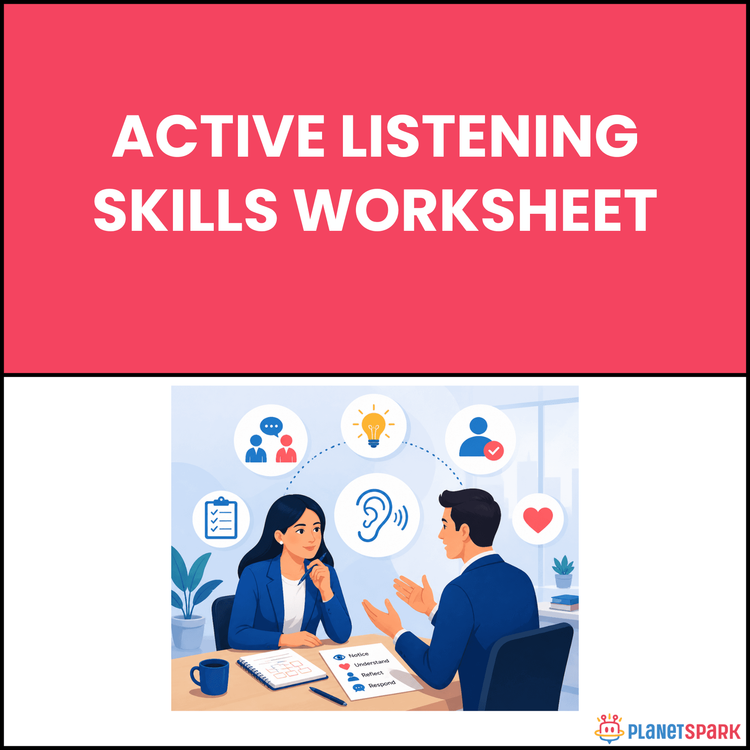
Active Listening Skills Worksheet
Interactive Active Listening Skills Exercise Sheet: A Practical Guide to Improve Communication, Build Trust, and Lead Better at Work
In today’s fast-paced work environment, most professionals are trained to speak, present, and persuade. But very few are trained to listen. And that gap quietly impacts everything—missed details in meetings, misunderstood client needs, disengaged teams, and lost opportunities.
Think about the last time someone truly listened to you—not just nodded along, but actually understood your point, your concern, your intent. It probably felt rare. That’s exactly the problem this Active Listening Skills Worksheet is designed to solve.
This resource goes beyond theory. It gives you a structured, practical way to build one of the most underrated yet career-defining skills: active listening.
Who Is This Resource For?
This worksheet is designed for working professionals who want to improve how they communicate and connect in real-world situations:
- Early to mid-career professionals navigating meetings, feedback, and collaboration
- Managers and team leads who want to build trust and improve team engagement
- Consultants and client-facing professionals who need to understand deeper client needs
- Job seekers and career switchers preparing for interviews and networking conversations
- Anyone who feels they “hear” conversations but may not always fully understand them
If your role involves people—and it always does—this resource is directly relevant to you.
What Does This Resource Contain?
This worksheet is not just a reading document—it’s a complete skill-building system. It combines frameworks, reflection tools, and real-world application exercises to help you improve quickly.
Here’s what you’ll find inside:
- A clear breakdown of what active listening actually means, including the four stages: Hear, Understand, Interpret, and Respond
- A self-diagnostic listening audit to identify your current strengths and gaps
- The HEAR Framework (Hold Space, Engage with Curiosity, Acknowledge, Respond Thoughtfully) for practical, real-time application
- Guided reflection worksheets to review real conversations and improve from them
- A structured “Before, During, After” listening lifecycle to maximise every interaction
- A comprehensive checklist for high-stakes conversations like interviews, client calls, and feedback discussions
- Advanced scenarios (disagreement, emotional conversations, criticism, unclear communication) with scripts you can use
- Common listening traps (like interrupting, multitasking, or mentally rehearsing responses) and how to fix them
- Weekly tracking tools to measure improvement and build consistency
- A 30-day action plan to turn listening into a habit, not just an intention
- Ready-to-use phrases for different workplace situations
This makes the resource both a learning guide and a practical toolkit you can revisit anytime.
Summary of the Resource
At its core, this worksheet helps you move from passive hearing to intentional listening.
Instead of reacting quickly, you learn how to:
- Slow down your responses
- Understand both content and emotion
- Ask better questions
- Reflect and improve after every conversation
It’s designed to help you build awareness, practise consistently, and apply listening skills in real professional situations—not just understand them conceptually.
How Will This Resource Be Useful?
The impact of better listening is immediate and far-reaching.
By using this worksheet, you will:
- Reduce miscommunication in meetings and projects
- Build stronger relationships with colleagues, clients, and managers
- Improve your ability to handle difficult or emotional conversations
- Make better decisions by understanding the full picture
- Increase your presence and credibility in professional settings
- Become more trusted as a collaborator, leader, or advisor
One of the most powerful ideas in this resource is that listening is not a personality trait—it’s a learnable skill. With the right structure and practice, anyone can improve.
How Should You Use This Resource?
To get the most value, this worksheet is designed to be used in multiple ways depending on your time and need:
1. Start with a full read-through
Go through the entire worksheet once to understand the concepts, frameworks, and structure.
2. Take the self-diagnostic audit
Assess your current listening habits honestly. This will help you focus on what matters most.
3. Apply one framework at a time
Start with the HEAR framework. Focus on one behaviour (for example, asking better questions or pausing before responding) instead of trying to do everything at once.
4. Use it during real conversations
Before important meetings, review the checklist. During conversations, apply one or two techniques intentionally.
5. Reflect after conversations
Use the reflection worksheet within 30 minutes of a meaningful conversation. This is where most of the learning happens.
6. Revisit weekly
Track your progress using the growth tracker. Consistency over time is what builds the habit.
This is not a one-time read. It’s a repeat-use tool designed for continuous improvement.
Action Steps
If you’ve just accessed this resource, here’s how to get started immediately:
1. Complete the listening self-audit to identify your baseline
2. Choose one listening behaviour to improve this week
3. Apply that behaviour in at least 2–3 conversations daily
4. Use the reflection worksheet after one key conversation each day
5. Identify your most common listening trap and actively work to avoid it
6. Review the checklist before any important meeting or discussion
7. Commit to the 30-day action plan to build consistency
Even 10–15 minutes of daily practice can significantly improve how you listen and communicate.
The ability to truly listen is one of the most powerful skills you can develop in your career. It influences how people perceive you, how much they trust you, and how effectively you can lead, collaborate, and grow.
This worksheet gives you everything you need—frameworks, tools, and structure. The only variable left is how consistently you apply it.
Start with your very next conversation. Listen differently. The results will follow.