
AI Automation Opportunity Mapping Worksheet

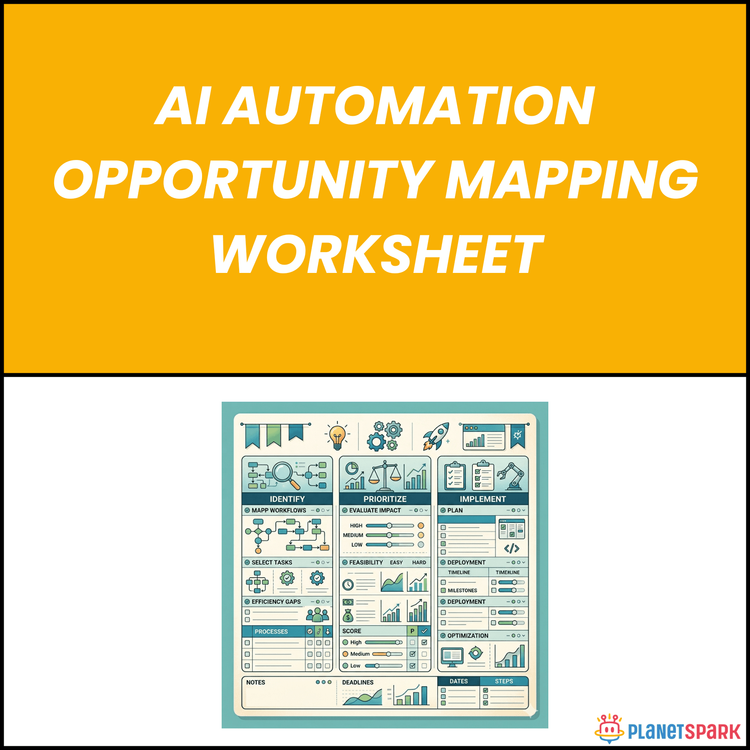
AI Automation Opportunity Mapping Worksheet
Identify Where AI Can Save Time in Your Work with Opportunity Mapping Worksheet
Most professionals know that AI can save time—but very few know exactly where to apply it in their day-to-day work.
As a result, they either underuse AI or try random tools without seeing meaningful impact. The real challenge isn’t access to AI—it’s identifying the right opportunities to use it effectively.
The “AI Automation Opportunity Mapping Worksheet” is designed to solve this problem. It helps you systematically identify, evaluate, and prioritize tasks that can be automated using AI—so you can focus on higher-value work.
Who Is This Resource For?
This resource is ideal for:
- Working professionals looking to improve productivity using AI
- Managers aiming to optimize team workflows
- Consultants identifying efficiency opportunities for clients
- Operations and process-driven roles handling repetitive tasks
- Anyone who feels overwhelmed with routine, manual work
If you often think “this task could probably be automated,” this worksheet will help you prove and act on it.
What Does This Resource Contain?
This worksheet provides a structured approach to discovering automation opportunities. It includes:
- Task Identification Section
Helps you list and break down your daily, weekly, and monthly tasks
- Repetition and Effort Analysis
Guides you to identify tasks that are time-consuming and repetitive
- Automation Feasibility Framework
Helps evaluate whether a task can be automated using AI
- Impact vs Effort Matrix
Prioritizes tasks based on potential time savings and ease of implementation
- AI Use-Case Mapping
Connects tasks with specific AI applications or tools
- Implementation Planning Section
Helps you outline steps to automate selected tasks
Each section is designed to move you from awareness to action.
Summary of the Resource
This resource is a practical worksheet that helps you identify where AI can actually make a difference in your work. Instead of guessing or experimenting randomly, you follow a structured process to find high-impact automation opportunities.
It turns AI from a vague concept into a clear productivity tool.
How Will This Resource Be Useful?
By using this worksheet, you can:
- Identify hidden time drains in your workflow
- Discover tasks that can be automated quickly
- Prioritize high-impact opportunities instead of low-value ones
- Reduce manual, repetitive work
- Improve efficiency without increasing workload
- Build a more strategic approach to using AI
Over time, this helps you work smarter, not harder.
How Should You Use This Resource?
Follow these steps to maximize its value:
1. List all your tasks
Capture everything you do regularly—big or small
2. Analyze repetition and effort
Identify tasks that consume time and are repeated frequently
3. Evaluate automation potential
Use the framework to assess which tasks can be automated
4. Prioritize using the matrix
Focus on high-impact, low-effort opportunities first
5. Map AI solutions
Identify tools or prompts that can help automate each task
6. Create an implementation plan
Define clear steps to execute automation
7. Review and expand
Continuously refine and identify new opportunities
This is not a one-time exercise—it’s a system you can revisit regularly.
Action Steps
Start immediately with these simple steps:
1. Block 30–45 minutes to complete the worksheet
2. List at least 10–15 tasks you handle regularly
3. Identify the top 3 repetitive tasks
4. Use the worksheet to evaluate automation potential
5. Select one task to automate this week
6. Implement and measure time saved
Once you see results, expand to more tasks.
AI is not just about tools—it’s about how you apply it to your work. The professionals who benefit the most are the ones who can clearly identify where AI creates value.
This worksheet gives you a structured way to do exactly that—turning everyday tasks into automation opportunities and freeing up time for more meaningful work.
Book your free session today!