
AI Use-Case Prioritization Matrix

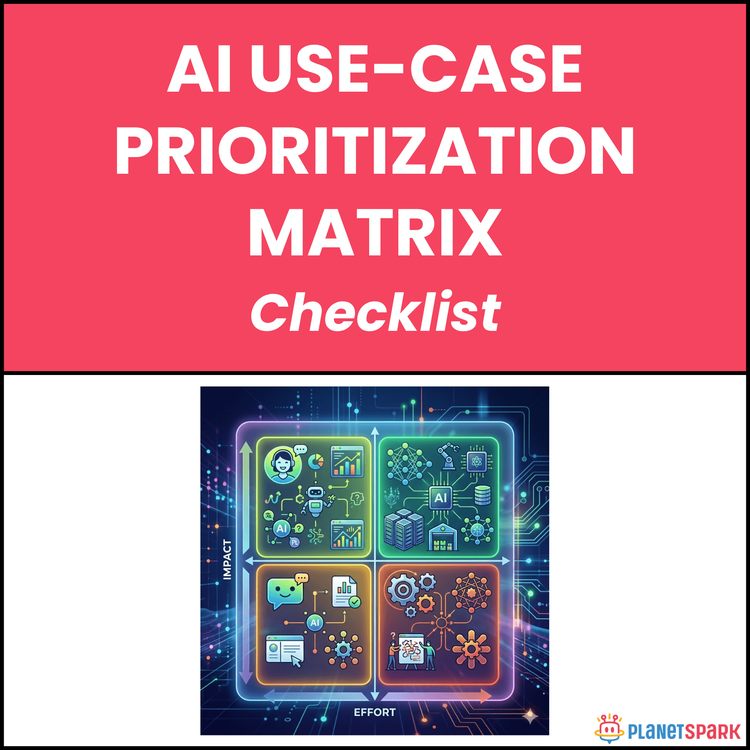
AI Use-Case Prioritization Matrix
How to Evaluate and Prioritize AI Projects That Actually Deliver Business Impact
If you’ve ever sat in a meeting where AI ideas were flying left, right, and center—but no one could agree on what to actually build first—you’ve already felt the problem this resource solves.
Every organization today is flooded with AI opportunities. Chatbots, predictive analytics, automation, generative AI—the list keeps growing. But here’s the uncomfortable truth: most teams don’t fail because they chose the wrong AI solution. They fail because they chose the wrong problem to solve.
That’s exactly why the resource “AI Use-Case Prioritization Matrix” exists. It gives you a clear, structured way to cut through the noise and decide which AI initiatives are actually worth your time, budget, and effort.
Instead of chasing hype, you start making decisions backed by logic, data, and business impact.
Who Is This Resource For?
This resource is especially valuable if you are:
- A working professional (0–15 years experience) involved in AI, tech, or strategy decisions
- A manager or team lead evaluating multiple AI initiatives
- A consultant advising clients on digital or AI transformation
- A career switcher looking to demonstrate practical AI decision-making skills
- A business professional trying to bridge the gap between technical teams and leadership
- Someone overwhelmed by too many AI ideas and not enough clarity
If you’ve ever thought, “We have too many options and no clear way to choose,” this is built for you.
What Does This Resource Contain?
This is not theory. It’s a decision-making system you can apply immediately.
Inside the resource, you’ll find:
- A structured framework to evaluate AI use cases based on real business impact
- A step-by-step method to build a complete AI use-case catalogue (your idea backlog)
- A 5-dimension scoring model covering:
- Business Value
- Data Readiness
- Technical Feasibility
- Strategic Alignment
- Implementation Speed
- A simple 1–5 scoring system to assess each use case objectively
- A weighted scoring model to prioritise based on your organisation’s context
- A prioritisation matrix to rank AI initiatives from “Act Now” to “Defer”
- A complete Before–During–After checklist for running prioritisation sessions effectively
- Reflection questions to challenge assumptions and avoid biased decisions
- A real-world case study showing how a company reprioritised AI projects (and avoided a bad bet)
- Common mistakes professionals make—and how to fix them
Everything is designed to help you move from confusion to clear decision-making in under an hour.
Summary of the Resource
The AI Use-Case Prioritization Matrix is a practical, business-first framework that helps you evaluate, score, and rank AI ideas based on what actually matters—impact, feasibility, and readiness.
It transforms AI from a vague, hype-driven conversation into a structured, defensible decision-making process you can confidently present to stakeholders.
In short: it helps you stop guessing and start prioritising like a strategist.
How Will This Resource Be Useful?
This resource doesn’t just give you clarity—it upgrades how you think.
You’ll gain:
- A clear framework to evaluate AI ideas objectively (no more “gut feeling” decisions)
- Faster decision-making in meetings and strategy discussions
- Stronger stakeholder alignment using a shared evaluation language
- Confidence in presenting AI recommendations backed by logic
- The ability to identify quick wins vs long-term bets
- Reduced risk of investing in low-impact or unfeasible AI projects
Most importantly, it positions you as someone who understands not just AI—but how AI drives business value.
That’s a rare and valuable skill.
How Should You Use This Resource?
To get real value, don’t just read it—apply it.
Start by reading the entire guide once to understand the overall framework and flow.
Next, build your AI use-case catalogue:
List out all potential AI ideas across teams—without filtering too early. Focus on breadth first.
Then, score each use case using the 5-dimension matrix:
Be honest. Overestimating data readiness or feasibility is the fastest way to waste months.
Apply weights based on your context:
For example, if your organisation lacks strong data infrastructure, data readiness should carry more weight.
Calculate final scores and rank your use cases:
This gives you a prioritised list that’s actually defensible—not political.
Finally, use the Before–During–After checklist to run structured prioritisation sessions and ensure nothing critical is missed.
Revisit this process every quarter. AI priorities change fast—and your roadmap should too.
Action Steps
After accessing this resource, take these steps immediately:
1. Identify 5–10 potential AI use cases in your current role or organisation
2. Create a simple use-case catalogue (problem, data, stakeholder, approach)
3. Score each use case across all 5 dimensions
4. Apply weights and calculate final prioritisation scores
5. Rank use cases into: Prioritise Now / Pipeline / Defer
6. Identify at least one “quick win” you can execute in the next 3–6 months
7. Present your prioritised list to a stakeholder or team for feedback
This entire process can be done in a single focused session—and it can save months of wasted effort.
AI is not about doing more. It’s about doing the right things first.
Most professionals get stuck chasing what sounds impressive instead of what delivers results. This resource flips that mindset. It forces clarity, exposes weak assumptions, and helps you make decisions that actually stand up in real-world business environments.
If you can walk into a room full of competing AI ideas and confidently say, “Here’s what we should prioritise—and why,” you’re no longer just participating in the conversation. You’re leading it.