
AI Writing Assistant Checklist

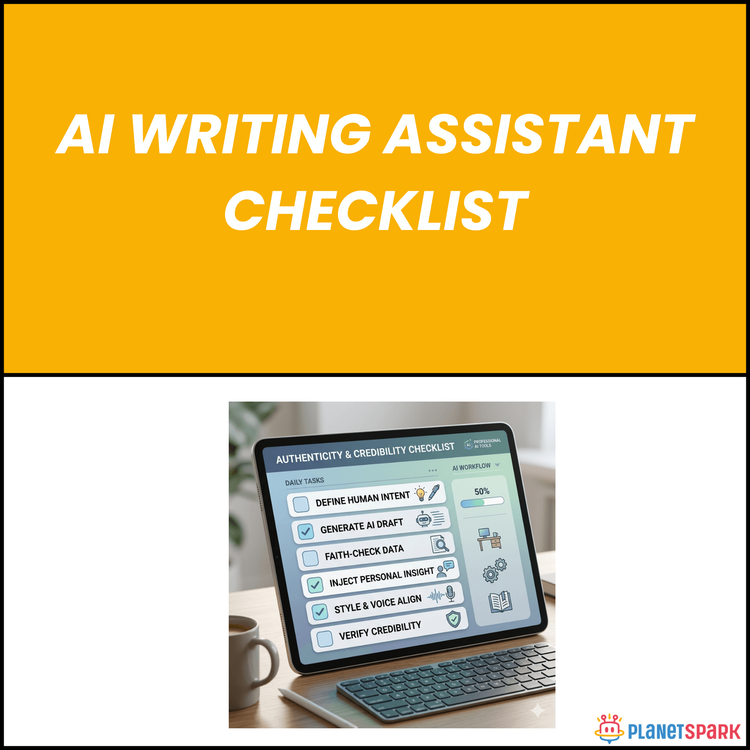
AI Writing Assistant Checklist
Write Faster and Better with This AI Writing Checklist
Writing is no longer just about what you say—it’s about how fast and how clearly you can say it.
Whether it’s a client email, LinkedIn post, proposal, or internal note, professionals today are expected to produce high-quality writing under constant time pressure. AI tools promise speed—but without the right approach, they often deliver generic, robotic output that doesn’t reflect your thinking or credibility.
That’s exactly the gap this AI Writing Assistant Checklist is designed to solve. It gives you a simple, repeatable system to use AI effectively—without losing your voice, accuracy, or professional edge.
Who Is This Resource For?
This resource is ideal for professionals who write frequently and want to improve both speed and quality:
- Career switchers crafting resumes, cover letters, and outreach messages
- Consultants writing proposals, reports, and client communication
- Managers handling emails, performance reviews, and team updates
- Early to mid-career professionals improving everyday communication
- Anyone using AI tools but not getting consistent, high-quality results
If you’ve ever felt that AI writing sounds “off,” too generic, or not like you—this checklist will fix that.
What Does This Resource Contain?
This checklist is structured into a clear 3-phase system that mirrors how professionals actually write:
- Phase 1: Before You Prompt
A preparation framework to define your goal, audience, inputs, tone, and output before using AI
- Phase 2: During (Prompting Like a Professional)
The RTCF framework (Role, Task, Context, Format) to write precise, high-quality prompts
- Phase 3: After (Review, Own, Elevate)
A structured editing system to refine AI output and make it sound like you
- Pre-Flight Checklist
A quick checklist to ensure you are set up correctly before prompting
- Prompting Techniques
Practical methods like assigning roles, constraining outputs, and iterative prompting
- Common Mistakes + Fixes
Real-world errors professionals make and how to correct them
- Master AI Writing Checklist
A complete before-during-after checklist you can reuse for every writing task
- Reflection Frameworks
Weekly and per-task questions to improve your AI writing skills over time
- Real-World Case Study
Demonstrates how a weak prompt becomes a strong, professional output
Summary of the Resource
This is not a writing guide—it is a workflow.
It helps you:
- Prepare effectively before using AI
- Write better prompts that produce usable drafts
- Edit and refine output to match your voice
- Avoid common mistakes like generic writing or factual errors
- Build a repeatable system for consistent, high-quality writing
In simple terms, it turns AI from a shortcut into a professional writing assistant.
How Will This Resource Be Useful?
The biggest benefit of this checklist is control.
Instead of letting AI dictate your writing, you stay in charge of the output.
By applying it, you will:
- Save time on drafting emails, posts, and documents
- Improve clarity and structure in your writing
- Maintain your personal tone and credibility
- Reduce back-and-forth edits and rewrites
- Build confidence using AI in high-stakes communication
Over time, this leads to faster execution and stronger professional presence—especially in roles where communication directly impacts outcomes.
How Should You Use This Resource?
This checklist is designed for both learning and real-time use.
Follow this approach:
Step 1: Use It End-to-End (First Time)
Work through all three phases—Before, During, and After—for one real writing task.
Step 2: Apply the Pre-Flight Checklist
Before every important piece of writing, quickly define your output, audience, inputs, and tone.
Step 3: Use the RTCF Framework
Structure your prompts clearly using Role, Task, Context, and Format.
Step 4: Iterate the Draft
Do not accept the first output. Refine specific sections using follow-up prompts.
Step 5: Run the Final Review
Check voice, accuracy, clarity, empathy, and originality before sending.
Over time, this process becomes instinctive and significantly reduces effort per task.
Action Steps
To start using this resource immediately, follow this simple plan:
1. Pick one important writing task you need to complete today
2. Define the output in one clear sentence
3. Identify your audience and desired outcome
4. Write one structured prompt using RTCF
5. Generate the first draft using AI
6. Refine one section with a follow-up prompt
7. Perform a final review: voice, accuracy, clarity, and tone
Avoid the biggest mistake: copying and pasting AI output without editing. That’s where most professionals lose credibility.
The real advantage comes not from using AI—but from using it well.
When you combine clear thinking, structured prompting, and disciplined editing, AI becomes a true multiplier of your communication skills.
In today’s professional world, writing well is no longer optional—it’s a core skill. This checklist ensures you can do it faster, better, and more consistently.
Book your free session today!