
Biodata Template with Family Details Section (Traditional Format)

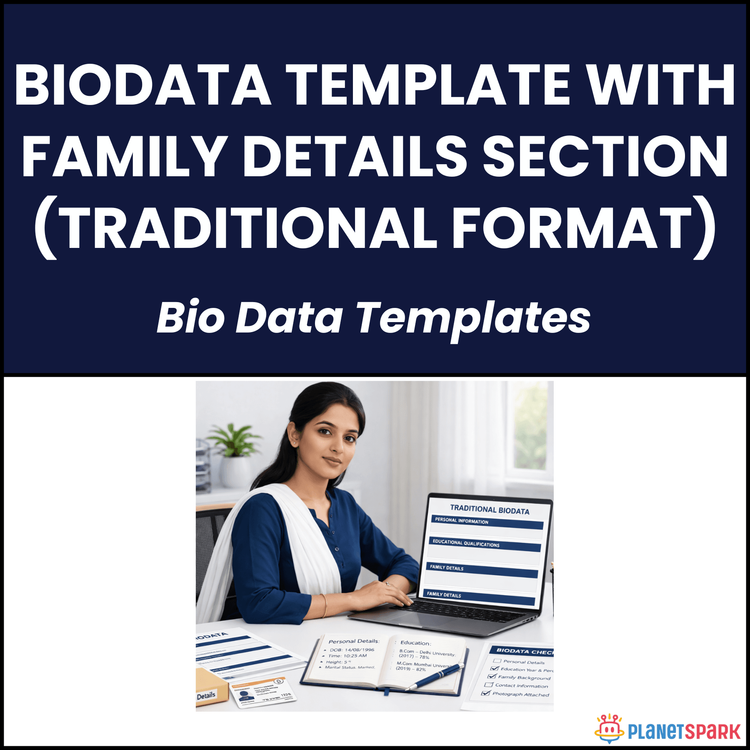
Biodata Template with Family Details Section (Traditional Format)
Biodata Template With Family Details: When and How to Use the Traditional Format
In many professional and personal contexts in India, a standard resume isn’t always enough.
Certain applications — especially government roles, formal institutions, and matrimonial profiles — require a more detailed, structured biodata that includes personal and family background. That’s where the traditional biodata format becomes essential.
The Biodata Template With Family Details Section (Traditional Format) is designed to meet these expectations — combining professional information with structured personal and family data in a clean, acceptable format.
Who Is This Resource For?
This resource is ideal for:
- Professionals applying to roles that require detailed personal disclosure
- Individuals creating matrimonial biodata profiles
- Candidates applying to government or PSU jobs
- Applicants for academic admissions or scholarships
- Freelancers or consultants needing a formal personal profile
As explained in the introduction (page 2), this template pack is built for multiple use cases where a biodata — not a resume — is expected.
What Does This Resource Contain?
This pack includes 10 structured biodata templates, each tailored to a specific scenario.
From the template directory, you get formats such as:
- Traditional Family Biodata (with detailed family background)
- Fresh Graduate Biodata
- Government Job Biodata
- Professional Career Biodata
- Skills-First Biodata
- Academic & Research Biodata
- Executive Summary Biodata
- Freelancer & Consultant Biodata
- Two-Column Modern Biodata
- Comprehensive All-Sections Biodata
Each template is structurally unique and designed for a different purpose — ensuring flexibility based on your needs.
For example, the Traditional Family Biodata includes:
- Personal details (DOB, religion, height, etc.)
- Professional information (occupation, income, work location)
- Family details (parents, siblings, family type, native place)
This makes it especially suitable for matrimonial or culturally formal applications.
Summary of the Resource
At a glance, this resource provides:
- 10 ready-to-use biodata templates for different professional scenarios
- Dedicated family details sections where required
- Clean, structured layouts aligned with Indian conventions
- Print-ready and editable formats (PDF, Word, Google Docs)
It bridges the gap between modern resumes and traditional biodata expectations.
How Will This Resource Be Useful?
This resource helps you present a complete personal and professional profile — especially in contexts where family background matters.
Key benefits include:
- Meets traditional requirements: Includes sections often expected in Indian applications
- Improves structure and clarity: Organizes personal, professional, and family details logically
- Saves time: Eliminates the need to create formats from scratch
- Ensures completeness: Guides you on what information to include
- Enhances credibility: Presents your profile in a culturally appropriate format
For instance, the comprehensive template integrates personal details, education, work experience, and detailed family information into one cohesive document.
How Should You Use This Resource?
Follow this simple workflow:
1. Choose the right template
Select based on your purpose — matrimonial, job, academic, etc.
2. Replace placeholders
Fill all fields carefully with accurate information
3. Convert if needed
Use Word or Google Docs for easy editing
4. Customize formatting
Adjust layout, remove unnecessary fields (e.g., religion for job roles)
Important tip: As mentioned on page 4, remove fields like religion, caste, or complexion when applying for professional roles unless explicitly required.
Action Steps
To get the best results:
1. Identify the purpose of your biodata (job, matrimonial, academic, etc.)
2. Select the most relevant template from the pack
3. Gather all required details (personal, educational, family)
4. Fill in each section clearly and accurately
5. Remove irrelevant or sensitive fields if not required
6. Proofread for consistency and formatting
7. Save and share as a clean PDF
A well-structured biodata is not just about information — it’s about presenting that information in the right format for the right context.
If you match the format to the expectation, your chances of acceptance improve significantly.