
Breaking Down Complex Decisions Into Manageable Components

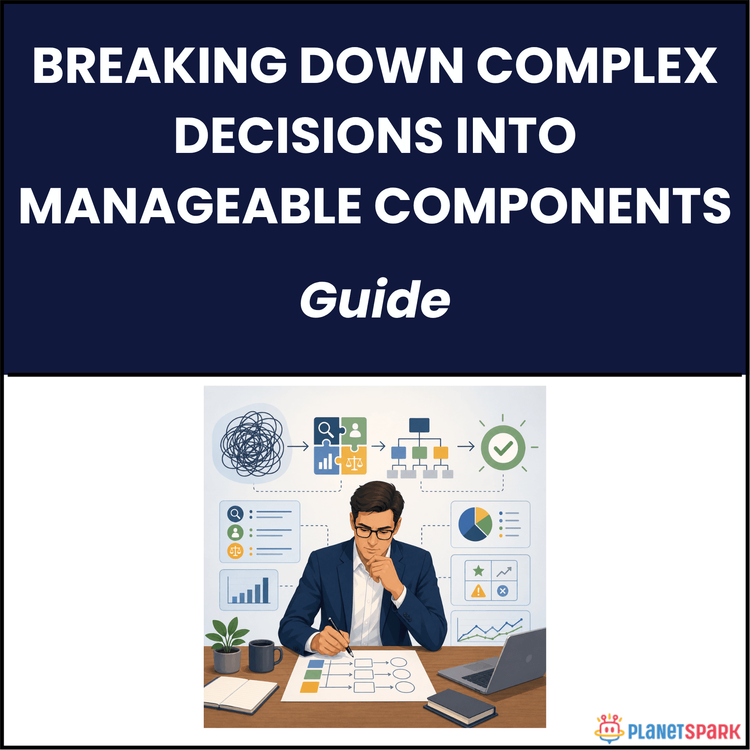
Breaking Down Complex Decisions Into Manageable Components
Creating Feedback Loops to Improve Decision Accuracy: A Practical Guide for Smarter, Faster Professional Decisions
Most professionals believe experience automatically improves decision-making.
It doesn’t.
Experience without reflection is just repetition.
If you’re making decisions every day—but not systematically learning from them—you’re likely repeating the same patterns, biases, and blind spots over and over again.
That’s exactly the problem solved by the resource “Creating Feedback Loops to Improve Decision Accuracy.” It introduces a structured system to turn everyday decisions into measurable learning and improved judgment over time.
Instead of relying on memory or instinct alone, you build a feedback-driven decision system.
Who Is This Resource For?
This guide is designed for:
- Working professionals (early to mid-career)
- Managers and team leads making frequent decisions
- Consultants and advisors under pressure
- Career switchers navigating uncertainty
- Anyone who wants to improve decision accuracy over time
If you’ve ever wondered, “Why do I keep making similar mistakes?”—this system gives you the answer.
What Is a Feedback Loop in Decision-Making?
A feedback loop is a simple but powerful concept:
You capture what you decided → track what happened → review the outcome → improve how you decide next time.
According to the framework illustrated on page 3, every effective feedback loop has four critical phases:
- Decide
- Track
- Review
- Calibrate
Skipping any phase breaks the system. Reviewing without calibration becomes journaling. Calibrating without review becomes guesswork.
The power lies in completing the full loop—consistently.
What Makes This System Powerful?
The biggest insight from the resource is this:
Experience ≠ Learning
As highlighted in the introduction on page 2, most professionals rely on memory and intuition, which are both unreliable. Feedback loops replace that with:
- Data-driven learning
- Pattern recognition
- Calibrated intuition
- Continuous improvement
Over time, your decisions stop being random—and start becoming accurate.
The 5-Step Feedback Loop Practice
The planner breaks the process into five actionable steps:
1. Document the Decision
Write what you decided, why, and what you expect to happen.
2. Define a Review Window
Set a clear date to evaluate the outcome.
3. Conduct the Outcome Review
Compare expectation vs reality.
4. Extract the Lesson
Define a clear takeaway:
“Next time, I will ___ because ___.”
5. Update Your Heuristics
Convert lessons into repeatable decision rules.
This transforms decisions into a learning engine—not isolated events.
Tools Included in the Resource
The guide provides practical tools (see page 5 worksheets):
- Decision Log Template
- Outcome Review Checklist
- Reflection Questions for deeper analysis
These tools ensure you don’t rely on memory—but on structured thinking.
Real-World Example: Why This Works
The case study on page 6 shows a project manager who improved decision accuracy from 55% to 78% simply by:
- Tracking decisions
- Identifying patterns
- Creating one key rule
Her improvement didn’t come from working harder—it came from learning systematically.
That’s the core idea: better systems beat more effort.
Common Mistakes This System Fixes
This resource directly addresses common issues like:
- Making decisions but never reviewing them
- Learning only from failures (ignoring successes)
- Writing vague lessons instead of actionable insights
- Abandoning systems during busy periods
The fix is consistency, not complexity.
Even a 3-minute daily log compounds into massive improvement.
Key Takeaways
From the summary on page 7, the most important principles are:
- Experience alone doesn’t improve decisions
- Capture reasoning at the moment of decision
- Schedule reviews in advance
- Be specific in your learning
- Build your personal decision heuristics
- Review both wins and failures
- Consistency beats intensity
These are not ideas—they are habits.
30-Day Action Plan (Simplified)
The resource outlines a clear plan:
- Week 1: Start logging decisions
- Week 2: Begin reviewing outcomes
- Week 3: Identify patterns and build heuristics
- Week 4: Conduct a monthly review
By the end of 30 days, you’ll already notice sharper judgment.
How This Connects to Faster Decision-Making
If you combine this with anti-paralysis strategies (like setting deadlines and limiting options), you get the best of both worlds:
- Faster decisions (from frameworks)
- Better decisions (from feedback loops)
Speed without learning creates mistakes.
Learning without action creates delay.
This system balances both.
Final Thought
The best decision-makers are not the ones who are always right.
They are the ones who improve faster than everyone else.
Feedback loops give you that edge.
Every decision becomes a data point.
Every outcome becomes a lesson.
Every week, you become sharper.
That’s how real professional growth happens.
Book your free session today!