
Breaking Down Your Life Into Core Systems For Better Control

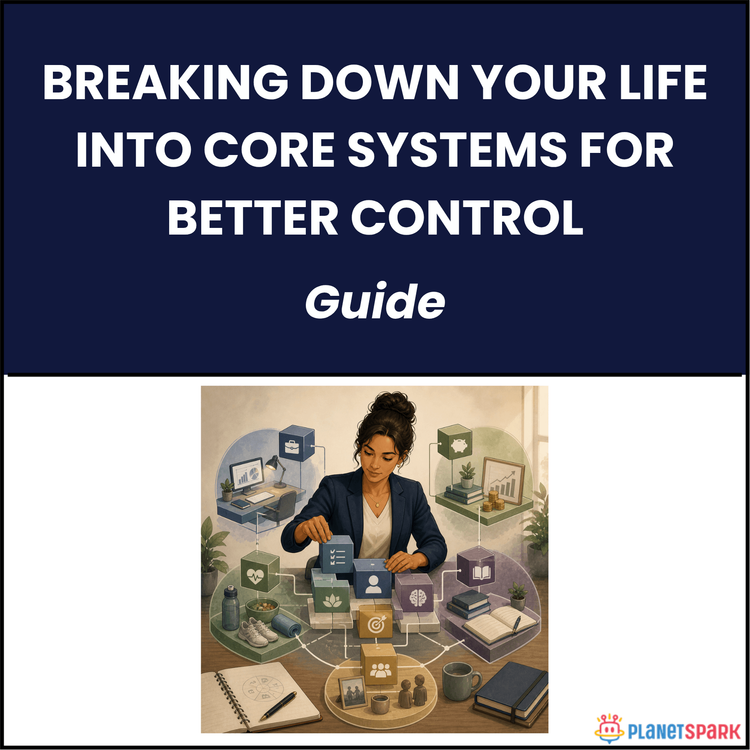
Breaking Down Your Life Into Core Systems For Better Control
Breaking Down Your Life Into Core Systems: A Practical Framework to Take Control of Your Career, Health, and Finances
You’re working hard. You’re busy all day. You’re constantly responding to something.
And yet, the things that actually matter—your health, your finances, your growth, your relationships—keep getting pushed to “later.”
If that sounds familiar, the issue isn’t productivity.
It’s structure.
Most working professionals operate in reactive mode, responding to whatever feels urgent in the moment. The result? A life that feels full—but not in control.
The resource “Breaking Down Your Life Into Core Systems” introduces a powerful shift: instead of managing tasks, you design systems that run your life with clarity and consistency.
Who Is This Resource For?
This playbook is ideal for:
- Working professionals juggling multiple responsibilities
- Individuals who feel constantly busy but not making real progress
- Managers and consultants dealing with high cognitive load
- Professionals struggling to balance career, health, and personal life
- People who want structure without overcomplicating their routines
- Anyone looking to move from reactive to intentional living
If your life feels scattered despite effort, this resource gives you a way to organize it meaningfully.
What Does This Resource Contain?
This is a comprehensive system design playbook—not just a checklist. It breaks your life into six core systems and helps you build each one deliberately.
Here’s what’s inside:
1. The Six Core Life Systems Framework
As illustrated in the diagram on page 3, your life is structured across:
- Work & Career
- Health & Energy
- Finances
- Relationships
- Mind & Learning
- Environment & Operations
2. Systems Audit Tool
A scoring framework (1–10) to evaluate how well each system is functioning
Helps identify your weakest areas and priority focus
3. Deep-Dive System Design Modules
Each system includes:
- Practical frameworks
- Common failure patterns
- Simple, actionable structures
4. Work & Career System
Covers growth planning, deep work structure, and weekly reviews
5. Health & Energy System
Focuses on sleep, movement, and sustainable energy management
6. Finance System
Introduces automated saving, visibility, and simplified budgeting
7. Relationship System
Helps build intentional personal and professional connections
8. Mind & Learning System
Includes daily learning, reflection, and mental well-being practices
9. Environment & Operations System
Covers workspace design, routines, and administrative efficiency
10. Minimum Viable System (MVS) Framework
A step-by-step approach to building systems gradually instead of all at once
11. 90-Day Systems Design Template
A structured implementation plan to focus on 1–2 systems at a time
12. Weekly Systems Review Ritual
A 15-minute method to stay aligned and avoid drift
13. Case Study (Real-World Application)
Demonstrates how focusing on just two systems created measurable transformation
14. Habit Tracking Framework
A system to make consistency visible and sustainable
15. Self-Evaluation Scorecard
Helps track long-term progress across all systems
Summary of the Resource
This resource helps you stop managing life randomly and start operating it systematically.
Instead of asking:
“What should I do today?”
You start asking:
“What system needs to run better?”
In simple terms, it helps you:
- Break complexity into manageable systems
- Identify where your life is actually breaking down
- Build simple structures that run consistently
- Create long-term control without constant effort
How Will This Resource Be Useful?
This playbook fundamentally changes how you approach productivity and life management.
You gain clarity
You can clearly see which areas are working and which are failing
You reduce overwhelm
Instead of fixing everything, you focus on 1–2 priority systems
You build consistency
Systems run automatically, reducing reliance on motivation
You improve decision-making
Less reactive thinking, more intentional actions
You create compounding results
Small improvements across systems lead to significant long-term impact
As explained in the framework, when one system fails, it affects others—so fixing the right system improves multiple areas simultaneously.
How Should You Use This Resource?
To get the best results, use it as a working system—not just a concept.
Step 1: Complete the Systems Audit
Rate all six systems honestly
Step 2: Identify Your Priority Systems
Focus on the two lowest-scoring areas
Step 3: Define Minimum Viable Systems (MVS)
Start with the smallest habit that creates improvement
Step 4: Implement Gradually
Build one system first, then layer the next
Step 5: Track Your Habits
Use simple tracking to maintain consistency
Step 6: Run Weekly Reviews
Spend 15 minutes reviewing progress and adjusting
Step 7: Review Every 90 Days
Reassess all systems and upgrade your structure
The resource emphasizes focusing on just two systems at a time to avoid overwhelm and ensure consistency.
Action Steps
Start applying this immediately:
1. List the six core systems in your life
2. Score each system from 1–10 honestly
3. Identify your two weakest systems
4. Define one simple habit for each (MVS)
5. Set a clear trigger for each habit
6. Track your progress daily
7. Schedule a 15-minute weekly review
8. Commit to a 90-day focus on just these two systems
Keep it simple. Consistency matters more than complexity.
Most professionals think they need more discipline.
What they actually need is better systems.
When your life is structured around well-designed systems, you stop reacting, stop overthinking, and start moving with clarity and control.
This resource gives you that structure.
Use it consistently, and you’ll move from feeling overwhelmed to operating your life with intention and confidence.
Book your free session today!