
Building a Learning Portfolio in Early Career

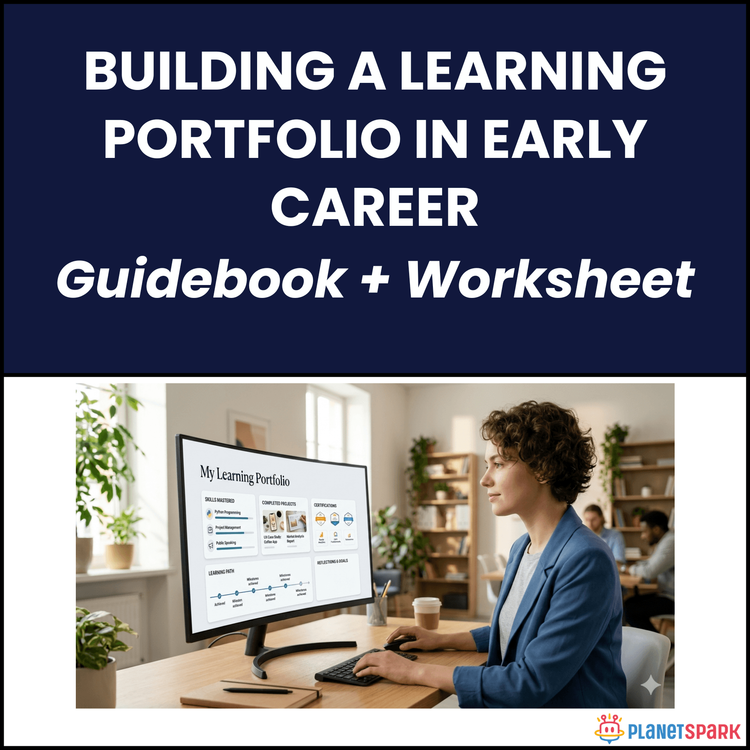
Building a Learning Portfolio in Early Career
Building a Learning Portfolio in Early Career: A Step-by-Step Guide to Showcase Skills, Growth, and Career Potential
If you’ve been learning consistently—taking courses, working on projects, reading, experimenting—but still struggle to prove your value in interviews or career conversations, you’re not alone.
Most professionals rely on resumes to communicate their experience. But here’s the problem: resumes show what you’ve done, not how you’ve grown. They capture roles and responsibilities—but not learning, evolution, or capability.
In today’s fast-changing job market, that’s a gap.
That’s exactly why the resource “Building a Learning Portfolio in Early Career” was created. It helps you move beyond static resumes and build a dynamic, evidence-backed portfolio that shows your skills, thinking, and real-world application—clearly and credibly.
This guide gives you a structured, practical system to document your learning, showcase your growth, and position yourself as a proactive, high-potential professional.
Who Is This Resource For?
This resource is especially valuable if you are:
- A working professional with 0–15 years of experience trying to stand out
- A job seeker struggling to demonstrate skills beyond your resume
- A career switcher who needs proof of capability in a new field
- A consultant or freelancer looking to build credibility and attract clients
- A manager or internal candidate preparing for the next role
- Someone who is learning actively but not documenting or showcasing it effectively
If you feel like you're doing the work but not getting recognition for it, this guide is built for you.
What Does This Resource Contain?
This is not just a conceptual guide—it’s a structured system with frameworks, worksheets, and step-by-step execution.
Inside the resource, you’ll find:
- A clear explanation of what a learning portfolio is and why it matters in modern careers
- A 6-step framework to build your portfolio from scratch
- A Portfolio Purpose Statement template to define your direction
- A Learning Audit system to uncover all your past work, courses, and experiences
- The STAR-L filter to help you curate high-quality, relevant portfolio entries
- Platform selection guidance (LinkedIn, Notion, personal website, etc.)
- The CLIP framework (Context, Learning, Impact, Proof) to write strong portfolio entries
- A structured habit system (daily, weekly, monthly, quarterly) to maintain your portfolio
- A 90-day action plan to build your portfolio consistently—even with limited time
- A real-world case study showing how a professional successfully transitioned careers using a portfolio
- A portfolio readiness checklist to evaluate quality before sharing
- A reflection worksheet to convert learning into expertise
- Common mistakes and practical fixes to avoid weak portfolios
Everything is designed to help you not just build—but sustain and grow—a portfolio over time.
Summary of the Resource:
“Building a Learning Portfolio in Early Career” is a practical, action-oriented guide that helps professionals turn invisible learning into visible proof.
It shows you how to:
- Capture your learning systematically
- Curate it strategically
- Present it clearly
- And use it to unlock career opportunities
Instead of relying only on a resume, this resource helps you build a living, evolving representation of your professional growth.
How Will This Resource Be Useful?
This resource helps you move from passive learning to visible credibility.
You’ll gain:
- Clarity on what to include (and what to leave out)
- Confidence in presenting your skills and growth
- A structured way to document your learning journey
- Strong, evidence-backed portfolio entries that build trust
- Better positioning in interviews, client conversations, and internal discussions
- A long-term career asset that grows with you
Most importantly, it helps you answer a critical question convincingly:
“Can you show what you can do?” — not just “Can you tell me?”
How Should You Use This Resource?
To get the best results, follow a phased approach:
Start by reading the guide end-to-end to understand the full framework and how each step connects.
Next, define your Portfolio Purpose. This becomes your decision-making filter for everything that follows.
Then, complete the Learning Audit. Capture everything—courses, projects, experiences—without filtering.
Once you have your raw material, use the STAR-L filter to curate the most relevant and high-impact entries.
After that, write your portfolio entries using the CLIP format. Focus on clarity, application, and real outcomes.
Choose a platform that fits your profession and comfort level, and publish your initial version.
Finally, build the habit system:
- Capture learning regularly
- Reflect consistently
- Update your portfolio monthly
Revisit and refine your portfolio as your career evolves.
Action Steps:
After accessing this resource, take these steps immediately:
1. Block 60–90 minutes in your calendar for focused work
2. Write your Portfolio Purpose Statement
3. Complete your Learning Audit (capture everything without filtering)
4. Identify 5–8 strong portfolio candidates using the STAR-L filter
5. Create your first 3 CLIP-format entries
6. Choose a simple platform (LinkedIn or Notion) and publish your first version
7. Share it with one trusted person for feedback
Consistency matters more than perfection—start small and build momentum.
Your learning is already happening. The real opportunity is to make it visible, structured, and credible.
A strong learning portfolio doesn’t just help you get noticed—it changes how you think about your growth, your skills, and your career trajectory. It turns you from someone who learns into someone who demonstrates capability.
Start before you feel ready. Build as you go. Improve with feedback.
Your career is not defined by what you’ve done—it’s defined by how clearly you can show what you can do next.
Book your free session today!