
Building A Personal Infrastructure For Long-Term Consistency

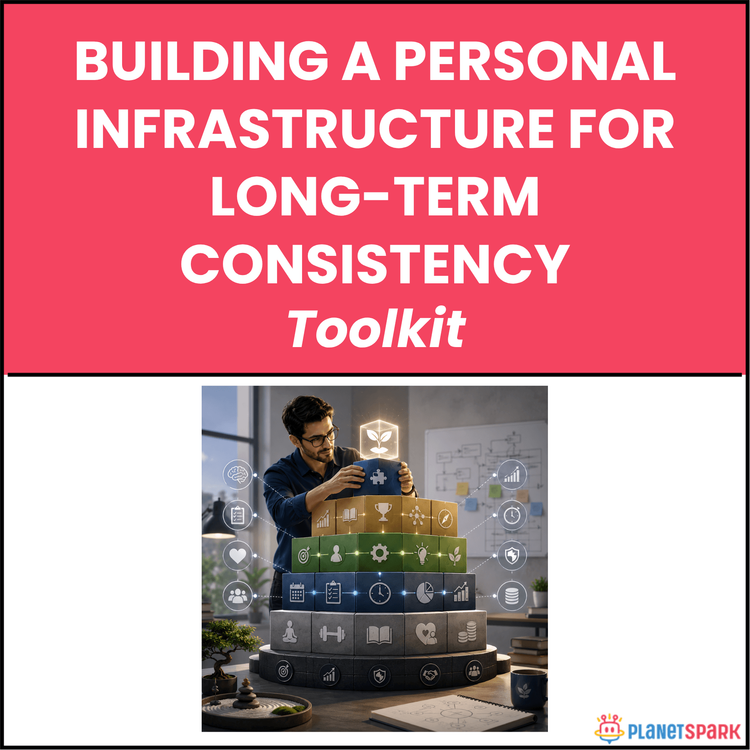
Building A Personal Infrastructure For Long-Term Consistency
Personal Infrastructure Building for Long-Term Consistency: A Practical Guide for Working Professionals
Most professionals are not bad at starting.
They are bad at sustaining.
A new learning plan begins with excitement. A fitness routine starts strong. A communication goal feels motivating for the first few weeks. A side project launches with energy and intention.
Then work gets busy.
Schedules become unpredictable. Motivation fades. Recovery from one missed day turns into two weeks of inactivity. Eventually, the routine quietly disappears.
This cycle frustrates even highly capable professionals.
Not because they lack ambition.
Not because they are lazy.
And not because they “don’t have discipline.”
The real issue is usually structural.
That’s exactly why the resource “Building a Personal Infrastructure for Long-Term Consistency” was created.
This practical playbook helps working professionals build systems, routines, environments, and recovery mechanisms that support sustainable consistency — even during stressful, unpredictable, real-world conditions.
Instead of relying on motivation, the resource teaches readers how to create personal infrastructure that makes consistency easier, more resilient, and more repeatable over time.
If you’re tired of constantly “starting over,” this guide is designed for you.
Who Is This Resource For?
This resource is especially valuable for:
- Working professionals with 0–15 years of experience
- Managers balancing multiple responsibilities and priorities
- Career switchers building new skills and habits
- Professionals struggling with follow-through
- Individuals who repeatedly lose momentum after strong starts
- People managing multiple goals simultaneously
- Professionals dealing with burnout, inconsistency, or mental fatigue
- Anyone who wants sustainable systems instead of temporary motivation
It is particularly useful for time-poor professionals who need realistic systems that work within busy schedules and unpredictable work environments.
What Does This Resource Contain?
This is not another motivational productivity guide filled with generic advice.
It is a structured framework focused on building consistency through systems, environment design, identity, and recovery protocols.
Inside the resource, you’ll find:
- A complete framework for understanding “consistency architecture”
- A breakdown of the three foundational layers:
- Environmental Layer
- Cognitive Layer
- Systemic Layer
- Guidance on identifying what is currently supporting or undermining your consistency
- The “Minimum Viable Routine” (MVR) framework
- Worksheets to design realistic, sustainable routines
- Practical examples of reducing goals into “floor versions” that still count
- Environment engineering strategies to reduce friction and improve follow-through
- Workspace and digital environment audit checklists
- The “2-Minute Rule” for reducing start-up resistance
- Identity-based consistency frameworks
- Templates for building identity-first goals
- Reflection prompts to reinforce long-term behavioural change
- Recovery systems for disruptions, missed days, travel, burnout, or overload
- The “Never Miss Twice” rule
- Planned pause strategies for high-pressure periods
- Weekly system review frameworks
- Real-world professional case studies
- Common consistency killers and practical fixes
- A complete long-term consistency blueprint
Everything inside the resource is designed to help professionals create systems that survive real life — not ideal conditions.
Summary of the Resource
“Building a Personal Infrastructure for Long-Term Consistency” is a practical systems-focused guide for professionals who want to stop relying on temporary motivation and start building sustainable behavioural infrastructure.
The resource teaches readers how to:
- Design realistic routines
- Build supportive environments
- Anchor behaviours to identity
- Recover effectively after disruptions
- Create systems that remain functional during busy or stressful periods
The core message is simple but powerful:
Consistency is not primarily a motivation problem.
It is an infrastructure problem.
When the right systems exist, consistency becomes easier, more stable, and more repeatable over time.
How Will This Resource Be Useful?
This resource helps professionals move from inconsistent effort to sustainable execution.
You’ll gain:
- A clearer understanding of why consistency repeatedly breaks down
- Practical systems that reduce dependence on motivation
- More realistic routines that fit real-world schedules
- Stronger follow-through across personal and professional goals
- Reduced guilt and frustration around missed days
- Better recovery mechanisms during stressful periods
- Increased confidence in sustaining long-term habits
- Improved focus through environment design and friction reduction
- Identity-based frameworks that strengthen behavioural change
- Greater long-term progress through repeatable systems
Most importantly, this resource helps professionals stop viewing inconsistency as a personal flaw.
Instead, it teaches them how to build systems that support progress even when energy, motivation, or schedules fluctuate.
How Should You Use This Resource?
To get the best results, work through the resource in sequence instead of skipping directly to tactics.
Start by completing the consistency architecture audit. Identify which layer is currently creating the biggest problem:
- Environment
- Mindset
- Systems
Next, design your Minimum Viable Routine (MVR). Focus on creating the smallest version of your important habits that still counts, even on difficult days.
After defining your MVR, move into environment engineering. Remove friction from your most important behaviours and reduce distractions that repeatedly interrupt your focus.
Then work through the identity-first consistency framework. Shift your focus from outcome-based thinking (“I want results”) to identity-based thinking (“I am someone who consistently practises this behaviour”).
Once your systems are established, implement a recovery protocol:
- Use the “Never Miss Twice” rule
- Schedule planned pauses when needed
- Conduct weekly system reviews
The resource works best when revisited regularly. Return to specific sections whenever your routines break down, your schedule changes, or you need to rebuild momentum after disruptions.
Action Steps
After accessing this resource, take these steps immediately:
1. Identify one area of life where consistency repeatedly breaks down
2. Audit whether the issue is environmental, cognitive, or systemic
3. Design a realistic Minimum Viable Routine (MVR)
4. Reduce your habit to the smallest version that still counts
5. Remove one major distraction from your environment
6. Add one environmental trigger that supports your habit
7. Write your identity statement using the provided framework
8. Schedule a recurring 15-minute weekly review session
9. Prepare a recovery plan for disruptions before they happen
10. Focus on protecting the streak, not achieving perfection
Long-term consistency is rarely built through intensity.
It is built through systems that survive ordinary life.
The professionals who sustain growth over years are not necessarily the most motivated people. They are the people who create structures that make progress easier to repeat, easier to recover, and harder to abandon.
This resource helps you build those structures.
Start small. Protect the minimum. Recover quickly. Repeat consistently.
That is how long-term transformation actually happens.
Book your free session today!