
Building a Personal System for Reviewing Major Decisions

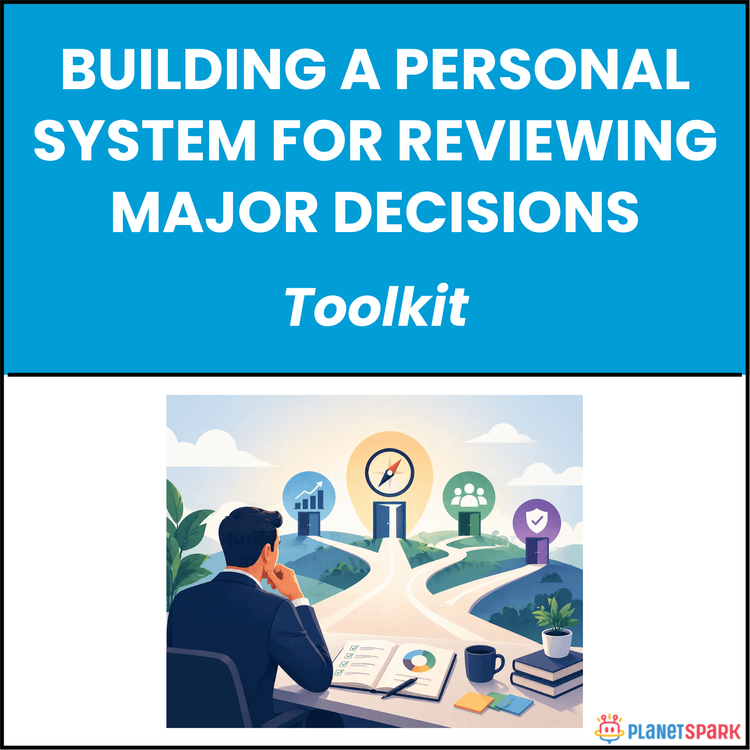
Building a Personal System for Reviewing Major Decisions
Establishing a Personal Method for Reviewing Major Decisions: A Practical Guide for Professionals
Every major decision has the potential to reshape your career, your team, or even your life. But how often do we make these choices in a structured and deliberate way? Too often, we rely on gut instincts, rushed timelines, or advice from others who may not fully understand our context. This toolkit is designed to change that. With a repeatable, personal system for evaluating high-stakes choices, you’ll be able to make decisions with the same rigor applied by great leaders and strategists — and you can do it in just minutes or hours, depending on your time.
Who Is This Resource For?
This resource is ideal for:
- Career changers: Deciding on a new job or career path with careful analysis.
- Managers: Making decisions that affect team dynamics, resources, and long-term strategy.
- Consultants: Navigating client decisions that could have far-reaching consequences.
- Mid-career professionals: Handling pivotal moments, such as promotions or job offers, with confidence.
If you’ve ever faced a decision that felt too big, too uncertain, or simply overwhelming, this toolkit will guide you toward making better choices.
What Does This Resource Contain?
The toolkit includes a comprehensive, step-by-step approach to decision-making:
- Framing the Decision: Learn how to define your decision clearly to avoid unnecessary complexity.
- Mapping Decision Criteria: Establish the factors that truly matter for each decision, including non-negotiables and trade-off elements.
- Stress-testing Options: Use decision matrices to objectively score your options against your criteria.
- Bias Check: A structured audit to identify cognitive biases that could distort your decision.
- Integration of Instinct and Analysis: Balance gut feeling with structured analysis to ensure you are making decisions with well-rounded insight.
- Documentation and Review: Track your decisions over time, learn from them, and improve your future choices.
Summary of the Resource
This toolkit is designed to help you approach major decisions with a structured, repeatable process. By focusing on defining the decision, establishing criteria, evaluating options, and reducing bias, you will be able to make confident, well-reasoned decisions. Whether you’re deciding on a career move, a project investment, or team changes, this system will provide the framework to help you navigate these decisions without regret.
How Will This Resource Be Useful?
Using this toolkit, you will:
- Increase confidence in your decision-making process.
- Make well-informed choices, grounded in your personal values and long-term goals.
- Reduce regret by ensuring your decisions are carefully considered and documented.
- Build long-term judgment through regular reviews and reflection on past decisions.
How Should You Use This Resource?
1. Start by framing your decision clearly: Use the framing worksheet to clearly define what decision you are making and why.
2. Establish your decision criteria: Identify your non-negotiables, trade-off factors, and what’s out of scope.
3. Evaluate options objectively: Use a decision matrix to score each option based on your criteria.
4. Run a bias audit: Reflect on any biases that could have influenced your decision.
5. Integrate analysis with instinct: Balance your analytical findings with your gut feeling.
6. Document and communicate: Once the decision is made, document it and inform stakeholders confidently.
7. Schedule reviews: Set reminders to revisit your decision after 30, 60, and 90 days.
Action Steps
1. Identify a current decision: Write down the decision you are facing and use the toolkit’s worksheets to frame it.
2. List your criteria: Determine your non-negotiables and prioritize them.
3. Create a decision matrix: Evaluate your options against your criteria.
4. Check for biases: Run the bias audit to ensure your decision-making is objective.
5. Make your decision and document it: Once you’ve made your decision, record the rationale for future review.
Book your free session today!